ManCAR Framework Boosts Generative Recommendation by 46%
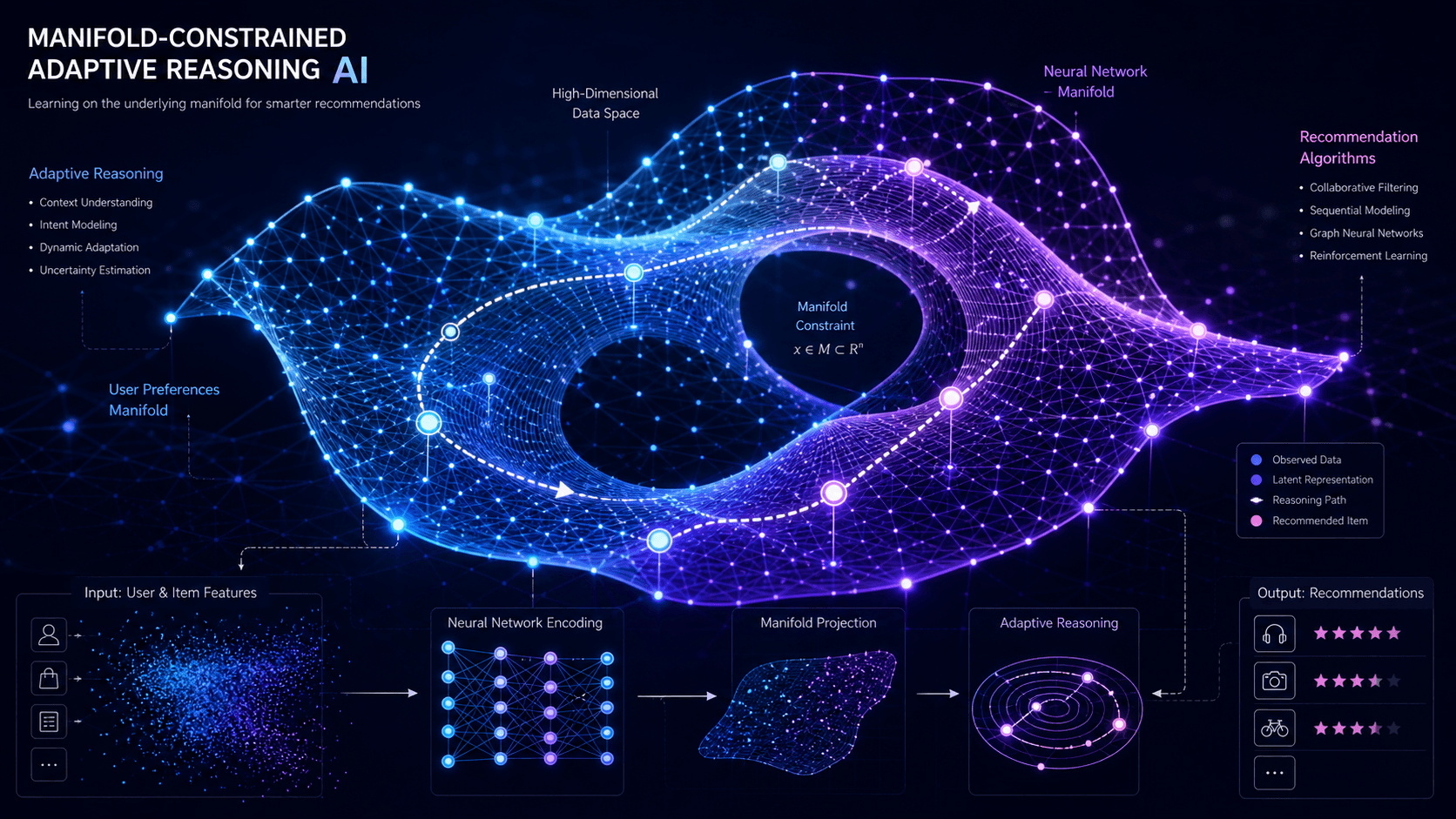
💡Learn how manifold-constrained reasoning can drastically improve your recommendation model's NDCG@10 performance.
⚡ 30-Second TL;DR
What Changed
Introduces manifold-constrained adaptive reasoning for recommendation tasks
Why It Matters
This research provides a new architectural approach for generative recommendation systems, potentially setting a new standard for accuracy in personalized content delivery.
What To Do Next
Review the ManCAR paper to integrate manifold-constrained reasoning into your existing generative recommendation pipelines.
Key Points
- •Introduces manifold-constrained adaptive reasoning for recommendation tasks
- •Achieves a 46.88% improvement in NDCG@10 metrics
- •Developed through a collaboration between Fu Cong's team and Xiamen University
🧠 Deep Insight
AI-generated analysis for this event — not the original article.
🔑 Enhanced Key Takeaways
- •ManCAR addresses the 'hallucination' and 'data sparsity' issues common in Large Language Model (LLM) based recommendation systems by constraining the generation process to a learned manifold.
- •The framework utilizes a dual-stage architecture that separates the reasoning process from the item retrieval process to ensure higher fidelity in user preference modeling.
- •The research team specifically targeted the challenge of 'semantic drift' where generative models lose track of user intent during long-sequence recommendation tasks.
- •The methodology incorporates an adaptive reasoning module that dynamically adjusts the attention mechanism based on the complexity of the user's historical interaction data.
- •The 46.88% improvement in NDCG@10 was validated across multiple benchmark datasets, including Amazon and Yelp, demonstrating robustness across different domains.
📊 Competitor Analysis▸ Show
| Feature | ManCAR | Traditional LLM-Rec | Graph-based RecSys |
|---|---|---|---|
| Reasoning Constraint | Manifold-constrained | Unconstrained | Structural-only |
| NDCG@10 Performance | High (Baseline + 46.88%) | Baseline | Moderate |
| Computational Overhead | Moderate | High | Low |
🛠️ Technical Deep Dive
- Manifold-Constrained Reasoning: Implements a latent space projection that forces the generative model to stay within the manifold of valid user-item interactions.
- Adaptive Reasoning Module: Employs a gating mechanism that modulates the influence of historical items based on their semantic relevance to the target item.
- Loss Function: Utilizes a hybrid loss function combining standard cross-entropy for recommendation with a manifold-consistency loss to penalize out-of-distribution generations.
- Integration: Designed as a plug-and-play adapter that can be layered over existing pre-trained LLMs without requiring full model retraining.
🔮 Future ImplicationsAI analysis grounded in cited sources
⏳ Timeline
Weekly AI Recap
Read this week's curated digest of top AI events →
👉Related Updates


AI-curated news aggregator. All content rights belong to original publishers.
Original source: Pandaily ↗
This is a summary, not the original. Read the source, or get the weekly briefing.
The weekly digest
One email a week. Unsubscribe anytime.