Managing repository noise with pull request limits
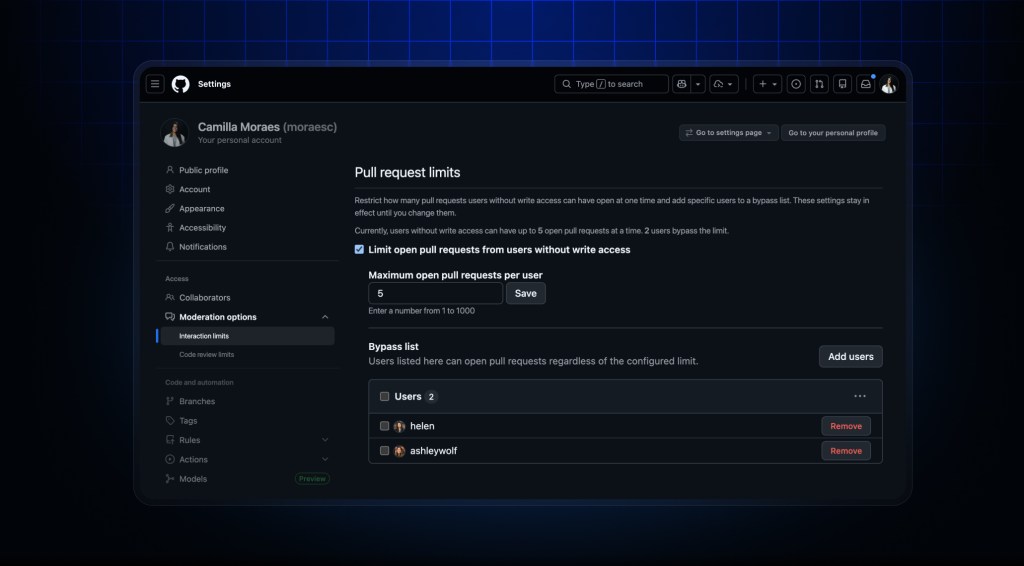
💡Learn how to reduce maintainer burnout and filter noise in high-traffic open-source repositories.
⚡ 30-Second TL;DR
What Changed
Implement limits on incoming pull requests to reduce repository noise
Why It Matters
This update helps maintainers of large open-source projects focus on high-quality contributions by automating volume control. It reduces the overhead of managing spam or low-effort PRs.
What To Do Next
Review your repository settings in GitHub to configure PR limits if you are experiencing high volumes of low-quality contributions.
Key Points
- •Implement limits on incoming pull requests to reduce repository noise
- •Improve maintainer productivity by filtering contribution volume
- •Roadmap update for future repository management tools
🧠 Deep Insight
AI-generated analysis for this event — not the original article.
🔑 Enhanced Key Takeaways
- •The feature leverages GitHub's 'Contribution Insights' API to allow maintainers to set thresholds based on contributor reputation, such as previous successful merges or membership in the organization.
- •This mechanism is designed to combat 'spam' pull requests often generated by automated bots or low-quality AI-assisted contributions that have surged in high-traffic repositories.
- •Maintainers can configure automated responses for rejected pull requests, providing contributors with links to contribution guidelines or alternative ways to engage, such as opening an issue first.
📊 Competitor Analysis▸ Show
| Feature | GitHub (PR Limits) | GitLab (Merge Request Limits) | Bitbucket (PR Restrictions) |
|---|---|---|---|
| Access Control | Reputation-based filtering | Branch-level protection rules | Branch permissions |
| Automation | Native AI-driven noise reduction | CI/CD pipeline gating | Custom script integration |
| Pricing | Included in Pro/Enterprise | Included in Premium/Ultimate | Standard/Premium tiers |
🛠️ Technical Deep Dive
- Implementation utilizes a new 'Contribution Gatekeeper' service layer that intercepts incoming PR webhooks before they trigger repository workflows.
- The system integrates with GitHub's existing 'Contributor Covenant' and 'Security Advisories' metadata to automatically whitelist trusted contributors.
- Rate-limiting logic is applied at the repository level, utilizing a token-bucket algorithm to manage burst traffic from automated sources.
- Configuration is managed via a new .github/pr-limits.yml schema, allowing for declarative definition of contribution thresholds.
🔮 Future ImplicationsAI analysis grounded in cited sources
⏳ Timeline
Weekly AI Recap
Read this week's curated digest of top AI events →
👉Related Updates
AI-curated news aggregator. All content rights belong to original publishers.
Original source: GitHub Blog ↗
This is a summary, not the original. Read the source, or get the weekly briefing.
Weekly AI briefing
One email a week. Unsubscribe anytime.