Manage Vercel Containers Directly from the CLI
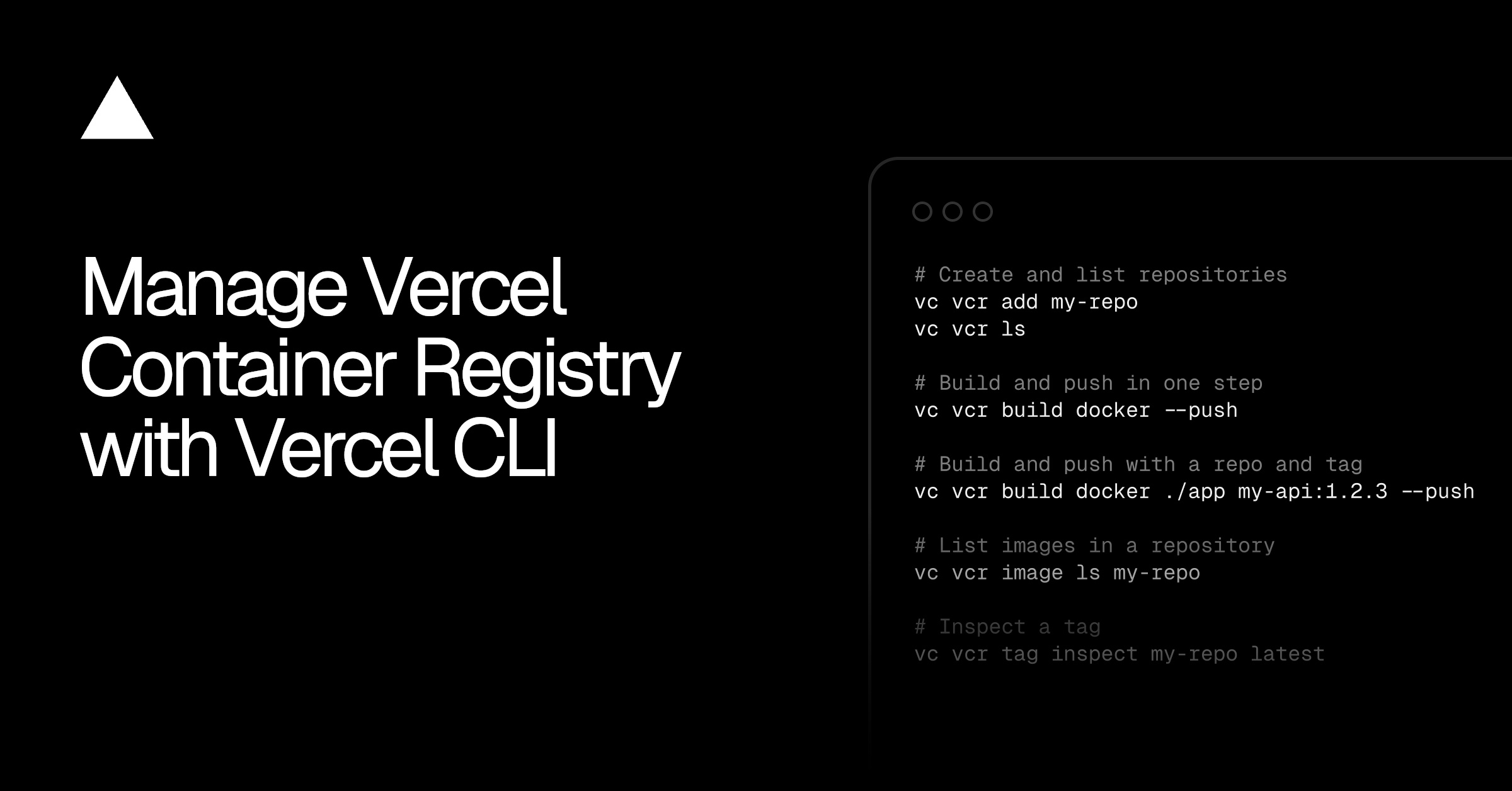
💡See how to push AI service containers to Vercel using standard Docker-compatible workflows.
⚡ 30-Second TL;DR
What Changed
The new `vercel vcr` command group manages Container Registry resources.
Why It Matters
This gives AI teams deploying inference services or containerized workloads a simpler path to integrate image storage with Vercel projects. Existing container workflows can continue using familiar Docker-compatible commands instead of adopting a separate publishing process.
What To Do Next
Update to `vercel@latest`, run the `vercel vcr` authentication flow, and test pushing one inference-service image from Docker or Podman.
Key Points
- •The new `vercel vcr` command group manages Container Registry resources.
- •Docker, Podman, and Buildah can authenticate with short-lived tokens scoped to a project.
- •Repositories are created automatically on the first push or explicitly with `vercel vcr add`.
- •CLI commands support listing stored content and inspecting individual images and tags.
🧠 Deep Insight
Background and context from public sources — not the original article. 20 sources cited.
🔑 Enhanced Key Takeaways
- •Vercel Container Registry (VCR) is an OCI-compliant image registry that implements the Docker Registry HTTP API v2, allowing developers to interact with it directly using standard OCI tooling like
docker pushorpodman pullwithout necessarily using the Vercel CLI. - •Images pushed to VCR are automatically optimized in the background by Vercel, creating precompiled snapshots for faster booting and execution when deployed to Vercel Functions and Vercel Sandboxes, leveraging Vercel's Fluid Compute.
- •Vercel Container Registry was officially introduced on June 30, 2026, marking Vercel's expansion into hosting container images.
- •VCR repositories can be configured as public, granting read-only access to any Vercel account for pulling images, in addition to the existing capability of sharing with up to 100 specific teams.
- •Container images stored in VCR can be deployed as Vercel Functions, inheriting serverless characteristics such as automatic scaling, Active CPU pricing (billing only for active CPU usage), and adherence to function limits regarding size, memory, and execution duration.
📊 Competitor Analysis▸ Show
| Feature / Provider | Vercel Container Registry (VCR) | AWS Elastic Container Registry (ECR) | Google Artifact Registry (GAR) | GitHub Container Registry (GHCR) | Docker Hub |
|---|---|---|---|---|---|
| OCI Compliance | Yes (Docker Registry HTTP API v2) | Yes | Yes (succeeded GCR) | Yes | Yes |
| Primary Integration | Vercel Functions, Vercel Sandbox, Vercel CLI | AWS services (ECS, EKS, Lambda) | Google Cloud services (Cloud Build, Deploy, GKE) | GitHub Actions, GitHub repositories | Wide tool support, public registry |
| Image Optimization | Automatic optimization for Fluid Compute (snapshots) | No (focus on storage/scanning) | No (focus on storage/scanning) | No (focus on storage/scanning) | No (focus on storage/scanning) |
| Authentication | Short-lived project-scoped OIDC tokens | AWS IAM | Google Cloud IAM | GitHub permissions (tied to repos/orgs) | Docker ID, access tokens |
| Public/Private Repos | Both (private by default, can be made public) | Both | Both | Both (free for public) | Both (one private free, public widely used) |
| Vulnerability Scanning | Not explicitly mentioned as built-in for VCR, but Vercel has platform security features | Yes, automated | Yes | Not explicitly mentioned as built-in for GHCR, but GitHub has security features | Not explicitly mentioned as built-in for Docker Hub, but third-party tools exist |
| Pricing Model (Storage) | 10 GB/month included, then $0.10 per GB-month (Beta) | $0.10/GB/month | $0.10/GB/month (for standard storage) | Free for public, 500MB free for private, then $0.25/GB | One private repo free, Team plan $7/user/month for unlimited private repos |
🛠️ Technical Deep Dive
- Vercel Container Registry (VCR) is an OCI-compliant image registry that adheres to the Docker Registry HTTP API v2 standard.
- It supports OCI image manifests, OCI image indexes, Docker schema 2 image manifests, and Docker manifest lists.
- Image layers pushed to VCR must use either gzip or zstd compression; uncompressed OCI layers are not supported.
- For single-platform images, the manifest must explicitly include
osandarchitecturewithin the image configuration. - Upon image push, VCR automatically processes and optimizes the image in the background by creating a precompiled snapshot, which is then served to Vercel Functions and Vercel Sandboxes for faster cold starts and execution on Fluid Compute.
- Authentication for
vercel vcr loginutilizes short-lived OpenID Connect (OIDC) tokens, which are valid for 12 hours and can be refreshed by re-executing the login command. - The
vercel vcr buildandvercel vcr pushcommands do not replace local container tools but rather orchestrate them, meaning Docker, Podman, or Buildah must be installed locally and on the system's PATH. - When Docker Buildx is installed, the CLI can build and push images in a single step with zstd compression, which is the recommended format for VCR images. Without Buildx, Docker builds and pushes without zstd compression.
- Container images deployed via VCR run as Vercel Functions, which means they benefit from automatic scaling and Active CPU pricing, but are subject to function limits on size, memory, and execution duration.
- As of the current date, Secure Compute and Static IPs are not yet supported for custom container images running on Vercel.
🔮 Future ImplicationsAI analysis grounded in cited sources
⏳ Timeline
📎 Sources (20)
Factual claims are grounded in the sources below. Forward-looking analysis is AI-generated interpretation.
Weekly AI Recap
Read this week's curated digest of top AI events →
👉Related Updates

AI-curated news aggregator. All content rights belong to original publishers.
Original source: Vercel News ↗
This is a summary, not the original. Read the source, or get the weekly briefing.
Weekly AI briefing
One email a week. Unsubscribe anytime.