Magnetic field connection discovered between planet and star
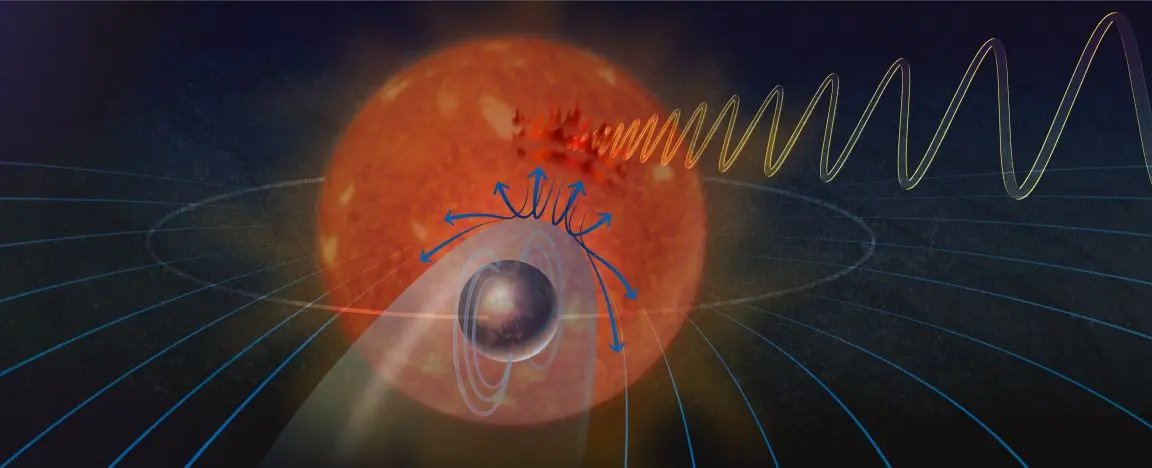
Understand how extreme magnetic interactions drive stellar activity, offering insights for advanced physics simulations.
30-Second TL;DR
What Changed
Discovery of magnetic field reconnection between an exoplanet and its host star
Why It Matters
This research provides critical data for modeling complex plasma environments, which can inform the development of more robust simulation algorithms for physics-based AI models.
What To Do Next
Incorporate these plasma physics dynamics into your physics-informed neural network (PINN) simulations to improve accuracy in astrophysical modeling.
Key Points
- •Discovery of magnetic field reconnection between an exoplanet and its host star
- •Observed brightening of the stellar chromosphere during specific orbital phases
- •Provides new data on planetary-stellar environmental interactions
Deep Insight
AI-generated analysis for this event — not the original article.
Enhanced Key Takeaways
- •The phenomenon is primarily observed in ultra-short-period (USP) planets, specifically those orbiting M-dwarf stars where magnetic coupling is significantly stronger due to the star's intense magnetic activity.
- •This magnetic interaction is theorized to cause atmospheric stripping, where the planet's upper atmosphere is eroded by the star's magnetic field lines, potentially altering the planet's long-term habitability.
- •Researchers utilize high-resolution spectropolarimetry to detect the specific signatures of magnetic reconnection, which manifests as localized heating in the stellar chromosphere.
- •The interaction creates a 'magnetic bridge' that can facilitate the transfer of stellar material onto the planet, potentially creating a detectable trail of ionized gas or a cometary-like tail.
- •This discovery challenges existing models of planetary migration, suggesting that magnetic braking between the planet and star may play a larger role in orbital decay than previously calculated.
Technical Deep Dive
- The interaction mechanism is driven by the Alfven surface of the star, where the planet's orbit lies within the sub-Alfvenic region, allowing for the propagation of Alfven waves back to the stellar surface.
- Chromospheric brightening is quantified through the analysis of the Ca II H & K lines and H-alpha emission, which serve as proxies for magnetic energy dissipation.
- The reconnection process is modeled using Magnetohydrodynamic (MHD) simulations that account for the planet's intrinsic magnetic moment and the stellar wind's plasma density.
- The energy flux transferred via the magnetic connection is estimated to be in the range of 10^18 to 10^20 Watts, depending on the stellar magnetic field strength and the planet's orbital distance.
Future ImplicationsAI analysis grounded in cited sources
Timeline
- 2003-05First theoretical proposal of star-planet magnetic interaction by Cuntz et al.
- 2008-02Detection of anomalous chromospheric activity in the HD 179949 system linked to its planet.
- 2019-11Publication of comprehensive MHD models explaining sub-Alfvenic interactions in exoplanetary systems.
- 2024-08Advanced spectropolarimetric surveys confirm magnetic reconnection signatures in multiple USP systems.
Weekly AI Recap
Read this week's curated digest of top AI events →
AI-curated news aggregator. All content rights belong to original publishers.
Original source: Ars Technica ↗
This is a summary, not the original. Read the source, or get the weekly briefing.
The weekly digest
One email a week. Unsubscribe anytime.