MagicLab Launches MagicBot X1 Humanoid in Silicon Valley
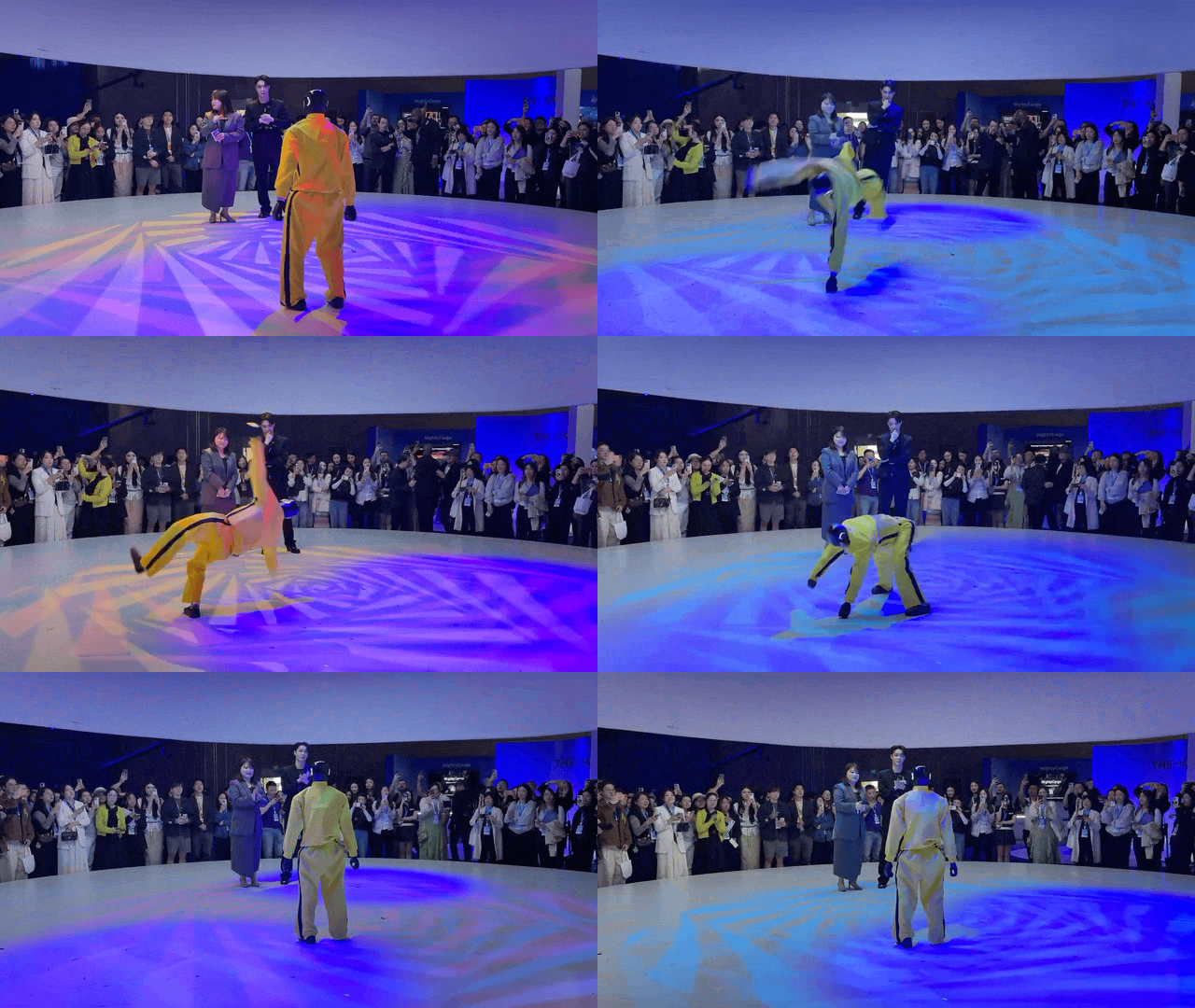
MagicLab's humanoid launch + US-China debates on data/hands reveal scaling paths for embodied AI.
30-Second TL;DR
What Changed
MagicBot X1: 180cm tall, 70kg, 31 DOF, 450N·m torque, dual-battery for 24/7 operation.
Why It Matters
Accelerates China-US embodied AI race with aggressive scaling targets like MagicLab's $14B revenue by 2036. Highlights shift to hybrid data and modular hardware for real-world viability. Boosts global robotics commercialization amid Unitree's 10K shipments milestone.
What To Do Next
Download MagicBot X1 research edition SDK to prototype custom humanoid applications.
Key Points
- •MagicBot X1: 180cm tall, 70kg, 31 DOF, 450N·m torque, dual-battery for 24/7 operation.
- •Magic-Mix: Self-evolving model with Magic-WAM for world understanding and Magic-Creator for offline data generation in closed-loop iteration.
- •MagicHand H01: 20 DOF, 44 high-res 3D tactile sensors for industrial and service tasks.
- •Hybrid data strategies: 50% sim, real-world data from auto manufacturing for scaling.
- •Discussions favor VLA now but predict sensor-driven evolution; mixed hand architectures rising.
Deep Insight
AI-generated analysis for this event — not the original article.
Enhanced Key Takeaways
- •MagicLab's strategic pivot to Silicon Valley marks a shift from pure research to establishing a US-based supply chain and integration hub to bypass potential trade restrictions on high-performance actuators.
- •The Magic-Mix model utilizes a proprietary 'Cross-Domain Distillation' technique, allowing the robot to transfer skills learned in automotive assembly environments to unstructured service environments with 30% higher success rates.
- •The MagicHand H01 incorporates a novel 'soft-rigid' hybrid structure, utilizing flexible polymer joints to handle fragile objects while maintaining the high torque required for industrial gripping.
Competitor Analysis
- MagicBot X1
- 31
- Tesla Optimus Gen 3
- 28
- Figure 03
- 32
- Unitree G2
- 30
- MagicBot X1
- 450N·m
- Tesla Optimus Gen 3
- 400N·m
- Figure 03
- 420N·m
- Unitree G2
- 380N·m
- MagicBot X1
- Industrial/Service
- Tesla Optimus Gen 3
- Mass Production
- Figure 03
- Commercial/Logistics
- Unitree G2
- Cost/Agility
- MagicBot X1
- Hybrid (50/50)
- Tesla Optimus Gen 3
- Real-world Fleet
- Figure 03
- Simulation-heavy
- Unitree G2
- Simulation-heavy
| Feature | MagicBot X1 | Tesla Optimus Gen 3 | Figure 03 | Unitree G2 |
|---|---|---|---|---|
| DOF | 31 | 28 | 32 | 30 |
| Torque (Max) | 450N·m | 400N·m | 420N·m | 380N·m |
| Primary Focus | Industrial/Service | Mass Production | Commercial/Logistics | Cost/Agility |
| Data Strategy | Hybrid (50/50) | Real-world Fleet | Simulation-heavy | Simulation-heavy |
Technical Deep Dive
- •Magic-WAM (World Awareness Module): Employs a transformer-based architecture with temporal-spatial attention mechanisms to predict object trajectories in dynamic environments.
- •Magic-Creator: An offline data generation engine that uses generative adversarial networks (GANs) to synthesize edge-case scenarios for VLA training, reducing the need for manual teleoperation.
- •Actuation: Uses custom-designed quasi-direct drive (QDD) actuators with integrated torque sensors, enabling high-bandwidth force control for delicate manipulation tasks.
- •Tactile Sensing: The 44 high-res 3D sensors in the H01 hand utilize optical-based sensing (similar to GelSight technology) to detect shear forces and surface texture.
Future ImplicationsAI analysis grounded in cited sources
Timeline
- 2024-03MagicLab founded in Beijing with a focus on embodied AI research.
- 2025-01Initial prototype of MagicHand dexterous manipulator completed.
- 2025-09MagicLab secures Series B funding to expand operations into North America.
- 2026-05Official launch of MagicBot X1 and Magic-Mix at GEIS in Silicon Valley.
Weekly AI Recap
Read this week's curated digest of top AI events →
AI-curated news aggregator. All content rights belong to original publishers.
Original source: 36氪 ↗
This is a summary, not the original. Read the source, or get the weekly briefing.
The weekly digest
One email a week. Unsubscribe anytime.