Loop Engineering: Moving Beyond Chat-Based AI Coding
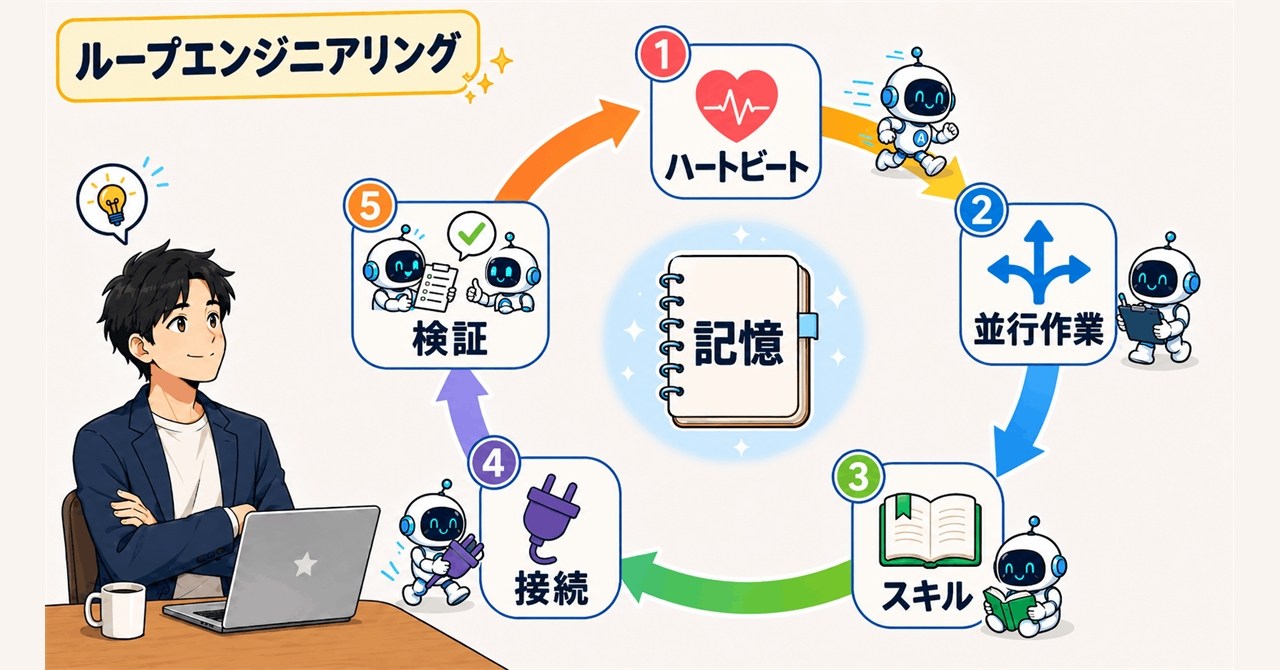
Learn how to move from manual chat-based prompting to autonomous agent loops for more efficient AI coding.
30-Second TL;DR
What Changed
Shifts development from manual prompt-response cycles to autonomous agent loops.
Why It Matters
This shift could significantly increase developer productivity by automating the iterative debugging and implementation process, reducing the need for constant human oversight.
What To Do Next
Evaluate your current coding workflow and identify tasks suitable for autonomous agent loops to reduce manual prompt engineering.
Key Points
- •Shifts development from manual prompt-response cycles to autonomous agent loops.
- •Aims to reduce the friction of constant human-AI back-and-forth interactions.
- •Focuses on continuous execution models for AI-driven software development.
Deep Insight
AI-generated analysis for this event — not the original article.
Enhanced Key Takeaways
- •Loop Engineering utilizes 'Agentic Workflows' where AI systems maintain persistent state across multiple execution cycles, rather than stateless request-response patterns.
- •The paradigm incorporates automated 'Self-Correction Loops' where the agent evaluates its own code output against test suites and iterates without human intervention.
- •It relies on 'Long-Context Memory Architectures' that allow agents to retain project-wide codebase context over extended periods of autonomous operation.
- •The approach emphasizes 'Human-in-the-loop Oversight' at high-level architectural milestones rather than at the individual code-generation step.
- •Loop Engineering frameworks often integrate with 'Tool-Use APIs' (e.g., terminal access, file system manipulation, and browser automation) to execute tasks in real-world development environments.
Competitor Analysis
- Loop Engineering (Agentic)
- Continuous Loop
- Traditional Chat-Based AI (e.g., ChatGPT/Claude)
- Request-Response
- Autonomous Dev Agents (e.g., Devin/OpenDevin)
- Task-Based Autonomous
- Loop Engineering (Agentic)
- High-level Oversight
- Traditional Chat-Based AI (e.g., ChatGPT/Claude)
- Constant Prompting
- Autonomous Dev Agents (e.g., Devin/OpenDevin)
- Goal-setting only
- Loop Engineering (Agentic)
- High (Long-term)
- Traditional Chat-Based AI (e.g., ChatGPT/Claude)
- Low (Session-based)
- Autonomous Dev Agents (e.g., Devin/OpenDevin)
- Medium (Task-based)
- Loop Engineering (Agentic)
- Complex System Design
- Traditional Chat-Based AI (e.g., ChatGPT/Claude)
- Snippet Generation
- Autonomous Dev Agents (e.g., Devin/OpenDevin)
- Bug Fixing/Scripting
| Feature | Loop Engineering (Agentic) | Traditional Chat-Based AI (e.g., ChatGPT/Claude) | Autonomous Dev Agents (e.g., Devin/OpenDevin) |
|---|---|---|---|
| Interaction Model | Continuous Loop | Request-Response | Task-Based Autonomous |
| Human Involvement | High-level Oversight | Constant Prompting | Goal-setting only |
| State Persistence | High (Long-term) | Low (Session-based) | Medium (Task-based) |
| Primary Use Case | Complex System Design | Snippet Generation | Bug Fixing/Scripting |
Technical Deep Dive
- Architecture: Utilizes a ReAct (Reasoning + Acting) pattern where the agent generates a thought process, selects a tool, observes the output, and loops back to the reasoning phase.
- Memory Management: Implements Vector Database integration (e.g., Pinecone or Milvus) to store and retrieve relevant codebase context, preventing context window overflow.
- Execution Environment: Operates within isolated Docker containers to ensure safe execution of generated code and system commands.
- Evaluation Loop: Integrates with CI/CD pipelines to trigger automated unit tests immediately upon code generation, feeding results back into the agent's prompt context for iterative refinement.
Future ImplicationsAI analysis grounded in cited sources
Timeline
- 2024-03Emergence of early autonomous coding agents demonstrating multi-step reasoning capabilities.
- 2025-01Industry shift toward 'Agentic Workflows' as the primary method for scaling AI-assisted development.
- 2026-04Formalization of 'Loop Engineering' as a distinct methodology in Japanese software engineering circles.
Weekly AI Recap
Read this week's curated digest of top AI events →
Related Updates
AI-curated news aggregator. All content rights belong to original publishers.
Original source: ITmedia AI+ (日本) ↗
This is a summary, not the original. Read the source, or get the weekly briefing.
The weekly digest
One email a week. Unsubscribe anytime.