London Team Completes First AI-Assisted Brain Tumour Surgery
💡See how real-time computer vision supported nerve and blood-vessel identification during brain surgery.
⚡ 30-Second TL;DR
What Changed
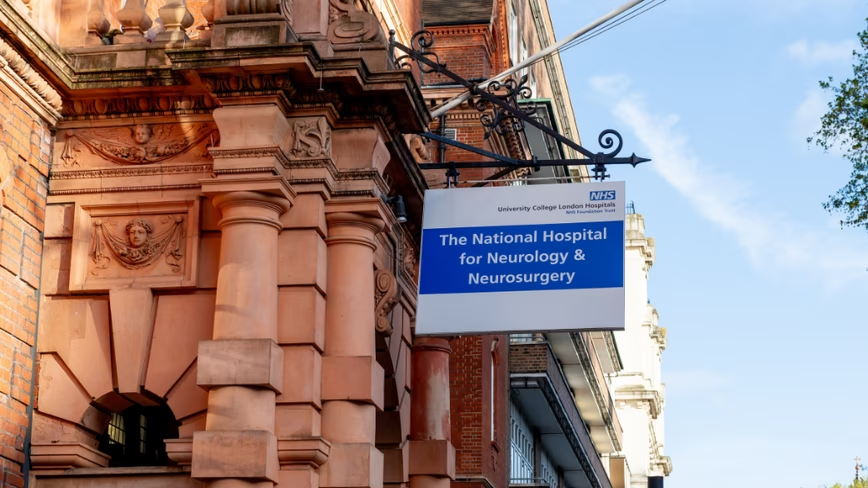
The operation was performed by surgeons at the National Hospital for Neurology and Neurosurgery in London.
Why It Matters
The procedure demonstrates a potential path for AI to support high-risk surgery without replacing the surgical team. If validated in larger studies, similar systems could improve anatomical awareness and reduce procedural risk in specialised operations.
What To Do Next
Review the system’s reported live-video latency, anatomical detection metrics, and regulatory pathway before adapting similar computer-vision assistance to clinical workflows.
Key Points
- •The operation was performed by surgeons at the National Hospital for Neurology and Neurosurgery in London.
- •AI analysed live camera footage during the procedure.
- •The system helped identify nerves and blood vessels near the brain tumour.
🧠 Deep Insight
Background and context from public sources — not the original article. 7 sources cited.
🔑 Enhanced Key Takeaways
- •The procedure specifically targeted an 11mm pituitary gland tumour that posed a direct risk to the patient's vision.
- •The AI system was developed at the UCL Hawkes Institute, leveraging a training dataset derived from hundreds of historical pituitary surgery recordings.
- •The surgery was conducted as part of a formal clinical trial supported by a partnership between the NIHR and Google.
- •The patient, a 48-year-old male, demonstrated rapid recovery, achieving independent mobility within seven days post-operation.
- •The project received multi-institutional funding support from the Wellcome Trust and the Engineering and Physical Sciences Research Council (EPSRC).
🛠️ Technical Deep Dive
- Real-time computer vision processing of endoscopic video feeds.
- Semantic segmentation used to identify and colour-code critical anatomical structures like nerves and vasculature.
- Model training utilized a large-scale retrospective dataset of pituitary surgical procedures to simulate years of clinical experience.
- Human-in-the-loop architecture ensuring the AI functions as an advisory overlay rather than an autonomous agent.
🔮 Future ImplicationsAI analysis grounded in cited sources
⏳ Timeline
📎 Sources (7)
Factual claims are grounded in the sources below. Forward-looking analysis is AI-generated interpretation.
Weekly AI Recap
Read this week's curated digest of top AI events →
👉Related Updates


AI-curated news aggregator. All content rights belong to original publishers.
Original source: The Next Web (TNW) ↗
This is a summary, not the original. Read the source, or get the weekly briefing.
Weekly AI briefing
One email a week. Unsubscribe anytime.