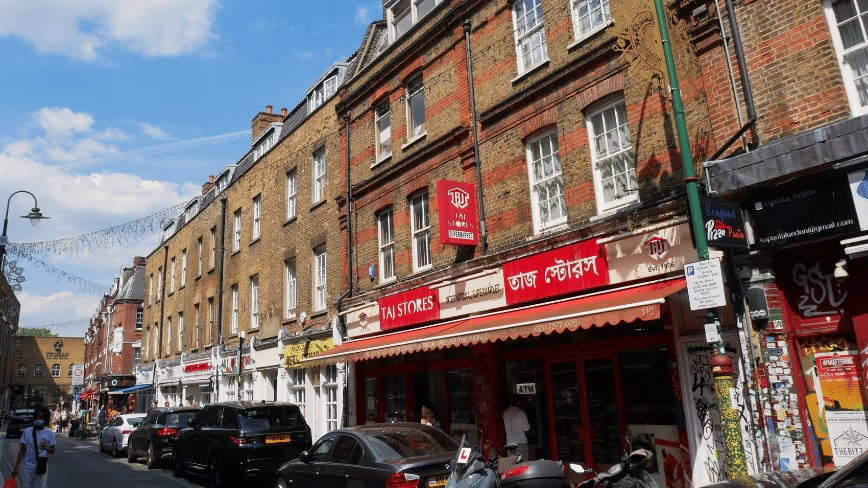
London residents protest new high-frequency trading datacenter
💡Understand the growing urban resistance to datacenter expansion and its impact on infrastructure planning.
⚡ 30-Second TL;DR
What Changed
Local opposition to urban datacenter construction
Why It Matters
This reflects a broader trend of 'not-in-my-backyard' (NIMBY) sentiment regarding digital infrastructure. It may complicate future site selection for companies requiring low-latency urban data proximity.
What To Do Next
If you are planning infrastructure deployment, factor in local community relations and zoning risks as part of your site selection process.
Key Points
- •Local opposition to urban datacenter construction
- •Focus on high-frequency trading infrastructure
- •Conflict between housing needs and industrial tech usage
- •Growing public scrutiny of datacenter environmental impact
🧠 Deep Insight
AI-generated analysis for this event — not the original article.
🔑 Enhanced Key Takeaways
- •The Truman Brewery site, located in the Spitalfields area, has been a flashpoint for gentrification debates for over a decade, with local activists arguing that industrial tech infrastructure undermines the area's cultural heritage.
- •High-frequency trading (HFT) datacenters require proximity to major financial hubs like the City of London to minimize latency, often necessitating 'micro-datacenters' in densely populated urban zones rather than remote industrial parks.
- •Local planning authorities are increasingly pressured by the 'Right to Light' and noise pollution regulations, which are frequently cited by residents opposing the cooling systems and backup generators required for HFT facilities.
- •The proposed development faces scrutiny regarding its energy consumption profile, as HFT facilities require specialized cooling and power redundancy that differ significantly from standard cloud computing or AI training clusters.
- •London's planning policy has recently seen a shift toward 'mixed-use' requirements, making it legally difficult for developers to justify single-purpose industrial infrastructure like datacenters in historically creative or residential districts.
🛠️ Technical Deep Dive
- HFT datacenters prioritize ultra-low latency networking, often utilizing FPGA (Field Programmable Gate Array) hardware to execute trades in sub-microsecond timeframes.
- Cooling requirements for HFT infrastructure often involve liquid cooling or high-velocity air handling units to maintain stable temperatures for overclocked server components.
- Power infrastructure for these sites typically includes massive Uninterruptible Power Supply (UPS) systems and diesel backup generators, which are primary sources of local noise and emission complaints.
- Connectivity relies on dedicated dark fiber paths to the London Stock Exchange and other liquidity pools to ensure the lowest possible round-trip time (RTT).
🔮 Future ImplicationsAI analysis grounded in cited sources
⏳ Timeline
Weekly AI Recap
Read this week's curated digest of top AI events →
👉Related Updates

AI-curated news aggregator. All content rights belong to original publishers.
Original source: The Next Web (TNW) ↗
This is a summary, not the original. Read the source, or get the weekly briefing.
The weekly digest
One email a week. Unsubscribe anytime.