Lithography: Chipmaking's Ultimate Challenge
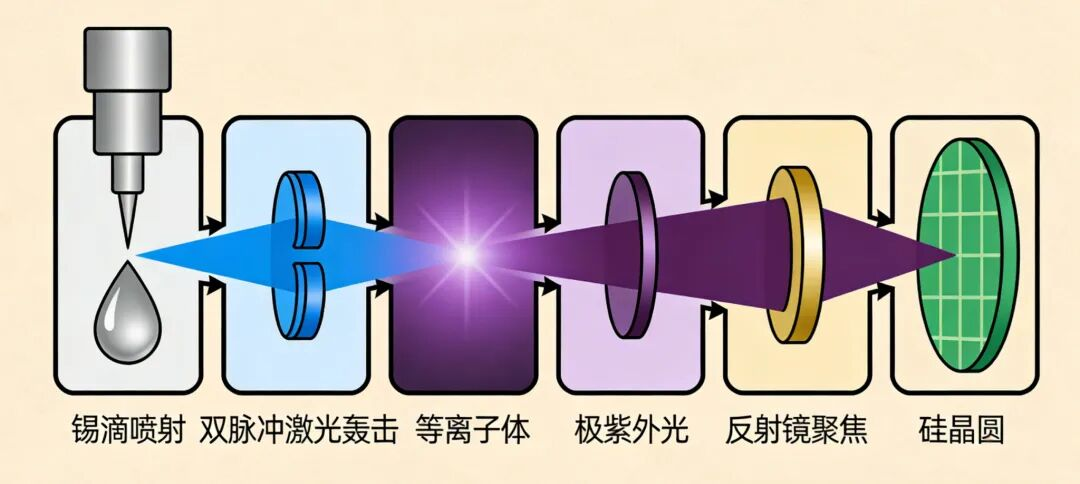
💡Unlocks secrets of chip fab tech powering AI GPUs—essential for hardware-aware devs.
⚡ 30-Second TL;DR
What Changed
Light lithography involves 8 key steps: deposition, coating, baking, exposure, development, inspection.
Why It Matters
Advanced lithography bottlenecks limit AI chip scaling; ASML monopoly pressures global supply chains amid US-China tensions.
What To Do Next
Study Rayleigh criterion to optimize custom lithography simulations for sub-5nm designs.
Key Points
- •Light lithography involves 8 key steps: deposition, coating, baking, exposure, development, inspection.
- •ASML holds 90%+ of high-end EUV/ArF shipments; total 2024 sales $26.4B.
- •Lithography accounts for 30% chip costs, 40-50% wafer time; resolution via CD = k1*λ/NA.
🧠 Deep Insight
Background and context from public sources — not the original article. 8 sources cited.
🔑 Enhanced Key Takeaways
- •EUV lithography operates at a 13.5nm wavelength, enabling production of 5nm and 3nm chip nodes with nanometer-scale alignment precision across multiple layers.[3][5]
- •Photolithography process is repeated 50+ times per chip to build multilayered structures, requiring ultra-clean ISO Class 3-4 cleanrooms to prevent particle defects.[3][4]
- •High-NA EUV systems increase numerical aperture for patterning below 3nm nodes, while laser-produced plasma sources boost wafer throughput.[5]
- •In February 2026, Intel unveiled a next-generation EUV process for 3nm and sub-3nm nodes to enhance transistor density and performance.[5]
🛠️ Technical Deep Dive
- •EUV systems use 13.5 nm wavelength light for finest details thousands of times smaller than a grain of sand, with computational lithography optimizing patterns via algorithmic models and test wafer data.[2]
- •DUV systems employ 248 nm (KrF) or 193 nm (ArF) lasers, including immersion lithography; steppers expose small areas sequentially, while scanners use slit light with synchronized stage movement for larger fields.[3]
- •Fluoropolymers like PTFE, PFA, PEEK, and PAI are used in EUV chambers for vacuum seals, reticle clamps, and purge gas manifolds to ensure chemical resistance and low outgassing.[4]
🔮 Future ImplicationsAI analysis grounded in cited sources
⏳ Timeline
📎 Sources (8)
Factual claims are grounded in the sources below. Forward-looking analysis is AI-generated interpretation.
- cubefabs.com — Steps in the Semiconductor Manufacturing Process
- asml.com — Semiconductor Manufacturing Process Steps
- averroes.ai — Photolithography Process in Semiconductor Manufacturing
- fluorocarbon.co.uk — Lithography in Semiconductor Manufacturing
- openpr.com — Euv Lithography Market 2026 Advanced Chipmaking Process
- spiedigitallibrary.org — 12.3052298
- semiconductor-digest.com — Semiconductor Lithography Materials Market Evolution Euv Integration and Advanced Device Drivers
- jamasoftware.com — 2026 Predictions for Semiconductors AI Chiplets and the Path to Sustainable Innovation
Weekly AI Recap
Read this week's curated digest of top AI events →
👉Related Updates
AI-curated news aggregator. All content rights belong to original publishers.
Original source: 虎嗅 ↗
This is a summary, not the original. Read the source, or get the weekly briefing.
Weekly AI briefing
One email a week. Unsubscribe anytime.