LiquidJet Claims 10°C Rubin GPU Cooling Gain
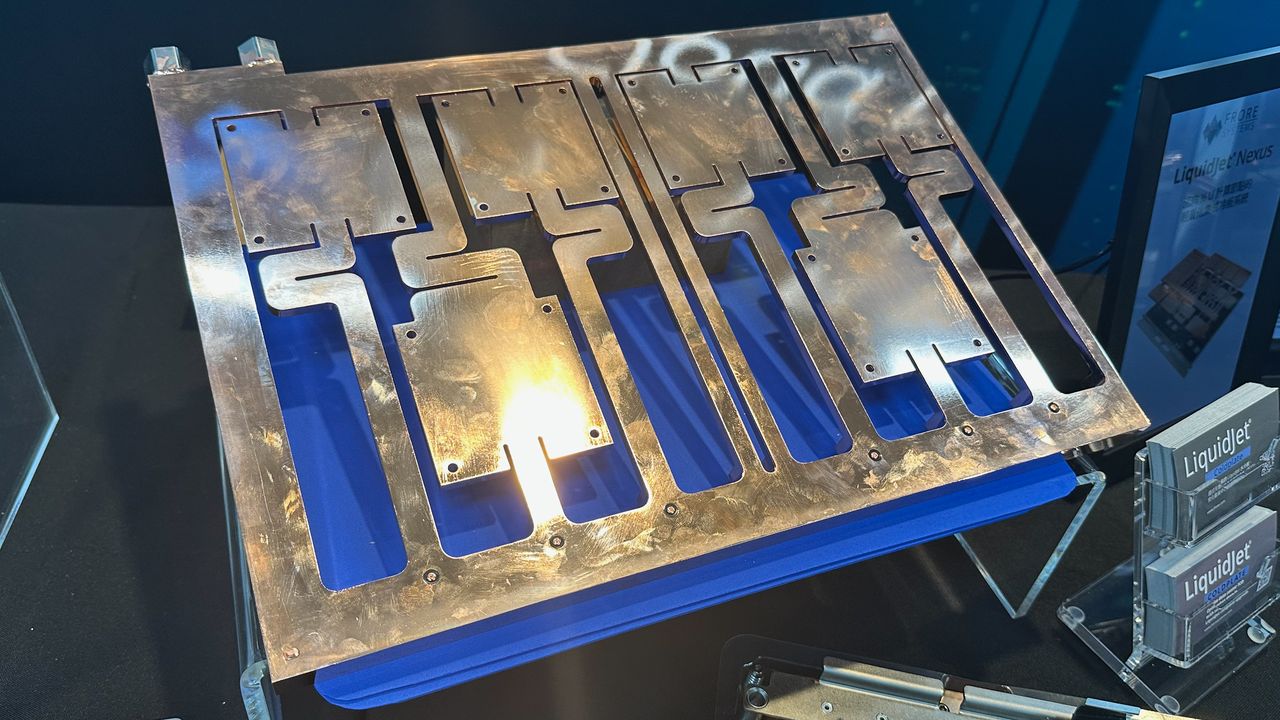
A claimed 15% token-efficiency gain could materially change AI data-center cooling economics.
30-Second TL;DR
What Changed
Frore claims LiquidJet can reduce Nvidia Rubin GPU temperatures by 10°C
Why It Matters
If independently validated, LiquidJet could improve AI data-center throughput and reduce the energy cost of inference. Adoption of delidded GPUs would also introduce manufacturing, warranty, reliability, and deployment risks for hyperscalers.
What To Do Next
Request Frore’s Rubin benchmark data and test LiquidJet against your current coldplate under identical token-generation workloads before planning deployment.
Key Points
- •Frore claims LiquidJet can reduce Nvidia Rubin GPU temperatures by 10°C
- •The company says token-generation efficiency could improve by 15%
- •Hyperscalers are exploring delidded GPUs and advanced cooling for production AI systems
Deep Insight
AI-generated analysis for this event — not the original article.
Enhanced Key Takeaways
- •LiquidJet utilizes Frore Systems' proprietary AirJet solid-state active cooling technology, which employs ultrasonic vibration to move air through micro-channels rather than traditional fans.
- •The 10°C temperature reduction is achieved specifically through a 'delidding' process, where the GPU's integrated heat spreader (IHS) is removed to allow the coldplate to interface directly with the silicon die.
- •Frore Systems is positioning LiquidJet as a solution to the 'thermal wall' encountered by Rubin-class GPUs, which operate at significantly higher TDPs than previous Blackwell or Hopper architectures.
- •The 15% token-generation efficiency gain is attributed to the ability to maintain higher sustained boost clocks by avoiding thermal throttling during intensive inference workloads.
- •Hyperscalers are evaluating this technology as a potential alternative to complex liquid-to-chip (DLC) cooling loops, which require extensive plumbing and carry higher risks of leakage in data center environments.
Competitor Analysis
- Frore LiquidJet
- Solid-State Ultrasonic
- Traditional DLC (Direct-to-Chip)
- Liquid Pump/Loop
- Standard Air Cooling
- Mechanical Fans
- Frore LiquidJet
- Low (No liquid)
- Traditional DLC (Direct-to-Chip)
- High (Plumbing/Leak risk)
- Standard Air Cooling
- Low
- Frore LiquidJet
- High
- Traditional DLC (Direct-to-Chip)
- Very High
- Standard Air Cooling
- Low/Medium
- Frore LiquidJet
- Premium/Enterprise
- Traditional DLC (Direct-to-Chip)
- High (Infrastructure cost)
- Standard Air Cooling
- Commodity
| Feature | Frore LiquidJet | Traditional DLC (Direct-to-Chip) | Standard Air Cooling |
|---|---|---|---|
| Mechanism | Solid-State Ultrasonic | Liquid Pump/Loop | Mechanical Fans |
| Complexity | Low (No liquid) | High (Plumbing/Leak risk) | Low |
| Thermal Density | High | Very High | Low/Medium |
| Pricing | Premium/Enterprise | High (Infrastructure cost) | Commodity |
Technical Deep Dive
- LiquidJet integrates piezoelectric membranes that oscillate at ultrasonic frequencies to generate high-pressure air jets.
- The system operates with a backpressure tolerance significantly higher than traditional fans, allowing it to push air through dense, high-fin-density heatsinks.
- Implementation requires a custom mounting mechanism to ensure uniform pressure across the delidded GPU die to prevent cracking or uneven thermal interface material (TIM) distribution.
- The cooling module is designed to be modular, allowing for integration into existing OAM (OCP Accelerator Module) form factors used by Rubin GPUs.
Future ImplicationsAI analysis grounded in cited sources
Timeline
- 2022-12Frore Systems launches AirJet Mini, the world's first solid-state active cooling chip.
- 2023-05Frore Systems expands AirJet product line to include AirJet Pro for higher-performance computing.
- 2025-03Frore Systems announces development of liquid-enhanced solid-state cooling prototypes for data centers.
- 2026-08Frore Systems unveils LiquidJet coldplate technology specifically optimized for Rubin GPU architectures.
Weekly AI Recap
Read this week's curated digest of top AI events →
AI-curated news aggregator. All content rights belong to original publishers.
Original source: Tom's Hardware ↗
This is a summary, not the original. Read the source, or get the weekly briefing.
The weekly digest
One email a week. Unsubscribe anytime.