Linux Kernel Preps for PCIe 7.0
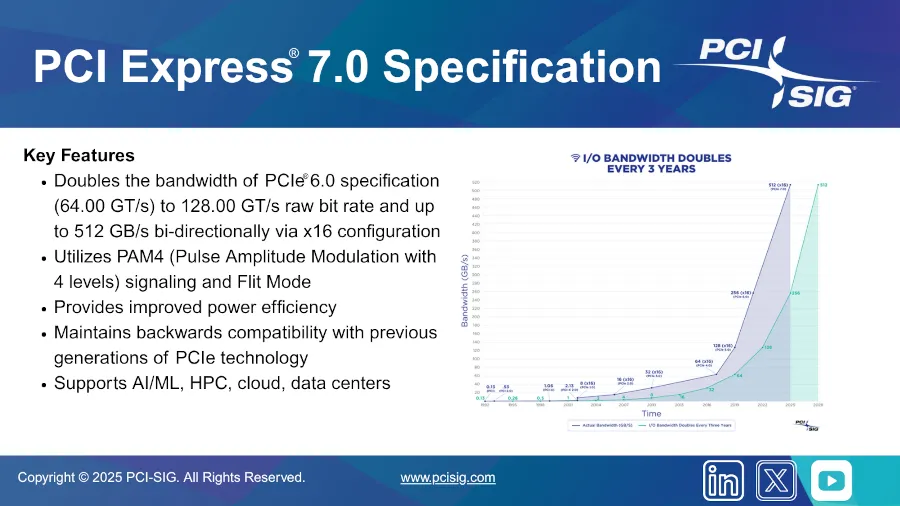
💡PCIe 7.0 prep in Linux means 512GB/s for next-gen AI accelerators & clusters.
⚡ 30-Second TL;DR
What Changed
PCI-SIG released PCIe 7.0 spec mid-2025
Why It Matters
Boosts high-performance computing for AI training with massive bandwidth gains. Enables future GPU/accelerator scaling in data centers. Linux support ensures developer readiness ahead of hardware.
What To Do Next
Check Linux kernel mailing list for PCIe 7.0 patches to prepare GPU drivers.
Key Points
- •PCI-SIG released PCIe 7.0 spec mid-2025
- •128 GT/s raw data transfer rate
- •x16 config: 512 GB/s bidirectional bandwidth
- •Backward compatible with prior PCIe versions
- •Linux kernel early preparation underway
🧠 Deep Insight
Background and context from public sources — not the original article. 4 sources cited.
🔑 Enhanced Key Takeaways
- •PCI-SIG released PCIe 7.0 specification in mid-2025, achieving 128 GT/s raw data transfer rate and 512 GB/s bidirectional bandwidth in x16 configuration.[article]
- •Linux kernel community initiating early groundwork for PCIe 7.0 support as of February 2026, concurrent with emerging PCIe 6.0 devices.[article]
- •PCIe 7.0 maintains backward compatibility with previous PCIe versions and includes efficiency improvements.[article]
- •Linux kernel 6.19, released around February 2026, adds encrypted communications between PCIe devices and virtual machines.[1][3]
- •Upcoming Linux kernel 7.0 follows 6.19, announced by Linus Torvalds due to his numbering convention, with preparations including drops of legacy support like Intel 440BX EDAC.[1][2][3]
🛠️ Technical Deep Dive
- PCIe 7.0 spec: 128 GT/s per lane, enabling 512 GB/s bidirectional in x16 (102.4 GB/s per direction after 20-23% encoding overhead).[article]
- Backward compatibility ensures seamless integration with PCIe 1.0-6.0 devices.[article]
- Linux kernel 6.19 introduces encrypted PCIe-VM communications and Live Update Orchestrator for non-disruptive kernel upgrades on VMs.[1][3]
- Kernel 7.0 removes non-functional Intel 440BX EDAC driver, inactive since 2007 due to AGP conflicts; 440BX predates PCIe.[2]
🔮 Future ImplicationsAI analysis grounded in cited sources
Early Linux kernel preparation for PCIe 7.0 positions open-source ecosystem to support next-gen high-bandwidth peripherals like AI accelerators and storage amid PCIe 6.0 rollout, enhancing competitiveness in HPC and data centers.[article][1]
⏳ Timeline
📎 Sources (4)
Factual claims are grounded in the sources below. Forward-looking analysis is AI-generated interpretation.
Weekly AI Recap
Read this week's curated digest of top AI events →
👉Related Updates



AI-curated news aggregator. All content rights belong to original publishers.
Original source: cnBeta (Full RSS) ↗
This is a summary, not the original. Read the source, or get the weekly briefing.
Weekly AI briefing
One email a week. Unsubscribe anytime.