Linus Torvalds: Linux is not an anti-AI project
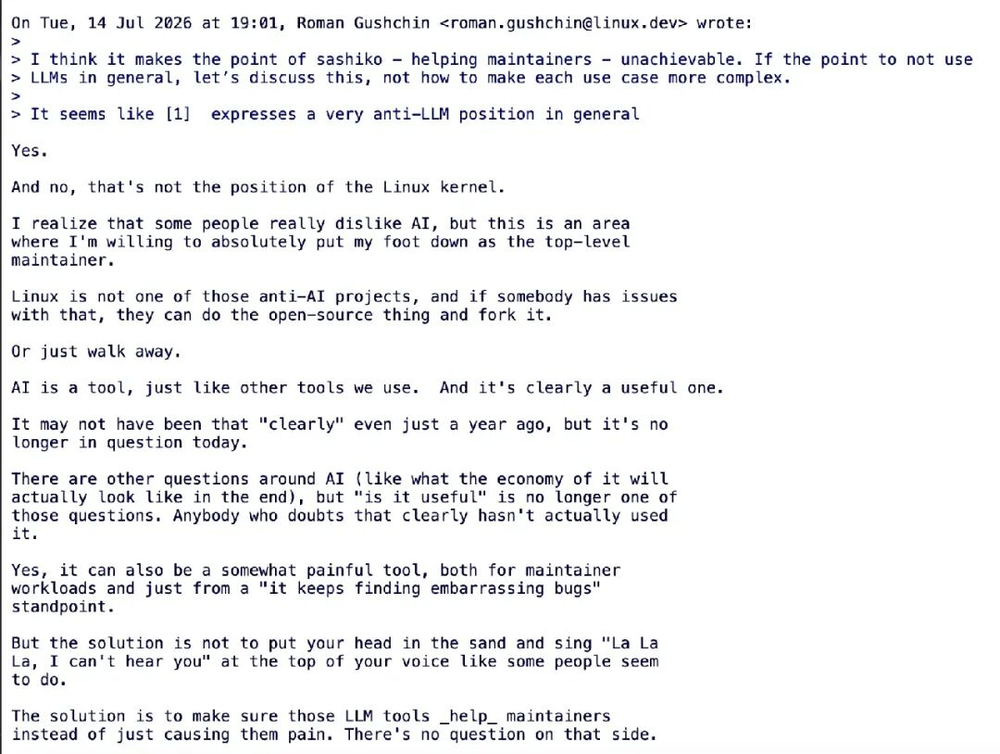
💡Linus Torvalds sets the definitive policy on AI in the world's most important open-source project.
⚡ 30-Second TL;DR
What Changed
Linus Torvalds rejects 'anti-AI' bans, viewing AI as a legitimate engineering tool.
Why It Matters
This stance provides a clear framework for AI integration in major open-source projects, likely encouraging more developers to use LLMs for code analysis and bug detection without fear of project-wide bans.
What To Do Next
If you contribute to open-source, adopt the 'Assisted-by' tagging convention and document your verification process for all AI-generated patches.
Key Points
- •Linus Torvalds rejects 'anti-AI' bans, viewing AI as a legitimate engineering tool.
- •AI-generated contributions must be verified by humans and adhere to strict kernel development standards.
- •The 'Signed-off-by' tag remains a human-only legal confirmation of code origin.
- •Linux kernel documentation now includes specific guidelines for AI-assisted contributions.
🧠 Deep Insight
AI-generated analysis for this event.
🔑 Enhanced Key Takeaways
- •The Linux kernel community updated its 'Submitting patches' documentation to explicitly state that AI-generated code is permitted only if the contributor understands the code and takes full responsibility for it.
- •Torvalds has expressed skepticism regarding the quality of AI-generated code, noting that while it can be useful for boilerplate, it often produces 'garbage' that requires rigorous human review.
- •The kernel community's stance is heavily influenced by the 'Developer's Certificate of Origin' (DCO), which legally mandates that the submitter has the right to submit the code, a requirement AI tools cannot currently fulfill independently.
- •Major Linux distributions and maintainers are increasingly using AI-assisted static analysis tools to detect potential vulnerabilities in incoming patches, complementing the human-centric review process.
- •The Linux Foundation has launched initiatives to explore how AI can assist in kernel maintenance, such as automating the identification of relevant maintainers for specific subsystems.
🛠️ Technical Deep Dive
- The Linux kernel's DCO (Developer's Certificate of Origin) requires a 'Signed-off-by' line, which serves as a legal attestation that the contributor has the right to submit the code under the open-source license.
- AI-assisted contributions are treated similarly to code imported from other projects; they must be verified for license compatibility and technical correctness.
- Kernel maintainers utilize automated tools like 'checkpatch.pl' and various static analyzers (e.g., Sparse, Coccinelle) to enforce coding standards, which now serve as the primary filter for AI-generated submissions.
- The community emphasizes that AI models lack the 'contextual understanding' of kernel subsystems, making them prone to introducing subtle regressions that automated testing may miss.
🔮 Future ImplicationsAI analysis grounded in cited sources
⏳ Timeline
Weekly AI Recap
Read this week's curated digest of top AI events →
👉Related Updates


AI-curated news aggregator. All content rights belong to original publishers.
Original source: 虎嗅 ↗