LINK Rescue Tests In-Orbit Servicing
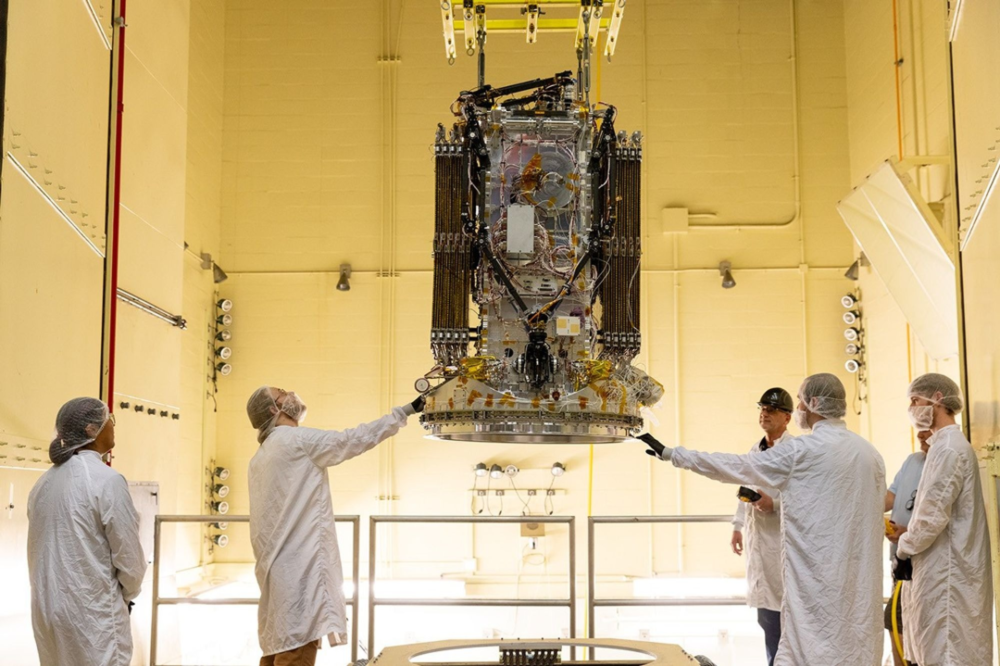
A $30 million rescue mission exposes the autonomy and fault-tolerance hurdles behind commercial in-orbit robotics.
30-Second TL;DR
What Changed
LINK was designed and launched in under a year to rescue Swift, a 2004-launched gamma-ray observatory.
Why It Matters
The mission could establish a market for commercial satellite repair, refueling, orbit raising, and end-of-life management. Its early control failure also highlights that low-cost, rapid spacecraft development still requires extensive verification of power, communications, navigation, control, and robotic contact operations.
What To Do Next
If you build robotics or autonomy systems, study LINK's fault-recovery sequence and add hardware-in-the-loop tests for degraded-actuator rendezvous and contact operations.
Key Points
- •LINK was designed and launched in under a year to rescue Swift, a 2004-launched gamma-ray observatory.
- •NASA's contract covers more than orbit raising: it tests commercial rendezvous, capture, stabilization, and life-extension services.
- •Two of LINK's three reaction wheels failed, but Hall-effect thrusters reduced its spin rate from 9 to below 4 degrees per second.
- •Swift lacks a standard servicing interface, making this a difficult non-cooperative target capture mission.
Deep Insight
AI-generated analysis for this event — not the original article.
Enhanced Key Takeaways
- •The LINK mission utilizes a proprietary 'Katalyst Capture Mechanism' (KCM) designed to interface with the launch adapter ring of legacy satellites, which were never intended for robotic docking.
- •Katalyst Space Technologies leveraged a 'digital twin' simulation environment running on NVIDIA Omniverse to retrain the LINK guidance, navigation, and control (GNC) algorithms in real-time following the reaction wheel failures.
- •The mission marks the first time Hall-effect thrusters have been used as the primary attitude control system for a non-cooperative rendezvous, moving beyond their traditional role as station-keeping propulsion.
- •Swift's orbit had decayed to an altitude of approximately 320 kilometers at the time of the rescue attempt, placing it in a high-drag regime that significantly complicated the final approach trajectory.
- •The $30 million NASA contract is structured as a milestone-based 'Fixed-Price Incentive' award, shifting the financial risk of the hardware anomalies largely to Katalyst Space Technologies.
Competitor Analysis
- Katalyst (LINK)
- Non-cooperative/Legacy
- Northrop Grumman (MRV)
- Cooperative (Docking Ring)
- Astroscale (ELSA-M)
- Cooperative (Magnetic Plate)
- Katalyst (LINK)
- Hall-Effect (Electric)
- Northrop Grumman (MRV)
- Chemical/Electric Hybrid
- Astroscale (ELSA-M)
- Chemical
- Katalyst (LINK)
- Life Extension/Deorbit
- Northrop Grumman (MRV)
- Life Extension
- Astroscale (ELSA-M)
- Debris Removal
- Katalyst (LINK)
- Fixed-Price Incentive
- Northrop Grumman (MRV)
- Service-as-a-Service
- Astroscale (ELSA-M)
- Government/Commercial Contract
| Feature | Katalyst (LINK) | Northrop Grumman (MRV) | Astroscale (ELSA-M) |
|---|---|---|---|
| Primary Target | Non-cooperative/Legacy | Cooperative (Docking Ring) | Cooperative (Magnetic Plate) |
| Propulsion | Hall-Effect (Electric) | Chemical/Electric Hybrid | Chemical |
| Mission Focus | Life Extension/Deorbit | Life Extension | Debris Removal |
| Pricing Model | Fixed-Price Incentive | Service-as-a-Service | Government/Commercial Contract |
Technical Deep Dive
- Propulsion System: Dual-mode Hall-effect thrusters utilizing Krypton propellant for high-impulse maneuvers and fine attitude control.
- GNC Architecture: Decentralized control logic allowing the flight computer to bypass failed reaction wheel nodes and map control authority directly to the thruster array.
- Capture Interface: Multi-point mechanical latching system designed to distribute stress across the target's launch adapter ring to prevent structural damage during stabilization.
- Computing: Radiation-hardened FPGA-based processing unit capable of executing real-time computer vision algorithms for pose estimation of tumbling targets.
Future ImplicationsAI analysis grounded in cited sources
Timeline
- 2025-05NASA awards $30 million contract to Katalyst Space Technologies for Swift observatory rescue.
- 2026-02LINK robotic servicing satellite successfully reaches orbit.
- 2026-04LINK experiences critical failure of two reaction wheels during initial checkout.
- 2026-06Katalyst team completes software patch for thruster-based attitude control.
- 2026-07LINK successfully stabilizes Swift's spin rate using Hall-effect thrusters.
Weekly AI Recap
Read this week's curated digest of top AI events →
AI-curated news aggregator. All content rights belong to original publishers.
Original source: 虎嗅 ↗
This is a summary, not the original. Read the source, or get the weekly briefing.
The weekly digest
One email a week. Unsubscribe anytime.