Li Auto Unveils Mach M100 Chip for Self-Driving AI
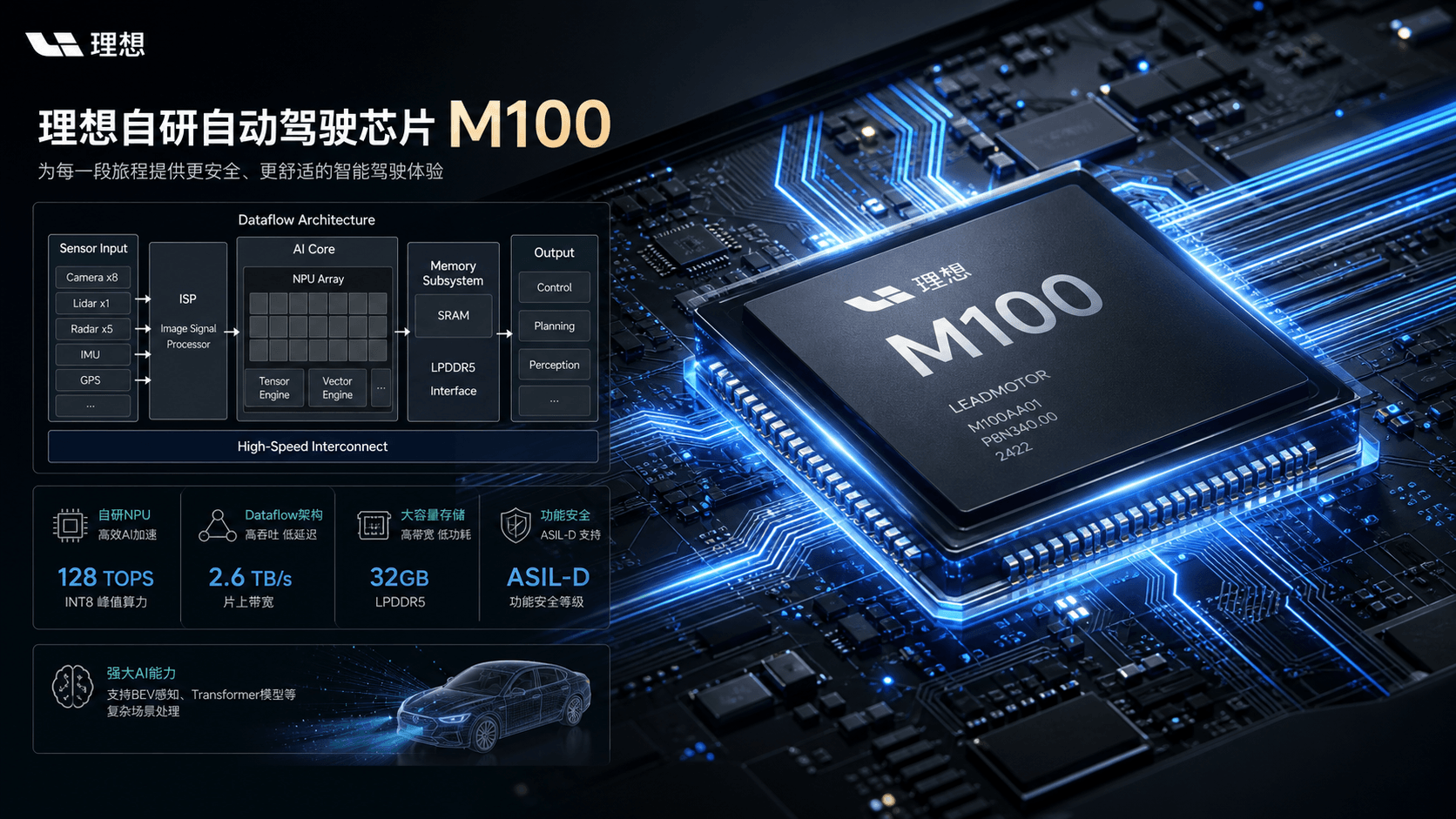
💡Li Auto challenges NVIDIA with a 1280 TOPS dynamic dataflow chip for autonomous driving.
⚡ 30-Second TL;DR
What Changed
Mach M100 chip delivers 1280 TOPS of computing power.
Why It Matters
Li Auto's shift to custom silicon could disrupt the automotive AI supply chain and force other EV manufacturers to reconsider their reliance on general-purpose GPUs.
What To Do Next
Evaluate the performance-per-watt of dynamic dataflow architectures compared to traditional GPU clusters for your specific inference pipelines.
Key Points
- •Mach M100 chip delivers 1280 TOPS of computing power.
- •Features a unique dynamic dataflow architecture for AI tasks.
- •Represents a strategic move to reduce reliance on NVIDIA GPU hardware.
🧠 Deep Insight
AI-generated analysis for this event — not the original article.
🔑 Enhanced Key Takeaways
- •The Mach M100 is manufactured using a 3nm process node, significantly improving energy efficiency compared to previous generation chips used by Li Auto.
- •Li Auto has integrated a proprietary 'Neural-Flow' compiler stack to optimize transformer-based models directly for the M100's dynamic dataflow architecture.
- •The chip includes a dedicated hardware-level safety island designed to meet ISO 26262 ASIL-D functional safety standards for autonomous driving.
- •Li Auto plans to deploy the M100 in its upcoming 'L-Series' refresh models, aiming to transition away from NVIDIA Orin-X platforms by Q4 2026.
- •The development of the M100 was led by Li Auto's internal 'X-Silicon' division, which was established in early 2024 to focus on vertical integration of AI hardware.
📊 Competitor Analysis▸ Show
| Feature | Li Auto Mach M100 | NVIDIA Orin-X | Tesla FSD Chip (HW4) |
|---|---|---|---|
| Architecture | Dynamic Dataflow | Ampere GPU | Custom ASIC |
| TOPS | 1280 | 254 | ~500 (est) |
| Process Node | 3nm | 7nm | 5nm |
| Primary Focus | Transformer Optimization | General Purpose AI | Vision-Centric Inference |
🛠️ Technical Deep Dive
- Architecture: Utilizes a non-von Neumann dynamic dataflow design that minimizes memory access latency by processing data in-situ.
- Memory: Features 64GB of integrated LPDDR6X memory with a bandwidth exceeding 800 GB/s.
- Power Consumption: Rated at 75W TDP, providing a high performance-per-watt ratio for vehicle battery longevity.
- Interconnect: Supports multi-chip scaling via a proprietary high-speed chip-to-chip interface, allowing up to 4 chips to act as a single unified compute cluster.
🔮 Future ImplicationsAI analysis grounded in cited sources
⏳ Timeline
Weekly AI Recap
Read this week's curated digest of top AI events →
👉Related Updates

AI-curated news aggregator. All content rights belong to original publishers.
Original source: Pandaily ↗
This is a summary, not the original. Read the source, or get the weekly briefing.
Weekly AI briefing
One email a week. Unsubscribe anytime.