Li Auto and Xiaomi extend range extender maintenance cycles
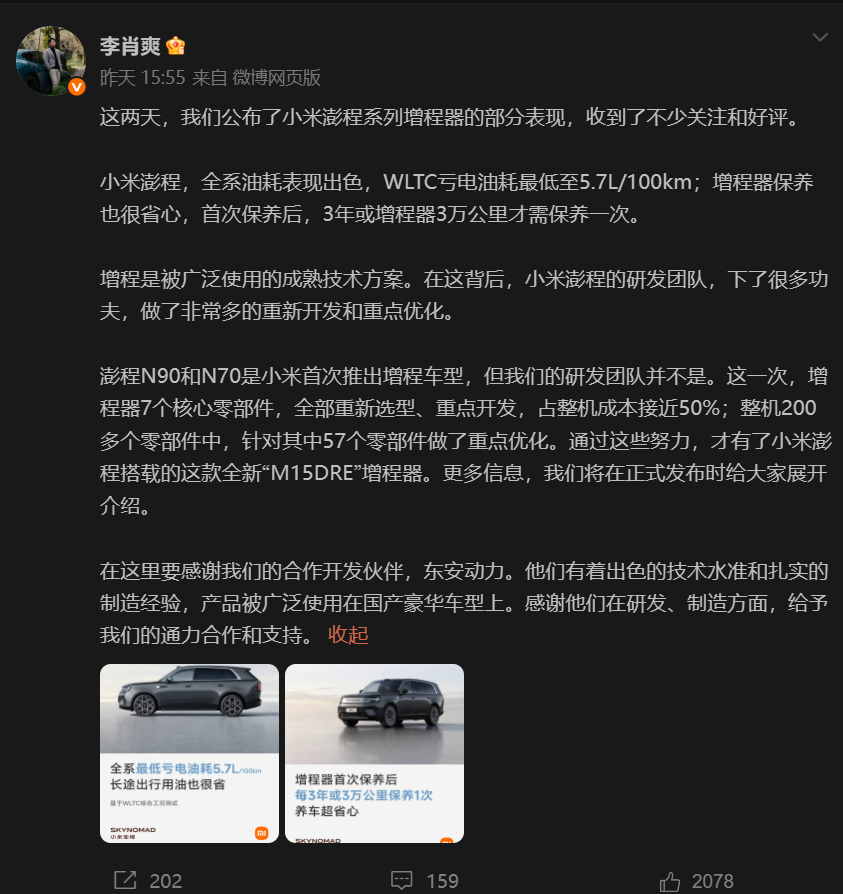
💡Learn how automotive giants are using service-level innovation to compete with pure EV user experience.
⚡ 30-Second TL;DR
What Changed
Li Auto and Xiaomi adopted a 3-year/30,000km maintenance interval for range extenders.
Why It Matters
This move forces other automotive manufacturers to rethink their after-sales service models for hybrid and range-extended vehicles to remain competitive in user experience.
What To Do Next
Analyze the maintenance cost-to-reliability ratio in your own product lifecycle management to identify opportunities for reducing user friction.
Key Points
- •Li Auto and Xiaomi adopted a 3-year/30,000km maintenance interval for range extenders.
- •The strategy aims to reduce maintenance 'friction' and compete with pure electric vehicle ownership experiences.
- •Maintenance costs remain relatively stable, but require exclusive use of official channels to maintain warranty.
🧠 Deep Insight
AI-generated analysis for this event — not the original article.
🔑 Enhanced Key Takeaways
- •The extended maintenance cycle specifically targets the range extender's oil and filter replacement intervals, which previously required more frequent servicing compared to pure battery electric vehicles (BEVs).
- •Industry analysts suggest this move is a response to consumer anxiety regarding the complexity of dual-powertrain systems, aiming to simplify the perceived total cost of ownership (TCO).
- •Both companies are leveraging improved engine oil formulations and advanced combustion management software to ensure engine longevity despite the extended service intervals.
- •This policy shift is part of a broader 'service-as-a-product' strategy, where manufacturers use low-maintenance claims to differentiate their EREV (Extended Range Electric Vehicle) offerings from traditional internal combustion engine vehicles.
- •The warranty terms associated with these extended cycles mandate the use of specific, manufacturer-approved synthetic lubricants to prevent premature wear during the longer service windows.
📊 Competitor Analysis▸ Show
| Feature | Li Auto / Xiaomi | AITO (Huawei) | BYD (DM-i) | Geely (Leishen) |
|---|---|---|---|---|
| Maintenance Interval | 3yr / 30,000km | 1yr / 10,000km | 1yr / 7,500-10,000km | 1yr / 10,000km |
| Primary Focus | Low-friction ownership | Smart cockpit integration | Cost-efficiency | Thermal efficiency |
🛠️ Technical Deep Dive
- The range extender units utilize high-compression ratio Miller-cycle engines optimized for steady-state operation to minimize carbon buildup.
- Implementation of advanced oil-life monitoring sensors allows the vehicle control unit (VCU) to track degradation based on actual engine load rather than just mileage.
- The extended cycle is supported by the use of low-viscosity, high-shear-stability synthetic oils that maintain protective film strength over longer durations.
- Software-defined maintenance alerts are integrated into the vehicle's OTA (Over-the-Air) system, providing real-time updates to the user's mobile app based on driving patterns.
🔮 Future ImplicationsAI analysis grounded in cited sources
⏳ Timeline
Weekly AI Recap
Read this week's curated digest of top AI events →
👉Related Updates

AI-curated news aggregator. All content rights belong to original publishers.
Original source: 虎嗅 ↗
This is a summary, not the original. Read the source, or get the weekly briefing.
The weekly digest
One email a week. Unsubscribe anytime.