LG Plans 2027 Humanoid Robot Powered by Nvidia
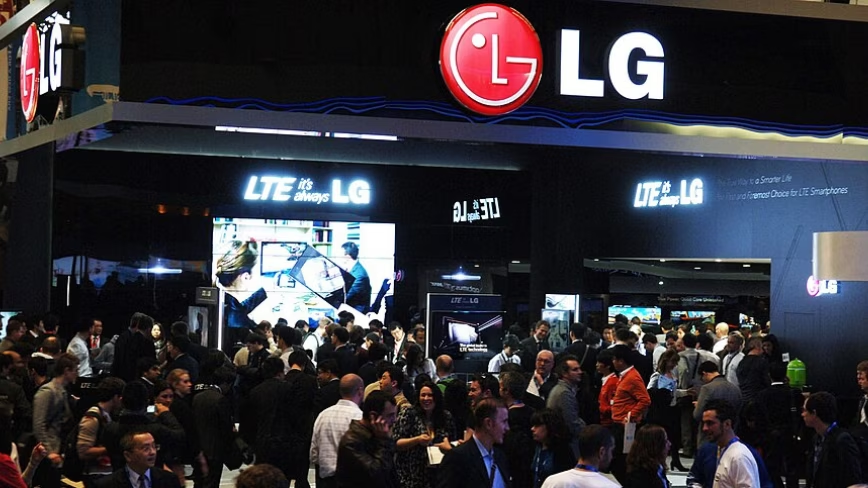
💡LG’s planned robot brings Nvidia’s GR00T model and safety stack into a major hardware platform.
⚡ 30-Second TL;DR
What Changed
LG expects to unveil the bipedal robot in the first quarter of 2027.
Why It Matters
The partnership connects LG’s hardware and consumer-electronics expertise with Nvidia’s embodied-AI software stack. It could accelerate the development of commercial humanoid robots while increasing demand for robot-specific compute and safety tooling.
What To Do Next
Prototype a simulated humanoid workflow with Nvidia Isaac GR00T and verify that your control stack can run on Jetson Thor hardware.
Key Points
- •LG expects to unveil the bipedal robot in the first quarter of 2027.
- •The system will use Nvidia’s Jetson Thor processor.
- •Nvidia’s Isaac GR00T foundation model will support the robot.
- •The Halos safety system is also part of the planned platform.
- •LG and Nvidia signed the agreement at Nvidia’s Santa Clara headquarters on August 13.
🧠 Deep Insight
AI-generated analysis for this event.
🔑 Enhanced Key Takeaways
- •LG Electronics aims to integrate this humanoid robot into its broader 'Smart Home' and industrial automation ecosystem, leveraging its existing leadership in home appliances.
- •The partnership builds upon a long-standing collaboration between LG and Nvidia, which previously focused on AI-driven infotainment systems for the automotive sector.
- •Nvidia's Jetson Thor is specifically designed as a modular system-on-a-chip (SoC) architecture, optimized for the high-compute demands of embodied AI and real-time sensor processing.
- •The Halos safety system is a specialized software framework developed by Nvidia to ensure human-robot interaction safety through real-time monitoring and collision avoidance protocols.
- •LG plans to utilize its 'LG ThinQ' AI platform as the primary interface for users to interact with and manage the humanoid robot within domestic environments.
📊 Competitor Analysis▸ Show
| Feature | LG (Nvidia-powered) | Tesla (Optimus) | Figure AI (Figure 02) |
|---|---|---|---|
| Processor | Nvidia Jetson Thor | Tesla FSD Computer | Intel/Custom AI chips |
| Software | Isaac GR00T | Tesla AI / Dojo | OpenAI Models |
| Primary Focus | Smart Home / Industrial | Manufacturing / General | Industrial / Logistics |
| Safety | Halos System | Autopilot Safety Stack | Proprietary Safety Layers |
🛠️ Technical Deep Dive
- Jetson Thor Architecture: Utilizes a transformer engine capable of running multimodal generative AI models at high speeds with low latency.
- Isaac GR00T Foundation Model: A general-purpose foundation model for humanoid robots that enables the robot to understand natural language and emulate human movements by observing human actions.
- Sensor Fusion: The platform supports high-bandwidth input from multiple LiDAR, depth cameras, and tactile sensors to create a 3D spatial map of the environment.
- Compute Efficiency: Designed to balance high-performance inference for complex tasks with power management suitable for mobile, battery-operated humanoid platforms.
🔮 Future ImplicationsAI analysis grounded in cited sources
⏳ Timeline
Weekly AI Recap
Read this week's curated digest of top AI events →
👉Related Updates

AI-curated news aggregator. All content rights belong to original publishers.
Original source: The Next Web (TNW) ↗