Leveraging Telepresence Robots for Inclusive Workforce Integration
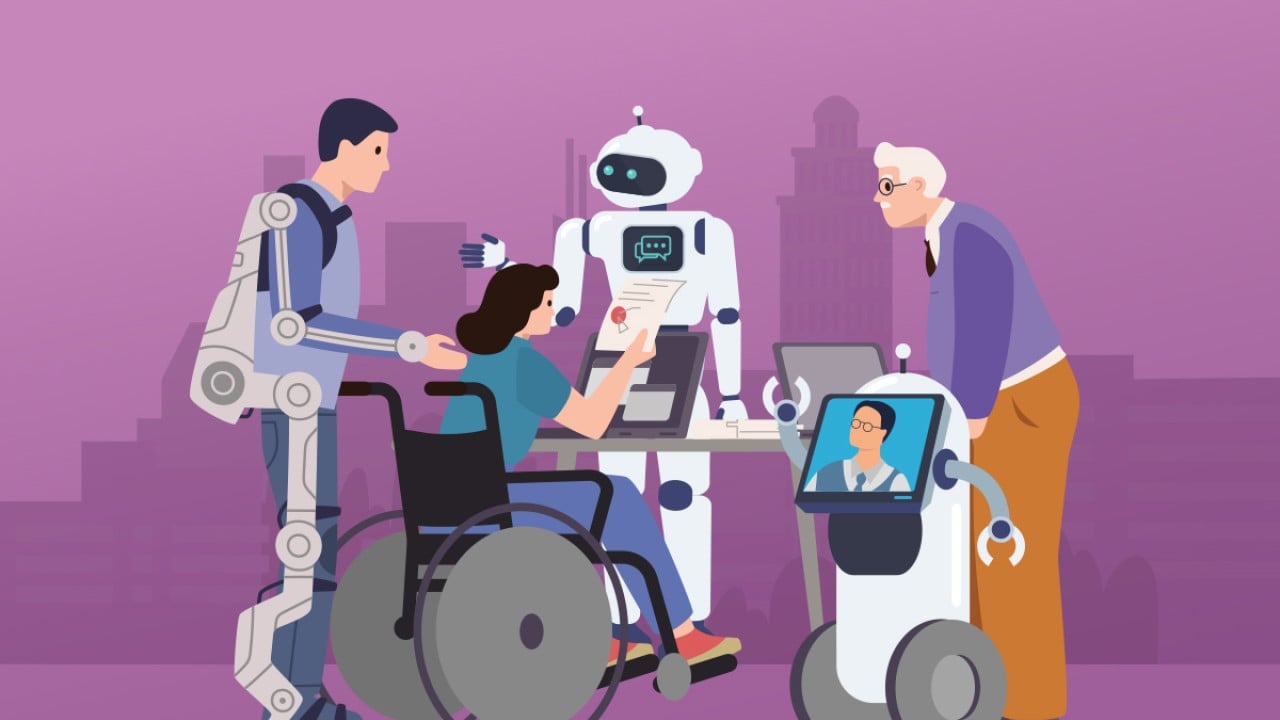
💡Discover how telepresence robotics is evolving from automation to a tool for human-centric workforce inclusion.
⚡ 30-Second TL;DR
What Changed
Telepresence robots enable remote employment for individuals with physical disabilities.
Why It Matters
This shift highlights a growing trend in embodied AI applications that prioritize human-in-the-loop accessibility over full automation. It opens new market segments for robotics companies focusing on social integration.
What To Do Next
Explore integrating WebRTC or similar low-latency streaming protocols into your robotics stack to enable human-in-the-loop teleoperation features.
Key Points
- •Telepresence robots enable remote employment for individuals with physical disabilities.
- •Human-centric design maintains personal connection through screen-based facial display.
- •Service robots are being repurposed as tools for social and professional inclusion.
🧠 Deep Insight
AI-generated analysis for this event — not the original article.
🔑 Enhanced Key Takeaways
- •The 'Avatar Robot Cafe' model, pioneered by companies like Ory Laboratory, has demonstrated that telepresence robots can reduce social isolation by providing operators with a sense of purpose and social agency beyond mere employment.
- •Advancements in low-latency 5G and 6G network integration have significantly reduced the 'telepresence lag' that previously caused motion sickness and communication friction for remote operators.
- •Regulatory frameworks in regions like Japan and the EU are beginning to classify telepresence robots as assistive technology, potentially qualifying them for government subsidies and workplace accommodation tax credits.
- •Modern telepresence systems now incorporate 'gaze-following' AI algorithms that automatically adjust the robot's camera angle to match the operator's eye movements, enhancing non-verbal communication cues.
- •Integration with Large Language Models (LLMs) allows robots to provide real-time translation and accessibility assistance, enabling operators to serve international customers regardless of language barriers.
📊 Competitor Analysis▸ Show
| Feature | Ory Laboratory (OriHime) | Double Robotics | OhmniLabs |
|---|---|---|---|
| Primary Focus | Social/Service Inclusion | Corporate/Education | Telehealth/Education |
| Facial Display | Dedicated Face Screen | iPad Integration | Integrated Screen |
| Mobility | Stationary/Limited | Self-Balancing Wheels | Wheeled Base |
| Pricing | Subscription/Rental | Mid-Range ($3k+) | Entry-Level ($1.5k+) |
🛠️ Technical Deep Dive
- Control Architecture: Utilizes WebRTC for peer-to-peer, low-latency video streaming between the operator's interface and the robot's onboard compute module.
- Sensory Feedback: Employs multi-microphone arrays for spatial audio, allowing operators to isolate and focus on specific conversations in noisy environments.
- Connectivity: Supports Wi-Fi 6E and 5G cellular modules to maintain stable connections in high-density public spaces.
- Compute: Typically powered by ARM-based SoCs (e.g., NVIDIA Jetson or similar) to handle real-time image processing and motor control locally.
- Security: Implements end-to-end encryption for video/audio streams to comply with workplace privacy and data protection regulations.
🔮 Future ImplicationsAI analysis grounded in cited sources
⏳ Timeline
Weekly AI Recap
Read this week's curated digest of top AI events →
👉Related Updates

AI-curated news aggregator. All content rights belong to original publishers.
Original source: SCMP Technology ↗
This is a summary, not the original. Read the source, or get the weekly briefing.
Weekly AI briefing
One email a week. Unsubscribe anytime.