🐯虎嗅•Stalecollected in 15m
Korean AI Companions Crush Japan Market
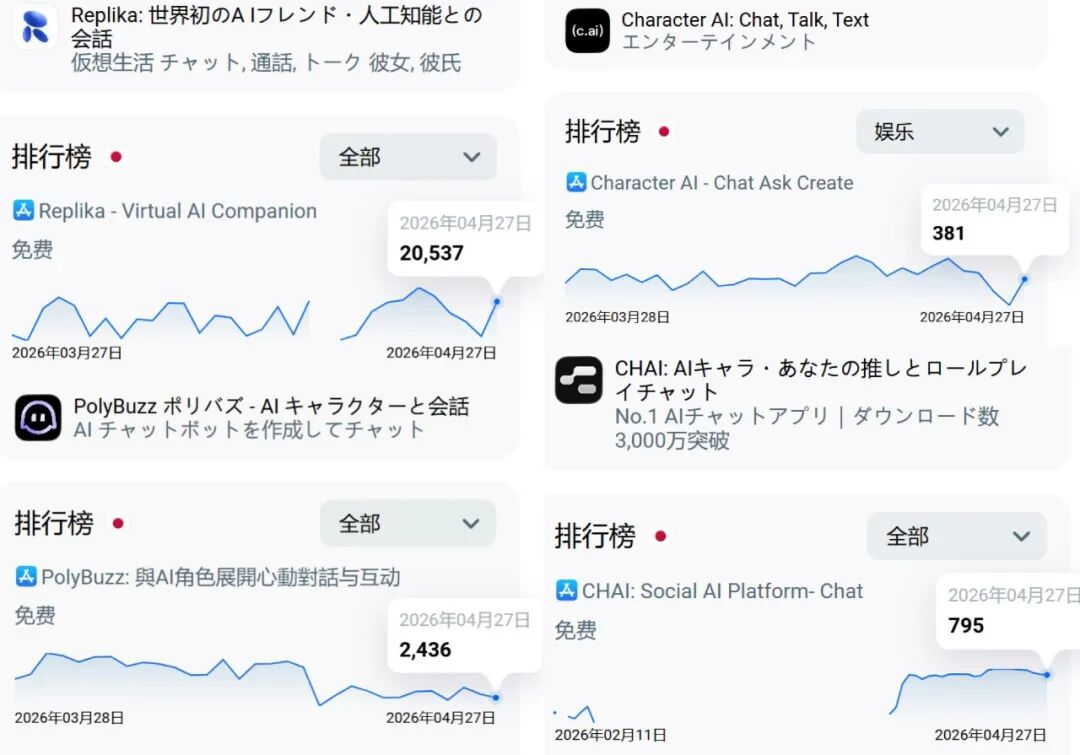
💡Narrative AI unlocks $2.6M/mo in Japan—strategy for your companion app?
⚡ 30-Second TL;DR
What Changed
Zeta and Crack generate $2.6M combined monthly revenue in single Japan market
Why It Matters
Proves narrative AI can capture high-value users in competitive markets, shifting revenue from downloads to engagement. Offers blueprint for global AI companion expansion beyond chatbots.
What To Do Next
Prototype Spotwrite-like narrative generation using Llama-3 with long-context prompts for roleplay apps.
Who should care:Founders & Product Leaders
Key Points
- •Zeta and Crack generate $2.6M combined monthly revenue in single Japan market
- •Spotwrite-1 model prioritizes entertainment with 300+ word plot-driven replies
- •Users demand consistent personas; apps succeed by minimizing role collapse
- •Narrative focus attracts creators from Character.AI, boosts premium spending
🧠 Deep Insight
AI-generated analysis for this event.
🔑 Enhanced Key Takeaways
- •The success of Zeta and Crack in Japan is heavily attributed to localized 'character card' ecosystems, where user-generated content (UGC) allows for complex, multi-layered persona definitions that exceed the capabilities of standard LLM system prompts.
- •Japanese market penetration is facilitated by aggressive 'otaku-centric' marketing strategies that leverage existing anime and light novel fan communities, rather than relying on general-purpose AI advertising.
- •Zeta's Spotwrite-1 model utilizes a proprietary long-context window optimization technique specifically tuned for maintaining narrative continuity over thousands of turns, effectively mitigating the 'amnesia' common in general-purpose chatbots.
📊 Competitor Analysis▸ Show
| Feature | Zeta (Spotwrite-1) | Character.AI | PolyBuzz |
|---|---|---|---|
| Primary Focus | Immersive Narrative/Roleplay | General Purpose/Utility | Social/Casual Chat |
| Context Window | Optimized for Long-form | Standard | Short/Medium |
| Pricing Model | Premium Subscription (High ARPU) | Freemium | Ad-supported/Freemium |
| Persona Stability | High (Hard-coded constraints) | Moderate (Prompt-based) | Low (Dynamic) |
🛠️ Technical Deep Dive
- •Spotwrite-1 Architecture: A specialized transformer-based architecture optimized for 'narrative-first' token generation rather than factual accuracy.
- •Context Management: Implements a hierarchical memory retrieval system that separates 'Core Persona' (static) from 'Narrative History' (dynamic) to prevent role collapse.
- •Inference Optimization: Uses a custom KV-cache compression technique to maintain 300+ word responses without significant latency spikes, crucial for the 'novel-like' user experience.
- •Fine-tuning: The model underwent extensive RLHF (Reinforcement Learning from Human Feedback) specifically on Japanese light novel datasets to mimic specific stylistic tropes and emotional pacing.
🔮 Future ImplicationsAI analysis grounded in cited sources
Zeta will expand into the Japanese mobile gaming market by Q4 2026.
The high ARPU and established user base provide a clear path for integrating AI-driven NPCs into existing gaming ecosystems.
Major Western AI competitors will launch 'Roleplay-specific' model variants by year-end.
The proven revenue success of narrative-focused AI in Japan creates a market pressure that general-purpose models cannot ignore.
⏳ Timeline
2025-03
Zeta launches initial beta in South Korea with the Spotwrite-1 prototype.
2025-09
Zeta officially enters the Japanese market with localized character support.
2026-02
Crack app launches in Japan, utilizing the same underlying model architecture as Zeta.
📰
Weekly AI Recap
Read this week's curated digest of top AI events →
👉Related Updates


AI-curated news aggregator. All content rights belong to original publishers.
Original source: 虎嗅 ↗