Knockoff Chrome extension filters unfamiliar Amazon brands
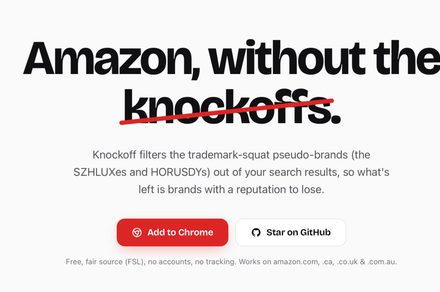
💡A simple example of using client-side filtering to solve the 'choice overload' problem in massive marketplaces.
⚡ 30-Second TL;DR
What Changed
Automatically identifies and dims unfamiliar brands on Amazon
Why It Matters
This tool highlights a growing consumer demand for AI-driven curation and filtering in cluttered e-commerce environments.
What To Do Next
Analyze the DOM structure of e-commerce sites to build similar browser-based filtering tools using manifest V3.
Key Points
- •Automatically identifies and dims unfamiliar brands on Amazon
- •Allows users to hide specific sellers to clean up search results
- •Reduces cognitive load during the e-commerce shopping experience
🧠 Deep Insight
AI-generated analysis for this event — not the original article.
🔑 Enhanced Key Takeaways
- •The extension utilizes a crowdsourced database of 'trusted' brands, allowing users to contribute to the whitelist to ensure community-driven accuracy.
- •It addresses the 'Amazonification' phenomenon where search results are increasingly dominated by sponsored products and private-label goods from unknown entities.
- •The tool operates primarily via DOM manipulation, injecting CSS styles into the Amazon search results page to visually alter the opacity of non-whitelisted items.
- •Privacy advocates have noted that the extension requires broad permissions to read and change data on Amazon websites, raising questions about data collection practices.
- •The developer behind Knockoff has explicitly stated the tool does not track user purchase history, distinguishing it from many other retail-focused browser extensions.
📊 Competitor Analysis▸ Show
| Feature | Knockoff | Jungle Scout | Keepa |
|---|---|---|---|
| Primary Goal | Filter/Dim unknown brands | Seller research/Analytics | Price tracking/History |
| User Focus | Consumer (Shopping) | Seller (Business) | Consumer (Price) |
| Pricing | Free | Paid Subscription | Freemium |
🛠️ Technical Deep Dive
- The extension is built using the Chrome Extensions Manifest V3 architecture.
- It employs a content script that executes on amazon.com and its regional subdomains to scan the DOM for product listing containers.
- Brand identification is performed by matching the 'by [Brand Name]' text element against a locally stored JSON-based whitelist.
- CSS injection is used to apply a 'dimming' filter (opacity: 0.3) to elements that do not match the whitelist criteria.
- The extension includes a toggle mechanism that allows users to switch between 'Dim' and 'Hide' modes, modifying the display property of the DOM nodes accordingly.
🔮 Future ImplicationsAI analysis grounded in cited sources
⏳ Timeline
Weekly AI Recap
Read this week's curated digest of top AI events →
👉Related Updates
AI-curated news aggregator. All content rights belong to original publishers.
Original source: Digital Trends ↗
This is a summary, not the original. Read the source, or get the weekly briefing.
Weekly AI briefing
One email a week. Unsubscribe anytime.