Kling AI spins off from Kuaishou at $18B valuation
💡A major $18B valuation for a video AI model signals a massive shift in how Chinese tech giants fund foundation models.
⚡ 30-Second TL;DR
What Changed
Kling AI raised up to $3 billion with a $18 billion valuation.
Why It Matters
This spin-off highlights the extreme capital intensity of video foundation models and the trend of Chinese tech giants restructuring AI assets to survive the 'compute war'.
What To Do Next
Monitor Kling AI's API pricing and feature releases to benchmark against Sora and Seedance for production-grade video generation workflows.
Key Points
- •Kling AI raised up to $3 billion with a $18 billion valuation.
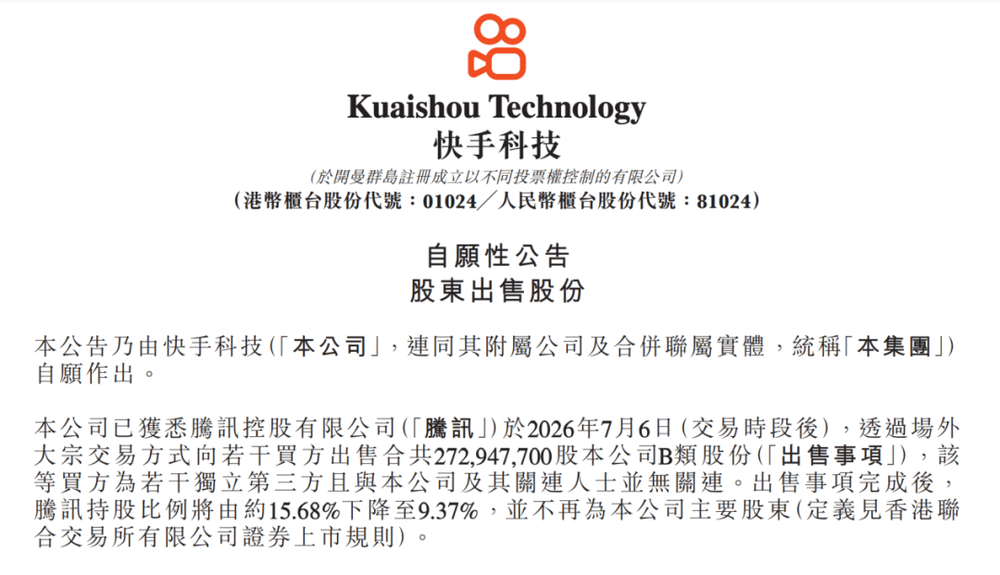
- •Kuaishou retains 68.33% ownership and control, keeping the unit consolidated in financial reports.
- •The move aims to alleviate Kuaishou's R&D cost pressure while allowing Kling AI to compete directly with ByteDance and Alibaba.
🧠 Deep Insight
AI-generated analysis for this event — not the original article.
🔑 Enhanced Key Takeaways
- •The spin-off entity, officially named Kling Intelligent Technology, is headquartered in Beijing and focuses on the commercialization of large-scale video generation models.
- •Kling AI's core model architecture leverages a 3D VAE (Variational Autoencoder) and a Diffusion Transformer (DiT) backbone to achieve high-fidelity temporal consistency.
- •The participation of Tencent, Alibaba, and Baidu marks a rare 'co-opetition' strategy where major Chinese tech giants collectively fund a model that competes with their own internal AI labs.
- •Kling AI has integrated its API into the Kuaishou ecosystem, specifically targeting short-video creators to automate content production and reduce post-production costs.
- •The $3 billion funding round is structured as a mix of primary capital injection and secondary share transfers, allowing Kuaishou to optimize its balance sheet while maintaining majority control.
📊 Competitor Analysis▸ Show
| Feature | Kling AI | Sora (OpenAI) | Veo (Google) | Jimeng (ByteDance) |
|---|---|---|---|---|
| Max Video Length | Up to 120s | Up to 60s | Up to 60s | Up to 60s |
| Architecture | DiT + 3D VAE | DiT | DiT | DiT |
| Primary Market | Global/China | Global | Global | China |
| Pricing Model | Usage-based API | Enterprise/API | Enterprise/API | Usage-based |
🛠️ Technical Deep Dive
- Model Architecture: Utilizes a Diffusion Transformer (DiT) framework which scales compute efficiency compared to traditional U-Net architectures.
- Latent Space: Employs a proprietary 3D VAE that compresses video data into a latent space while preserving spatial-temporal coherence across long durations.
- Training Data: Trained on a massive corpus of high-definition video data, specifically optimized for motion dynamics and complex physical interactions.
- Inference Optimization: Implements custom CUDA kernels to accelerate the denoising process, enabling near real-time generation capabilities for specific resolutions.
🔮 Future ImplicationsAI analysis grounded in cited sources
⏳ Timeline
Weekly AI Recap
Read this week's curated digest of top AI events →
👉Related Updates

AI-curated news aggregator. All content rights belong to original publishers.
Original source: 虎嗅 ↗
This is a summary, not the original. Read the source, or get the weekly briefing.
The weekly digest
One email a week. Unsubscribe anytime.