King's College gains access to Google's quantum processor
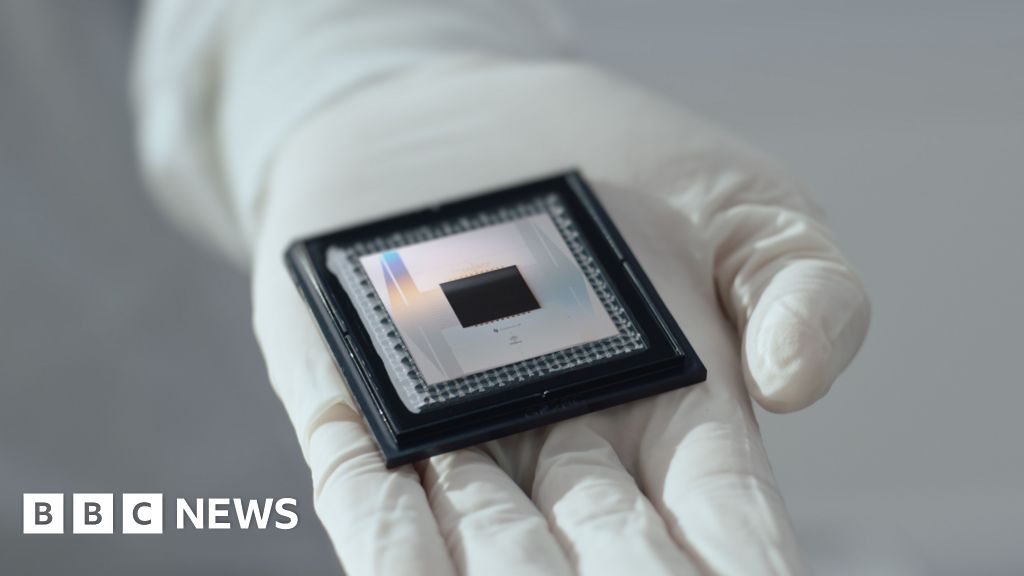
๐กSee how Google's quantum hardware is being applied to solve complex scientific problems beyond classical limits.
โก 30-Second TL;DR
What Changed
King's College London researchers granted access to Google's quantum hardware
Why It Matters
This collaboration highlights the growing trend of academic institutions leveraging proprietary quantum infrastructure to push the boundaries of scientific discovery. It signals a shift toward practical applications of quantum computing in fundamental research.
What To Do Next
Monitor Google Quantum AI's research publications to identify potential algorithmic breakthroughs applicable to your own simulation or optimization workflows.
Key Points
- โขKing's College London researchers granted access to Google's quantum hardware
- โขFocus on solving previously unanswerable questions in natural sciences
- โขLeveraging quantum advantage for complex process simulation
๐ง Deep Insight
Web-grounded analysis with 16 cited sources.
๐ Enhanced Key Takeaways
- โขKing's College London is the first UK academic research team to be granted access to Google's Willow quantum processor, facilitated by a scheme launched last year with the UK's National Quantum Computing Centre (NQCC).
- โขThe Willow processor, Google's latest quantum chip, features 105 qubits and has demonstrated a significant breakthrough in error correction by showing error rates halving as qubit arrays scale.
- โขThe research, co-led by Dr. Eleanor Crane from King's and Dr. Alexander Schuckert from ENS Paris, will investigate a mathematical analogy for neurons in the brain to understand how quantum computers can study interacting quantum systems.
- โขThis collaboration is part of a broader initiative stemming from the UK-US Technology Prosperity Deal and Google's ยฃ5 billion investment in the UK's AI economy, aiming to accelerate quantum technology applications.
๐ Competitor Analysisโธ Show
Google's quantum computing service, particularly access to its Willow processor, is currently restricted-access and research-focused, without public commercial pricing. This contrasts with other major players in the quantum computing market who offer Quantum Computing as a Service (QCaaS) with various commercial models:
- IBM Quantum: Offers pay-per-minute QPU time, with a 127-qubit Eagle processor.
- Microsoft Azure Quantum: Provides access to backends like Quantinuum (monthly subscription using credits) and Rigetti (time-based billing per 10 ms of execution time).
- IonQ: Offers resource-estimator based, quote-driven pricing, with hardware available on major cloud platforms.
- D-Wave Systems: Specializes in quantum annealing, with hybrid solver usage typically offered through pilots.
While Google has demonstrated quantum supremacy with its Sycamore processor (53 operational qubits) in 2019 and verifiable quantum advantage with Willow (105 qubits) in October 2025, direct feature and pricing comparisons for commercial use are not applicable given Google's current access model. Competitors like IBM and IonQ also focus on increasing qubit counts and improving error rates, with IBM's Eagle having 127 qubits.
๐ ๏ธ Technical Deep Dive
- Processor Name: Willow (latest generation), Sycamore (previous generation).
- Qubit Count: Willow has 105 qubits. The Sycamore processor initially had 54 qubits (53 operational) and was later upgraded to 70 qubits.
- Qubit Type: Superconducting qubits, specifically transmon qubits for Sycamore.
- Operating Environment: Requires specialized cryogenic environments to maintain the super-sensitive qubits and prevent decoherence.
- Core Principles: Operates using quantum superposition and entanglement to perform complex calculations, allowing for massive parallel processing.
- Error Correction: Willow represents a significant milestone by demonstrating error rates halving as qubit arrays scale, a crucial step towards fault-tolerant quantum computing. Google employs error-correcting codes and advanced calibration procedures.
- System Architecture: Google takes a full-system approach, integrating chip architecture, gate development, fabrication, calibration, and error correction. It utilizes tunable qubits and couplers to dynamically adjust performance and optimize for faster gates and operations.
- Software Stack: Includes an advanced software stack for calibration and error correction, alongside open-source tools like Cirq for writing quantum circuits.
- Performance Milestones: The 53-qubit Sycamore processor achieved quantum supremacy in 2019, completing a task in 200 seconds that would have taken classical supercomputers thousands of years. The 70-qubit Sycamore completed a task in under five minutes that would take classical supercomputers nearly 47 years. Willow achieved verifiable quantum advantage in October 2025, solving problems that would take classical supercomputers longer than the age of the universe.
๐ฎ Future ImplicationsAI analysis grounded in cited sources
โณ Timeline
๐ Sources (16)
Factual claims are grounded in the sources below. Forward-looking analysis is AI-generated interpretation.
Weekly AI Recap
Read this week's curated digest of top AI events โ
๐Related Updates
AI-curated news aggregator. All content rights belong to original publishers.
Original source: BBC Technology โ