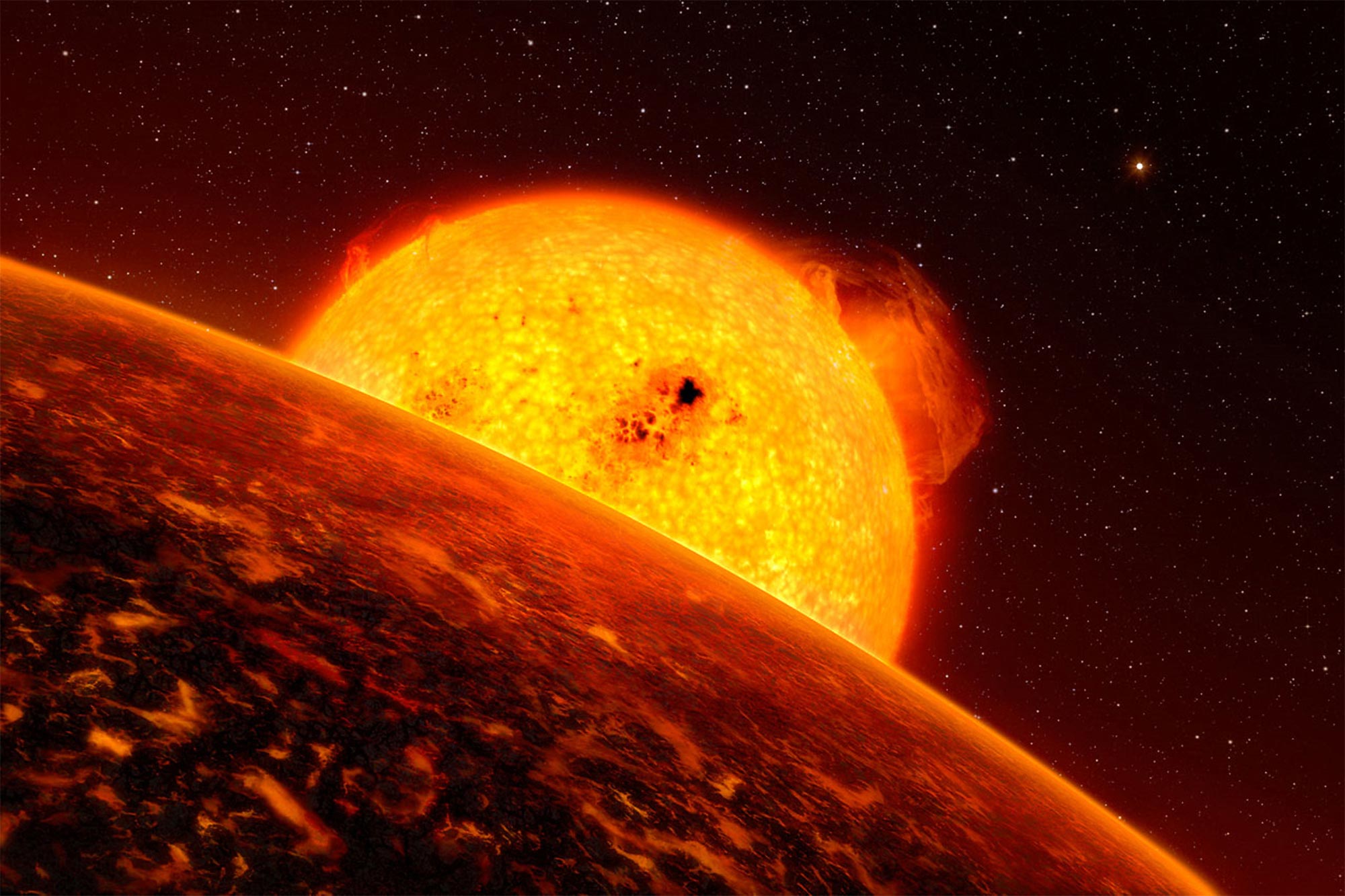
JWST reveals lava world 41 light-years away
💡Learn how JWST data is pushing the boundaries of exoplanet atmospheric modeling and remote sensing.
⚡ 30-Second TL;DR
What Changed
Observed 55 Cancri e, a super-Earth exoplanet 41 light-years away
Why It Matters
This research enhances our understanding of planetary atmospheres, which is critical for training models to detect biosignatures in exoplanet data.
What To Do Next
Explore the MAST (Mikulski Archive for Space Telescopes) portal to access JWST raw datasets for your own astronomical data analysis projects.
Key Points
- •Observed 55 Cancri e, a super-Earth exoplanet 41 light-years away
- •Evidence of a hydrogen-rich atmosphere on a lava-covered world
- •Data provides insights into the formation and evolution of lava planets
🧠 Deep Insight
AI-generated analysis for this event — not the original article.
🔑 Enhanced Key Takeaways
- •The atmosphere of 55 Cancri e is likely a secondary atmosphere, replenished by the continuous outgassing of magma oceans rather than a primordial one captured during formation.
- •Observations were conducted using the JWST's Near-Infrared Spectrograph (NIRSpec) and Mid-Infrared Instrument (MIRI) to measure thermal emission from the planet.
- •The planet is tidally locked, meaning one side permanently faces its host star, creating extreme temperature gradients that drive the atmospheric circulation patterns.
- •The detection of a thick atmosphere challenges previous models that suggested 55 Cancri e might be a 'naked' rock stripped of its volatiles by intense stellar radiation.
- •The planet's high density and proximity to its star (orbiting in less than 18 hours) make it a primary laboratory for studying the transition between super-Earths and mini-Neptunes.
🛠️ Technical Deep Dive
- Instrument: NIRSpec (Near-Infrared Spectrograph) used for secondary eclipse spectroscopy to detect atmospheric absorption features.
- Instrument: MIRI (Mid-Infrared Instrument) used to measure the planet's brightness temperature and map thermal emission.
- Methodology: Secondary eclipse mapping, which involves observing the planet as it passes behind the star to isolate the planet's own thermal radiation.
- Atmospheric Composition: Evidence suggests a high-mean-molecular-weight atmosphere, likely rich in CO2 or CO, sustained by volcanic activity.
- Orbital Period: Approximately 17.6 hours, placing the planet in an extremely close-in orbit around its K-type host star.
🔮 Future ImplicationsAI analysis grounded in cited sources
⏳ Timeline
Weekly AI Recap
Read this week's curated digest of top AI events →
👉Related Updates




AI-curated news aggregator. All content rights belong to original publishers.
Original source: cnBeta (Full RSS) ↗
This is a summary, not the original. Read the source, or get the weekly briefing.
Weekly AI briefing
One email a week. Unsubscribe anytime.