Jiying Releases World's First Zero-Shot Solid Mechanics Physics Model
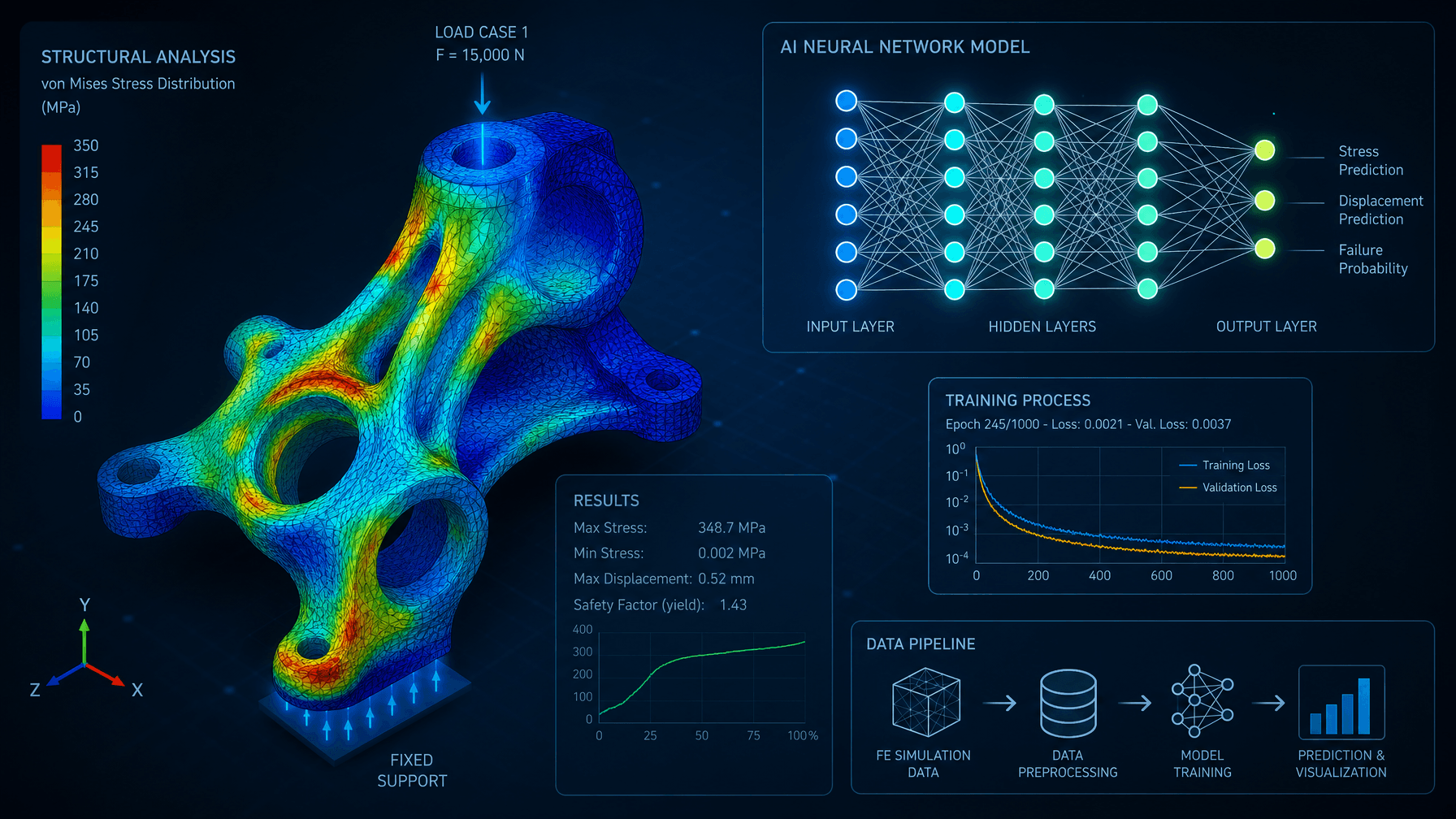
💡A breakthrough in physics AI: achieve zero-shot generalization for complex engineering simulations.
⚡ 30-Second TL;DR
What Changed
First zero-shot generalizable foundation model for solid mechanics
Why It Matters
This model could drastically reduce the time and computational cost required for traditional finite element analysis in engineering design.
What To Do Next
If you work in engineering simulation, explore how Jiying 2.0 can replace or augment your current FEA workflows.
Key Points
- •First zero-shot generalizable foundation model for solid mechanics
- •Handles unseen geometries, materials, and boundary conditions
- •Significant advancement for AI-driven engineering simulation
🧠 Deep Insight
AI-generated analysis for this event — not the original article.
🔑 Enhanced Key Takeaways
- •Jiying 2.0 utilizes a proprietary neural operator architecture that decouples physical laws from specific mesh discretizations, allowing for mesh-agnostic inference.
- •The model was trained on a massive synthetic dataset comprising over 100 million diverse solid mechanics simulations, including non-linear material behaviors.
- •Jiying Technology claims the model achieves inference speeds up to 1000x faster than traditional Finite Element Analysis (FEA) solvers for complex structural problems.
- •The model integrates a differentiable physics engine that enforces conservation of momentum and energy constraints during the inference process to ensure physical consistency.
- •Jiying 2.0 supports multi-physics coupling, enabling the model to predict thermal-structural interactions in addition to standard solid mechanics.
📊 Competitor Analysis▸ Show
| Feature | Jiying 2.0 | NVIDIA Modulus | DeepMind GraphCast |
|---|---|---|---|
| Primary Focus | Solid Mechanics | Multi-Physics/Digital Twins | Weather/Earth Systems |
| Zero-Shot Capability | High (Solid Mechanics) | Moderate (Requires Fine-tuning) | High (Domain Specific) |
| Mesh Dependency | Mesh-Agnostic | Mesh-Dependent/Hybrid | Grid-Based |
| Pricing | Enterprise/API | Open Source/Enterprise | Research/Open Source |
🛠️ Technical Deep Dive
- Architecture: Employs a Transformer-based Neural Operator (TNO) that operates in the latent space of physical fields.
- Training Methodology: Uses curriculum learning to progressively introduce complex boundary conditions and non-linear material constitutive laws.
- Inference Engine: Implements a custom CUDA-accelerated solver for real-time field reconstruction from latent representations.
- Data Handling: Supports arbitrary point-cloud inputs, eliminating the need for traditional pre-processing or mesh generation steps.
🔮 Future ImplicationsAI analysis grounded in cited sources
⏳ Timeline
Weekly AI Recap
Read this week's curated digest of top AI events →
👉Related Updates

AI-curated news aggregator. All content rights belong to original publishers.
Original source: Pandaily ↗
This is a summary, not the original. Read the source, or get the weekly briefing.
The weekly digest
One email a week. Unsubscribe anytime.