🐯虎嗅•Freshcollected in 6m
SHEIN's IPO Path: From $100B Dream to $40B Reality
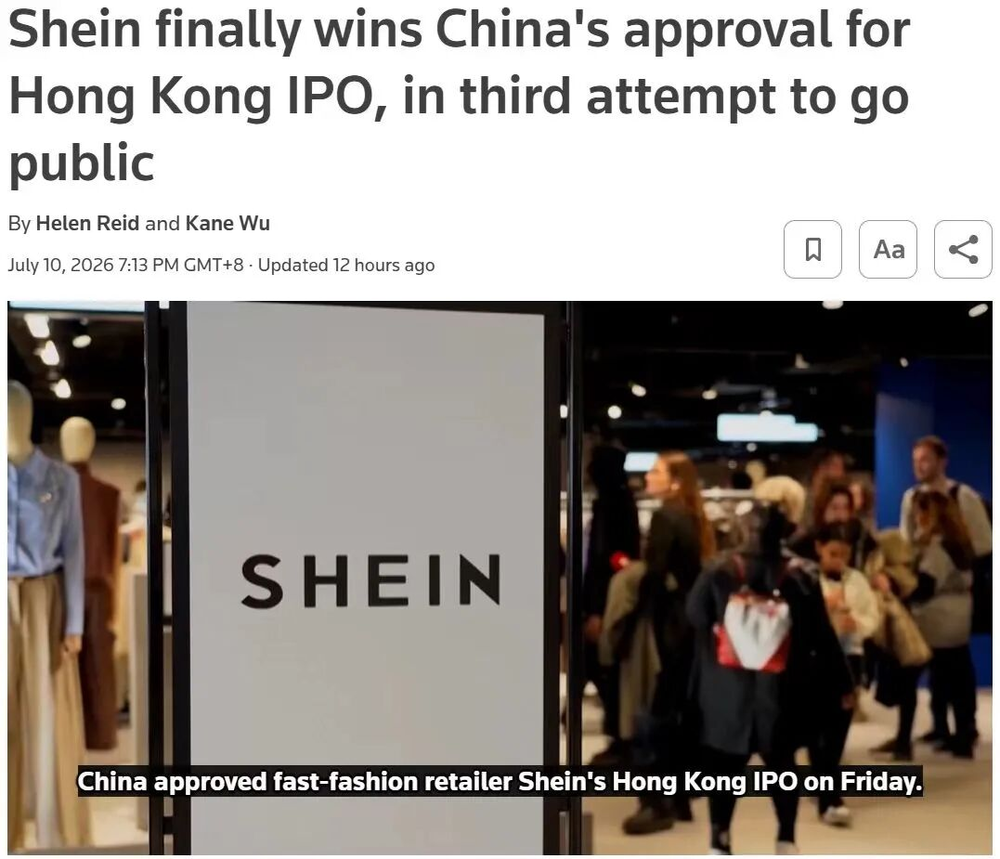
💡Understand how global regulatory shifts and intense competition are forcing a massive valuation reset for a retail giant
⚡ 30-Second TL;DR
What Changed
SHEIN plans a Hong Kong IPO to raise $2-3 billion.
Why It Matters
The shift in SHEIN's valuation reflects a broader market move away from 'growth at all costs' toward sustainable, compliant profitability for cross-border e-commerce.
What To Do Next
Analyze the 'small-batch, quick-response' supply chain model to see if it can be adapted for your own inventory-heavy AI-driven retail applications.
Who should care:Founders & Product Leaders
Key Points
- •SHEIN plans a Hong Kong IPO to raise $2-3 billion.
- •Valuation has dropped from $100B in 2022 to $40B in 2026.
- •Facing 'four little dragons' competition: Temu, AliExpress, and TikTok Shop.
- •European regulations are imposing new 'eco-taxes' on fast fashion.
🧠 Deep Insight
AI-generated analysis for this event.
🔑 Enhanced Key Takeaways
- •SHEIN has shifted its primary IPO venue strategy multiple times, initially targeting a U.S. listing in 2023 before encountering significant pushback from U.S. lawmakers regarding supply chain transparency and labor practices.
- •The company has been actively diversifying its supply chain beyond China, establishing manufacturing hubs in Turkey and Brazil to mitigate geopolitical risks and reduce import duties.
- •SHEIN's 'on-demand' manufacturing model utilizes a proprietary real-time data feedback loop that connects consumer purchasing behavior directly to small-batch production orders, minimizing inventory waste.
- •The European Union's 'Strategy for Sustainable and Circular Textiles' is specifically targeting fast-fashion platforms with new Digital Product Passport (DPP) requirements, which will mandate detailed traceability for all items sold in the bloc.
- •To improve its ESG profile ahead of the IPO, SHEIN has launched the 'evoluSHEIN' collection, which incorporates recycled polyester and has committed to a roadmap for achieving net-zero emissions by 2050.
📊 Competitor Analysis▸ Show
| Feature | SHEIN | Temu | AliExpress | TikTok Shop |
|---|---|---|---|---|
| Primary Model | On-demand/Private Label | Marketplace/Third-party | Marketplace/Third-party | Social Commerce |
| Pricing | Ultra-low | Ultra-low (Aggressive) | Low to Mid | Variable/Influencer-led |
| Supply Chain | Proprietary/Integrated | Aggregated/Direct-to-Consumer | Aggregated | Integrated/Creator-led |
| Key Strength | Trend speed/Inventory control | Customer acquisition cost | Established logistics | Viral discovery/Engagement |
🛠️ Technical Deep Dive
- Real-time Demand Sensing: Utilizes a proprietary algorithm that analyzes search trends, social media sentiment, and click-through rates to trigger production batches as small as 100-200 units.
- Automated Supply Chain Management: A centralized ERP system that provides real-time production visibility to thousands of independent workshops, allowing for dynamic capacity allocation.
- AI-Driven Design: Employs generative AI tools to assist designers in identifying emerging fashion patterns and color trends, significantly shortening the design-to-production cycle compared to traditional retail.
- Logistics Optimization: Uses predictive analytics to pre-position inventory in regional warehouses based on localized demand forecasts, reducing cross-border shipping times.
🔮 Future ImplicationsAI analysis grounded in cited sources
SHEIN will face mandatory supply chain audits in the EU by 2027.
New EU Corporate Sustainability Due Diligence Directive (CSDDD) regulations will require large companies to identify and mitigate human rights and environmental risks in their value chains.
The company's valuation will remain capped below $50B until it achieves a successful public listing.
Secondary market liquidity and investor sentiment remain cautious due to ongoing regulatory scrutiny in both the U.S. and Europe regarding cross-border data privacy and labor standards.
⏳ Timeline
2012-07
Chris Xu founds the company as SheInside, focusing on wedding dresses.
2015-06
Rebrands to SHEIN and pivots to a broader fast-fashion model.
2022-04
Company reaches a $100 billion valuation following a funding round.
2023-11
Confidential filing for a U.S. IPO is submitted to the SEC.
2024-05
Company pivots IPO focus toward the Hong Kong Stock Exchange amid U.S. regulatory hurdles.
📰
Weekly AI Recap
Read this week's curated digest of top AI events →
👉Related Updates


AI-curated news aggregator. All content rights belong to original publishers.
Original source: 虎嗅 ↗