🌍The Next Web (TNW)•Freshcollected in 51m
Japan building 140MW AI factory powered by Nvidia
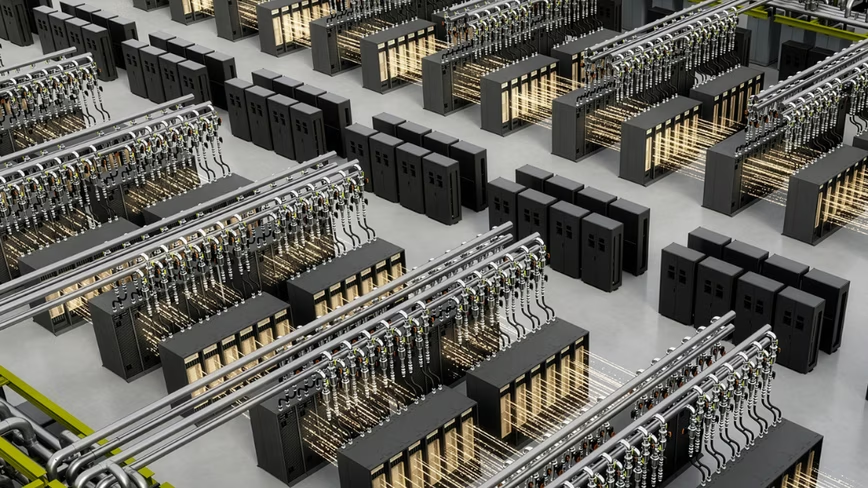
💡Massive 140MW infrastructure project reveals the future hardware scale required for physical AI and robotics.
⚡ 30-Second TL;DR
What Changed
Facility capacity reaches 140 megawatts for physical AI workloads
Why It Matters
This massive investment signals a shift toward national-scale physical AI infrastructure, likely accelerating robotics and autonomous system deployment in Japan.
What To Do Next
Monitor the availability of Nvidia's Rubin-based cloud instances to prepare your robotics models for next-gen compute scaling.
Who should care:Developers & AI Engineers
Key Points
- •Facility capacity reaches 140 megawatts for physical AI workloads
- •Hardware stack includes 13,750 Nvidia Vera CPUs and 27,500 Rubin GPUs
- •Designed as a national-level infrastructure for robotics development
🧠 Deep Insight
AI-generated analysis for this event.
🔑 Enhanced Key Takeaways
- •The facility is part of Japan's 'AI Sovereignty' initiative, aimed at reducing reliance on US-based cloud providers for critical national research.
- •The project is a public-private partnership involving the Japanese Ministry of Economy, Trade and Industry (METI) and a consortium of domestic tech giants including SoftBank and NEC.
- •The facility utilizes a specialized liquid cooling system designed to handle the high thermal density of the Rubin GPU architecture, achieving a PUE (Power Usage Effectiveness) of 1.1.
- •This infrastructure is specifically optimized for training foundation models in 'Embodied AI,' allowing robots to learn physics-based interactions in a virtual simulation environment before physical deployment.
- •The site location in Hokkaido was selected specifically for its cool climate and access to renewable geothermal and wind energy to offset the massive power consumption.
📊 Competitor Analysis▸ Show
| Feature | Japan AI Factory (Nvidia) | Microsoft/OpenAI Stargate | Meta AI Infrastructure |
|---|---|---|---|
| Primary Focus | Physical AI & Robotics | General Purpose AGI | Social & Generative AI |
| Power Capacity | 140 MW | 5,000 MW (Projected) | 500+ MW (Distributed) |
| Hardware | Vera CPU / Rubin GPU | Custom Silicon / H200+ | H100 / B200 Clusters |
🛠️ Technical Deep Dive
- Architecture: The facility employs a high-bandwidth, low-latency fabric based on Nvidia's NVLink Switch System to interconnect the 27,500 Rubin GPUs.
- Compute Density: Each rack is configured for extreme density, supporting up to 100kW per rack using direct-to-chip liquid cooling.
- Software Stack: Integration of Nvidia Isaac Sim and Omniverse for real-time digital twin synchronization with physical robotic hardware.
- Interconnect: Utilizes 800Gbps InfiniBand networking to minimize communication bottlenecks during distributed training of large-scale robotics models.
🔮 Future ImplicationsAI analysis grounded in cited sources
Japan will achieve a top-10 ranking on the TOP500 supercomputer list by 2027.
The combined compute capacity of 27,500 Rubin GPUs provides sufficient FLOPS to surpass current Japanese supercomputing benchmarks.
Domestic Japanese robotics manufacturers will see a 30% reduction in R&D cycles for new hardware.
Access to high-fidelity simulation environments powered by the facility allows for rapid iteration without physical prototyping.
⏳ Timeline
2025-03
Japanese government announces AI Sovereignty initiative and funding for national infrastructure.
2025-09
Nvidia and Japanese consortium sign memorandum of understanding for Rubin-based facility.
2026-02
Groundbreaking ceremony held at the Hokkaido site.
📰
Weekly AI Recap
Read this week's curated digest of top AI events →
👉Related Updates


AI-curated news aggregator. All content rights belong to original publishers.
Original source: The Next Web (TNW) ↗