Iron Bestie Wins Hong Kong’s AI Hackathon
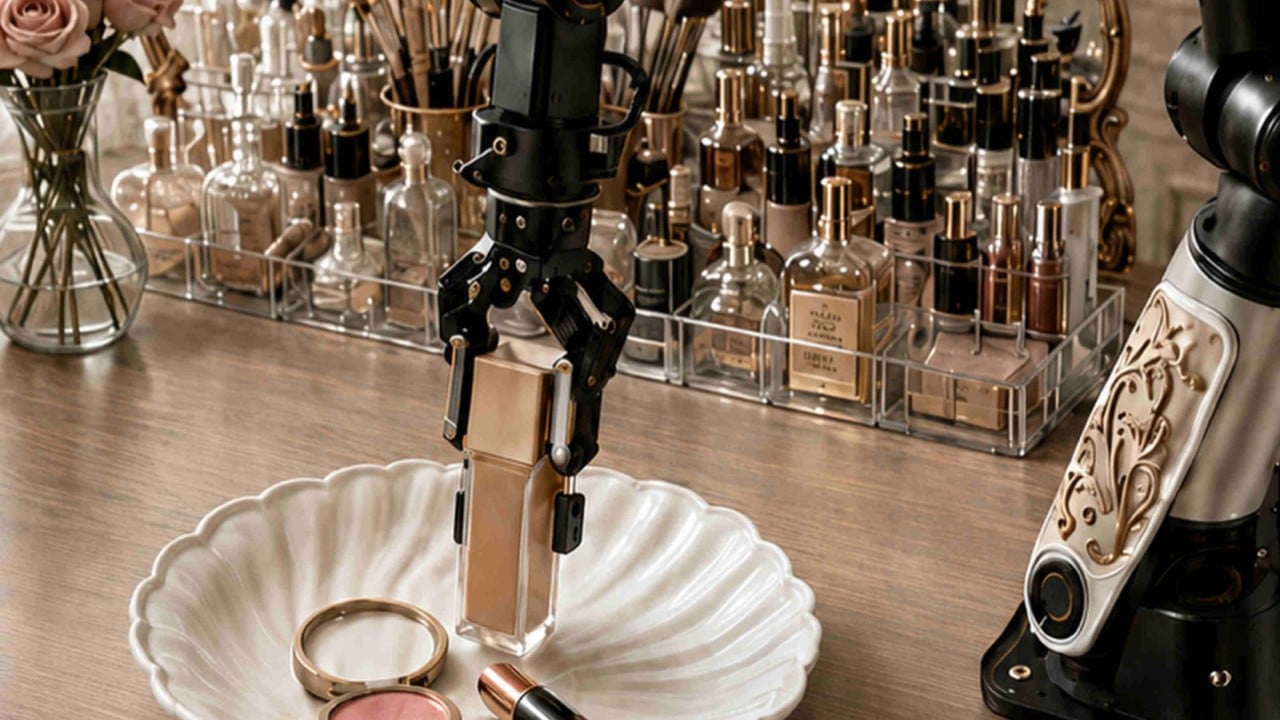
See how vision-language models and voice control turned a robotic arm into a make-up assistant.
30-Second TL;DR
What Changed
Iron Bestie combines a robotic arm with vision-language models and voice capabilities.
Why It Matters
Iron Bestie demonstrates how multimodal AI can move beyond chat interfaces into precise, safety-sensitive household robotics. Its hackathon success may encourage builders to explore personalised embodied-AI applications, although reliable manipulation and user safety remain major hurdles.
What To Do Next
Prototype a tabletop embodied-AI workflow by connecting a vision-language model and voice-command layer to a simulated robotic arm before testing cosmetic manipulation.
Key Points
- •Iron Bestie combines a robotic arm with vision-language models and voice capabilities.
- •The system is designed to pick up cosmetics and apply lipstick for a user.
- •It won first place in a 48-hour Hong Kong physical AI hackathon with more than 160 global competitors.
Deep Insight
AI-generated analysis for this event — not the original article.
Enhanced Key Takeaways
- •The hackathon was organized by the Hong Kong University of Science and Technology (HKUST) in collaboration with major industry partners to foster local AI talent.
- •Iron Bestie utilizes a specialized computer vision pipeline that maps facial landmarks in real-time to ensure precise application of cosmetics despite user movement.
- •The project team consists of undergraduate students who integrated open-source large language models (LLMs) to handle natural language processing for voice commands.
- •Safety mechanisms include a proximity sensor array that automatically halts the robotic arm if the user makes sudden movements or if the device detects an obstruction.
- •The prototype was developed using a modular hardware architecture, allowing the robotic arm to be swapped or upgraded for different beauty-related tasks beyond lipstick application.
Competitor Analysis
- Iron Bestie
- Robotic Application
- L'Oréal Perso
- Personalized Formulation
- Prinker
- Temporary Tattoo Printing
- Iron Bestie
- Voice/Vision-Language
- L'Oréal Perso
- App-based
- Prinker
- App-based
- Iron Bestie
- Prototype (N/A)
- L'Oréal Perso
- ~$299 (Est.)
- Prinker
- ~$200-$300
- Iron Bestie
- High precision/Real-time
- L'Oréal Perso
- High formulation accuracy
- Prinker
- High print speed
| Feature | Iron Bestie | L'Oréal Perso | Prinker |
|---|---|---|---|
| Primary Function | Robotic Application | Personalized Formulation | Temporary Tattoo Printing |
| Interaction | Voice/Vision-Language | App-based | App-based |
| Pricing | Prototype (N/A) | ~$299 (Est.) | ~$200-$300 |
| Benchmarks | High precision/Real-time | High formulation accuracy | High print speed |
Technical Deep Dive
- Vision-Language Model: Employs a fine-tuned vision-language model to interpret user intent and map facial geometry.
- Robotic Kinematics: Uses a 6-axis robotic arm controlled by a custom inverse kinematics solver for smooth, human-like motion.
- Voice Processing: Integrates a lightweight speech-to-text engine running locally to minimize latency during interaction.
- Calibration: Features an automated calibration routine that uses a camera-in-hand setup to align the applicator with the user's lips.
Future ImplicationsAI analysis grounded in cited sources
Timeline
- 2026-07Iron Bestie team forms for the HKUST AI Hackathon.
- 2026-08Iron Bestie wins first place at the Hong Kong physical AI hackathon.
Weekly AI Recap
Read this week's curated digest of top AI events →
Related Updates


AI-curated news aggregator. All content rights belong to original publishers.
Original source: SCMP Technology ↗
This is a summary, not the original. Read the source, or get the weekly briefing.
The weekly digest
One email a week. Unsubscribe anytime.