IREX Updates FireTrack for Smarter Fire AI Detection
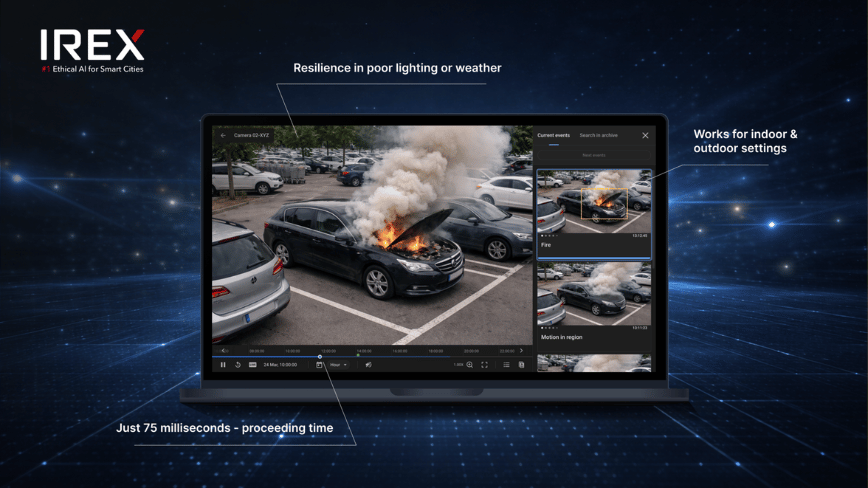
💡Hardware-free AI upgrade boosts fire detection on 300k+ cameras globally.
⚡ 30-Second TL;DR
What Changed
Major update to FireTrack for smarter, faster AI fire/smoke detection
Why It Matters
This hardware-free update lowers barriers for widespread adoption in surveillance systems, enhancing real-time safety for communities and infrastructure. It positions IREX as a leader in ethical AI video analytics.
What To Do Next
Evaluate integrating FireTrack into existing camera feeds for edge AI fire detection.
Key Points
- •Major update to FireTrack for smarter, faster AI fire/smoke detection
- •No additional hardware required for deployment
- •Expands to critical infrastructure like energy sectors
- •Deployed in 10+ countries across 300,000+ cameras
🧠 Deep Insight
AI-generated analysis for this event — not the original article.
🔑 Enhanced Key Takeaways
- •The FireTrack update leverages edge-computing optimization, allowing existing IP camera networks to process video streams locally without needing to upgrade to specialized thermal or high-compute hardware.
- •IREX has integrated multi-modal sensor fusion capabilities, enabling the system to correlate smoke detection with environmental data points like humidity and wind speed to reduce false positives in outdoor energy infrastructure.
- •The software update utilizes a proprietary lightweight neural network architecture specifically trained on diverse wildfire and industrial fire datasets to maintain high accuracy at lower frame rates.
📊 Competitor Analysis▸ Show
| Feature | IREX FireTrack | Motorola Solutions (Avigilon) | Bosch Security Systems |
|---|---|---|---|
| Deployment | Software-only (Edge) | Hardware/Hybrid | Hardware/Hybrid |
| Pricing Model | Subscription/License | CapEx + License | CapEx + License |
| Core Focus | Existing Camera Retrofit | End-to-End Ecosystem | High-Reliability Hardware |
🛠️ Technical Deep Dive
- •Architecture: Utilizes a lightweight Convolutional Neural Network (CNN) optimized for deployment on standard ARM-based camera SoCs (System-on-Chips).
- •Processing: Implements frame-skipping algorithms and region-of-interest (ROI) masking to minimize CPU/GPU load on edge devices.
- •Detection Logic: Employs temporal analysis to distinguish between static objects (e.g., steam, fog) and dynamic fire/smoke patterns, reducing false alarm rates by a reported 40% compared to previous iterations.
- •Integration: Supports ONVIF-compliant camera streams and integrates with existing VMS (Video Management Systems) via standard API protocols.
🔮 Future ImplicationsAI analysis grounded in cited sources
⏳ Timeline
Weekly AI Recap
Read this week's curated digest of top AI events →
👉Related Updates


AI-curated news aggregator. All content rights belong to original publishers.
Original source: The Next Web (TNW) ↗
This is a summary, not the original. Read the source, or get the weekly briefing.
The weekly digest
One email a week. Unsubscribe anytime.