Intel Raises $20B for Its Foundry Push
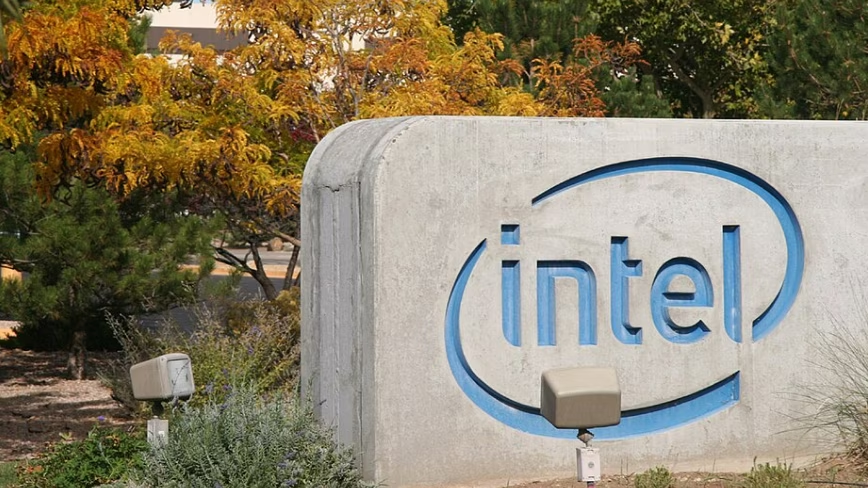
Intel’s huge raise could reshape the supplier options available for future AI chips.
30-Second TL;DR
What Changed
Intel is offering $15 billion in common stock.
Why It Matters
A stronger Intel Foundry could give AI hardware companies another manufacturing partner beyond TSMC. However, the equity raise also signals that Intel’s turnaround and process-scale ambitions require substantial external capital.
What To Do Next
Compare Intel Foundry’s process, packaging, and capacity roadmap with TSMC before committing your next AI accelerator design to a manufacturer.
Key Points
- •Intel is offering $15 billion in common stock.
- •The deal could grow to $20 billion through underwriter overallotment options.
- •The funding reinforces Intel’s strategy to become a major foundry competitor to TSMC.
Deep Insight
AI-generated analysis for this event — not the original article.
Enhanced Key Takeaways
- •The capital raise follows Intel's strategic decision to separate its product design and foundry businesses into distinct operating units to improve transparency and accountability.
- •Intel has secured significant government subsidies under the U.S. CHIPS and Science Act, which are being leveraged alongside this private capital to fund multi-billion dollar fab expansions in Ohio and Arizona.
- •The foundry push is heavily reliant on the successful deployment of High-NA EUV lithography technology, which Intel has been aggressively adopting to achieve process node parity with TSMC.
- •Market analysts note that this equity dilution is a response to high capital expenditure requirements and the need to maintain a strong balance sheet while Intel transitions to the 'Intel 18A' process node.
- •Intel's foundry services (IFS) have recently secured key external customers, including major cloud service providers and automotive chip designers, marking a shift from internal-only manufacturing.
Competitor Analysis
- Intel Foundry
- IDM 2.0 (Internal + External)
- TSMC
- Pure-play Foundry
- Samsung Foundry
- IDM + Foundry
- Intel Foundry
- Intel 18A
- TSMC
- N2 (2nm)
- Samsung Foundry
- SF2 (2nm)
- Intel Foundry
- Challenger/Expanding
- TSMC
- Market Leader
- Samsung Foundry
- Major Competitor
- Intel Foundry
- U.S./EU-based capacity
- TSMC
- Ecosystem/Yield maturity
- Samsung Foundry
- Advanced Memory Integration
| Feature | Intel Foundry | TSMC | Samsung Foundry |
|---|---|---|---|
| Primary Strategy | IDM 2.0 (Internal + External) | Pure-play Foundry | IDM + Foundry |
| Leading Node | Intel 18A | N2 (2nm) | SF2 (2nm) |
| Market Position | Challenger/Expanding | Market Leader | Major Competitor |
| Key Advantage | U.S./EU-based capacity | Ecosystem/Yield maturity | Advanced Memory Integration |
Technical Deep Dive
- Intel 18A process node utilizes RibbonFET gate-all-around (GAA) transistor architecture to improve power efficiency and performance.
- Implementation of PowerVia backside power delivery technology separates power and signal routing, reducing IR drop and increasing transistor density.
- Adoption of High-NA EUV (Extreme Ultraviolet) lithography tools to enable finer feature scaling beyond traditional EUV capabilities.
- Utilization of Foveros 3D packaging technology to integrate heterogeneous chiplets into a single package, targeting high-performance computing and AI workloads.
Future ImplicationsAI analysis grounded in cited sources
Timeline
- 2021-03Intel announces IDM 2.0 strategy and the creation of Intel Foundry Services (IFS).
- 2022-08U.S. CHIPS and Science Act is signed into law, providing federal support for Intel's domestic manufacturing.
- 2024-02Intel holds its first 'Direct Connect' foundry event, detailing the roadmap for 18A and beyond.
- 2025-05Intel begins initial high-volume manufacturing trials using High-NA EUV lithography.
- 2026-08Intel announces a $15B-$20B common-stock offering to accelerate foundry expansion.
Event Coverage
Weekly AI Recap
Read this week's curated digest of top AI events →
Related Updates


AI-curated news aggregator. All content rights belong to original publishers.
Original source: The Next Web (TNW) ↗
This is a summary, not the original. Read the source, or get the weekly briefing.
The weekly digest
One email a week. Unsubscribe anytime.