Intel All-Big-Core Core 2 Series Launches Sans Retail
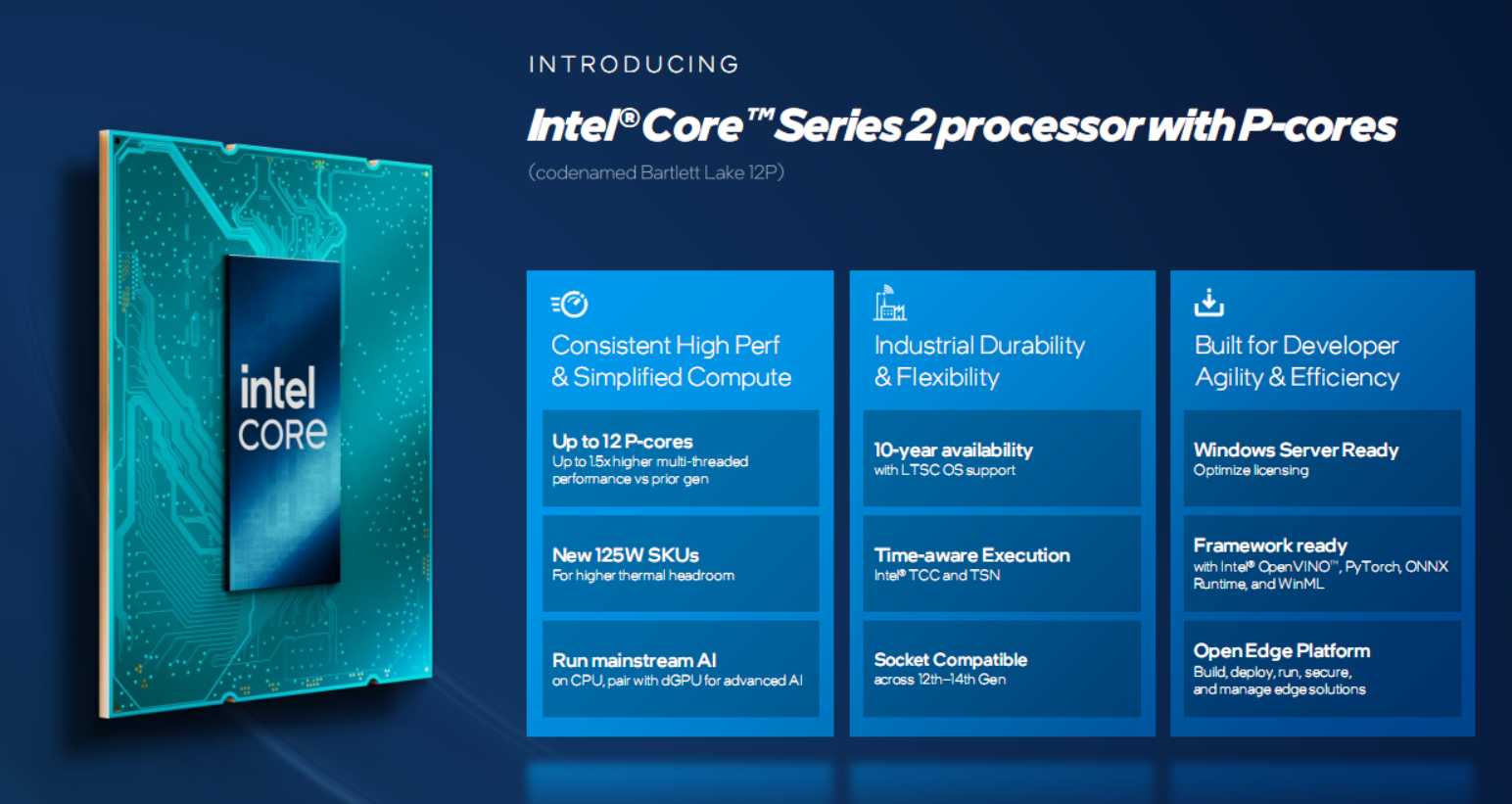
💡Intel's pure P-core CPU for desktops launches – ideal for uniform AI compute loads.
⚡ 30-Second TL;DR
What Changed
All P-cores, no E-cores design
Why It Matters
Offers high-performance alternative for hybrid-averse users in workstations. Reinforces Intel's hybrid future while providing all-big-core option for specific needs like consistent threading in AI workloads.
What To Do Next
Benchmark Bartlett Lake Xeon in your workstation for consistent multi-threaded AI inference.
Key Points
- •All P-cores, no E-cores design
- •Codenamed Bartlett Lake
- •Targets desktops and gaming laptops
- •Not available for retail
🧠 Deep Insight
Background and context from public sources — not the original article. 5 sources cited.
🔑 Enhanced Key Takeaways
- •Bartlett Lake processors use LGA1700 socket for compatibility with existing 600/700-series motherboards[1][4][5].
- •Top model Core 9 273PQE features 12 Raptor Cove P-cores, 3.4 GHz base clock, up to 5.9 GHz single-core boost, 36 MB L3 cache, and 125W TDP[2][4][5].
- •Targeted at embedded, edge servers, real-time applications, and industrial markets with vPro and ECC memory support, not consumer retail[1][3][4].
- •Includes integrated Intel UHD Graphics with 32 execution units and supports DDR5 up to 5600 MT/s with up to 192GB capacity[1][5].
📊 Competitor Analysis▸ Show
| Feature | Intel Core 9 273PE (65W) | AMD Ryzen 7 9700X (embedded) |
|---|---|---|
| PCIe Latency | Up to 4.4x lower max | Baseline |
| Deterministic Response Time | 2.5x more | Baseline |
| Deterministic Performance | 3.8x better | Baseline |
🛠️ Technical Deep Dive
- •LGA1700 socket compatibility with 600/700-series chipsets[1][4][5].
- •Raptor Cove P-cores only (no E-cores); models include 12-core (273PQE: 3.4/5.9/5.3 GHz, 125W), 10-core (253PQE: 3.5/5.7/5.2 GHz, 125W), 8-core (223PQE: 4.0/5.5/5.3 GHz, 125W), and 65W variants[2][4][5].
- •L3 cache: 36MB (12-core), 33MB (10-core), 24MB (8-core); 32 EUs Xe-LP iGPU[2][3][4].
- •Memory: DDR4/DDR5 up to 5600 MT/s, 192GB max with ECC; PCIe Gen5/Gen4; 2.5GbE with TSN[1][5].
- •vPro support, no consumer optimizations like APO/IPO[3][4].
🔮 Future ImplicationsAI analysis grounded in cited sources
⏳ Timeline
📎 Sources (5)
Factual claims are grounded in the sources below. Forward-looking analysis is AI-generated interpretation.
- premioinc.com — What Is Intel Bartlett Lake
- hwcooling.net — Bartlett Lake Intels P Core Only Cpus Models and Specs
- techolam.com — Intels Bartlett Lake S a High Performance Cpu with Limited Consumer Access
- Tom's Hardware — Intel Bartlett Lake S Cpus Reportedly Wield 12 Blazing P Cores and 5 8 Ghz Boost Turbocharged Chips That Will Not Make It to Retail
- Tom's Hardware — Intel Keeps Socket Lga 1700 Alive with New P Core Only Cpus Bartlett Lake Is Official but Targets Embedded Applications with Up to 12 Cores
Weekly AI Recap
Read this week's curated digest of top AI events →
👉Related Updates




AI-curated news aggregator. All content rights belong to original publishers.
Original source: cnBeta (Full RSS) ↗
This is a summary, not the original. Read the source, or get the weekly briefing.
Weekly AI briefing
One email a week. Unsubscribe anytime.