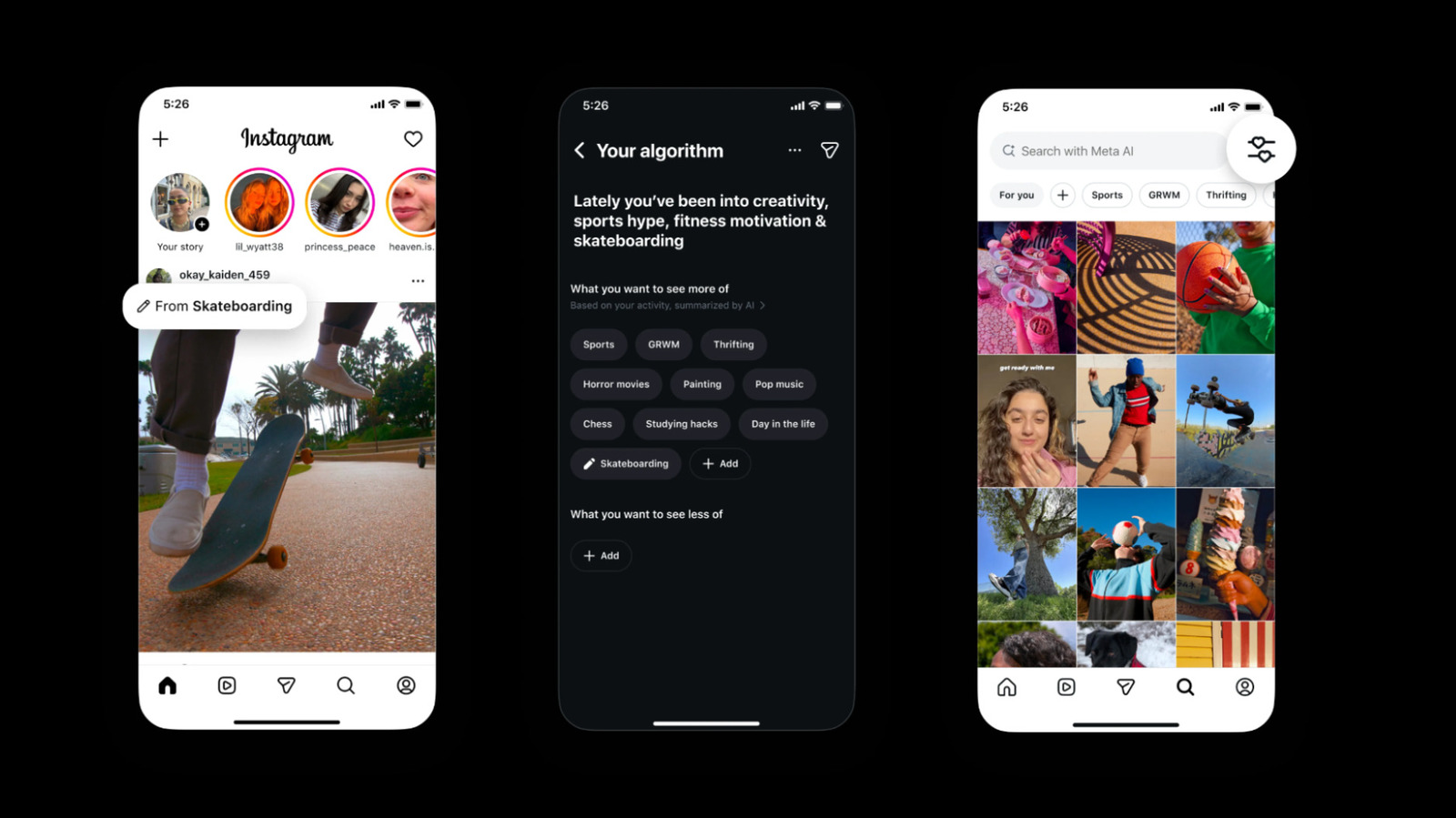
Instagram expands algorithm personalization to main feed
💡Understand how major social platforms are tuning recommendation engines to balance discovery and user retention.
⚡ 30-Second TL;DR
What Changed
Algorithm personalization now on main feed
Why It Matters
This change shifts the balance between algorithmic discovery and social graph priority. It forces creators to adapt to a more dynamic recommendation environment.
What To Do Next
Monitor your engagement metrics to see how these algorithm changes affect your reach and adjust your content strategy accordingly.
Key Points
- •Algorithm personalization now on main feed
- •Users gain more control over content discovery
- •Potential trade-off with visibility of followed accounts
🧠 Deep Insight
Background and context from public sources — not the original article. 22 sources cited.
🔑 Enhanced Key Takeaways
- •Instagram's algorithm is not a singular system but comprises multiple AI-driven ranking systems tailored for different sections of the app, including the main Feed, Reels, Stories, and Explore page, each prioritizing distinct user behaviors and content types.
- •The platform has fundamentally shifted to a "recommendation-first" approach, increasingly prioritizing content based on an "interest graph" (what users engage with) over the traditional "social graph" (accounts users follow), especially in the main feed and Reels.
- •A significant update in 2026 emphasizes "Sends Per Reach" (private shares via Direct Messages) as the strongest signal of content value, alongside "Views" becoming the primary metric for content performance across all formats.
- •Instagram now actively penalizes "aggregator" accounts that repost content without adding substantial original value, indicating a push to prioritize and reward original creators.
- •The user control features, initially launched in December 2025 as "Your Algorithm" for Reels, allow users to explicitly select topics they are interested in or want to see less of, moving from a passive feedback system to direct user influence over content recommendations.
📊 Competitor Analysis▸ Show
Competitor Analysis: Algorithmic Personalization
| Feature/Platform | Instagram (Post-2026 Update) | TikTok | YouTube | |
|---|---|---|---|---|
| Core Algorithm Focus | Multi-algorithm system (Feed, Reels, Stories, Explore) with a shift to recommendation-first, prioritizing user interests and explicit feedback. Strong emphasis on 'Sends' (private shares) and 'Views'. | "Magic Algorithm" for For You Page (FYP), highly personalized based on 100+ signals, focusing on rapid content consumption and trend detection. | AI-powered Feed, prioritizing "meaningful social interactions" and content from connections, alongside a "Discovery Feed" for recommended content. | Deep learning recommendation system, predicting next watch and session watch time, prioritizing user satisfaction and engagement depth. |
| User Control over Feed | Expanded personalization to main feed; users can select topics to see more/less of. "Your Algorithm" feature allows direct influence over recommendations. | Highly personalized FYP that evolves with user interests; users can mark "Not Interested" or select initial interest categories. | Users can provide feedback (e.g., hide post, unfollow), and the algorithm adapts, but direct topic selection is less prominent than Instagram's new feature. | Users can mark "Not Interested" or "Don't Recommend Channel"; explicit feedback surveys and account settings influence recommendations. |
| Key Ranking Signals | Sends (DMs), Views, engagement history, content type, recency, originality (penalizes aggregators), user-selected topics. | Watch time, video completion rate, likes, shares, comments, accounts followed, video information (captions, hashtags, sounds), user information (language, country). | Who posted, content type, engagement (likes, comments, shares), recency, meaningful interactions. | Watch time, click-through rate, satisfaction surveys, rewatches, session continuation, search behavior, contextual data. |
| Impact on Creators | Requires hyper-specific content, focus on shareability, and continuous adaptation to user-defined interests. Generalist accounts may struggle. | Rewards engaging, short-form video content with high watch time and completion rates; niche relevance is increasingly important. | Encourages content that sparks discussion and authentic engagement; understanding audience behavior is key for reach. | Focus on viewer satisfaction and sustained watch time; packaging (thumbnails) gets clicks, but content quality sustains distribution. |
🛠️ Technical Deep Dive
- Instagram's recommendation system employs a "two-tower model" architecture, where one neural network processes user features and another processes content features. Both are encoded into a shared, high-dimensional vector space.
- The content recommendation process operates in multiple stages: initially, a candidate generation phase narrows down billions of potential posts to thousands, followed by a ranking phase that further refines these to the dozens displayed to the user.
- "Embeddings" are crucial, representing users and content as vectors in this shared space, allowing the system to identify similar users and content by their proximity in the vector space.
- The algorithm integrates both historical user patterns and real-time signals, such as recent likes or the current time of day, to generate highly personalized rankings.
- User features, including stable profile data (demographics, long-term interests) and real-time interactions (e.g., last 50 interactions, current session activity), are assembled into a feature vector. This vector is then processed by the user tower to produce a user embedding vector, often 128-dimensional.
- Candidate retrieval involves parallel execution of multiple sources, including Approximate Nearest Neighbor (ANN) search within the embedding index (yielding ~500 candidates), collaborative filtering (adding ~200 "users like you also watched" candidates), and popularity-based sources (adding ~100 trending candidates).
🔮 Future ImplicationsAI analysis grounded in cited sources
⏳ Timeline
📎 Sources (22)
Factual claims are grounded in the sources below. Forward-looking analysis is AI-generated interpretation.
Weekly AI Recap
Read this week's curated digest of top AI events →
👉Related Updates

AI-curated news aggregator. All content rights belong to original publishers.
Original source: Engadget ↗
This is a summary, not the original. Read the source, or get the weekly briefing.
The weekly digest
One email a week. Unsubscribe anytime.