Insta360 vs DJI: The Intense Drone Imaging War
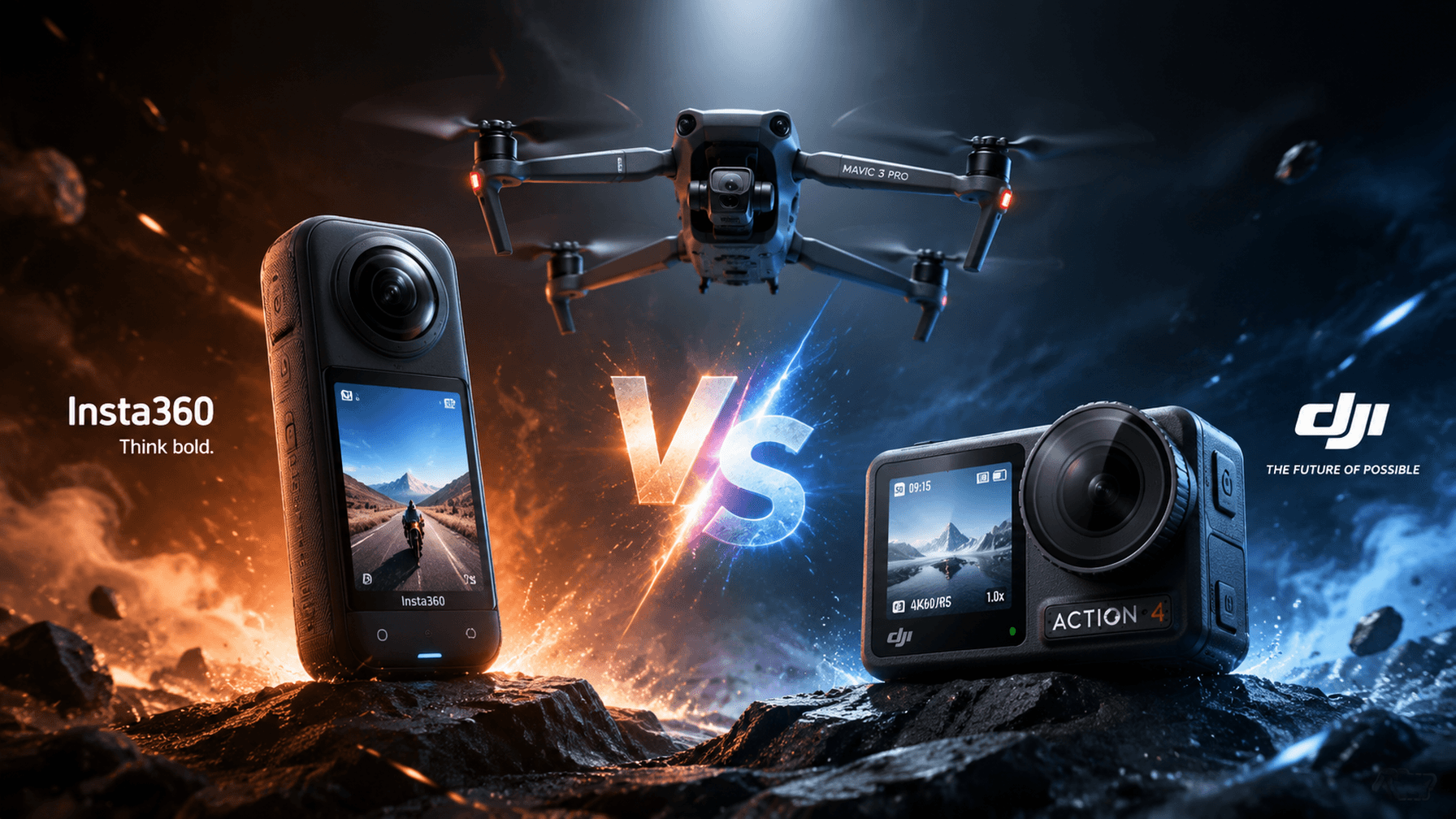
💡Understand how the DJI-Insta360 rivalry is driving hardware innovation for aerial AI and computer vision platforms.
⚡ 30-Second TL;DR
What Changed
Insta360 and DJI are engaged in a high-stakes battle for drone camera market share.
Why It Matters
This rivalry is accelerating the pace of innovation in drone imaging hardware, forcing faster product cycles and lower costs for consumers and developers building aerial AI applications.
What To Do Next
Monitor the patent filings of both companies to identify emerging hardware stabilization techniques for your own drone-based computer vision projects.
Key Points
- •Insta360 and DJI are engaged in a high-stakes battle for drone camera market share.
- •The conflict involves complex patent lawsuits and aggressive pricing strategies.
- •Talent wars are intensifying as both companies fight to secure top engineering resources.
🧠 Deep Insight
Background and context from public sources — not the original article. 35 sources cited.
🔑 Enhanced Key Takeaways
- •The patent litigation between Insta360 and DJI escalated significantly in June 2026, with DJI filing lawsuits against Insta360's newly launched Luna Ultra camera for alleged design and utility patent infringements related to its Osmo Pocket series. Insta360 promptly retaliated with two countersuits, claiming DJI infringes on five of its utility patents covering gimbal stabilization, directional controls, smooth stabilization, telemetry overlays, and panoramic video stabilization, technologies used across DJI's Osmo Pocket, Ronin, RS, and Osmo 360 product lines.
- •Insta360 has strategically diversified its offerings by launching a new, independent drone brand called "Antigravity" in collaboration with third parties, with its first product being an 8K 360 drone, directly challenging DJI's established dominance in the drone market.
- •The intense competition has led to significant shifts in market share within the broader action and panoramic camera sectors; by Q1-Q3 2025, DJI had captured 66% of the action camera market, with Insta360 holding 13%, while GoPro's share dropped to 18%. In the panoramic camera segment, where Insta360 was historically dominant, DJI's entry with the Osmo 360 in July 2025 quickly secured 49% market share in China's e-commerce channels, closely trailing Insta360's 47%.
- •Insta360's innovative product strategy includes developing "invisible drone" cameras like the Insta360 Sphere, which is specifically designed to attach to existing DJI drones (such as the Mavic Air 2/2S) to capture 360-degree footage where the drone itself is automatically removed from the shot using proprietary stitching algorithms.
- •Despite experiencing over 90% revenue growth in Q3 2025, Insta360's profit margins have been significantly compressed, reportedly to 3.4%, due to the aggressive price wars and rising raw material costs, indicating the high financial stakes of this market battle.
📊 Competitor Analysis▸ Show
| Feature/Product | Insta360 Sphere | Insta360 Ace Pro | DJI Mavic 3 Cine | DJI Osmo 360 |
|---|---|---|---|---|
| Category | Drone 360 Camera Accessory | Action Camera (FPV drone compatible) | Professional Drone Camera System | Panoramic Camera |
| Key Feature | "Invisible drone" 360 footage, FlowState Stabilization | 8K/24fps, 1/1.3" Leica sensor, superior low-light | Dual camera (4/3" Hasselblad + Tele), Apple ProRes, 1TB SSD | 8K panoramic video, direct competitor to Insta360 X5 |
| Resolution (Video) | 5.7K/30fps (360) | 8K/24fps, 4K/120fps | 5.1K/50fps, DCI 4K/120fps | 8K (panoramic) |
| Stabilization | FlowState Stabilization | FlowState Stabilization (built-in) | 3-axis mechanical gimbal | Panoramic video stabilization (subject of patent dispute) |
| Compatibility | DJI Mavic Air 2/2S drones | Universal mounts, FPV drones | Integrated into Mavic 3 Cine drone | Standalone / Osmo ecosystem |
| Launch Date | May 2022 | November 2023 | November 2021 (Mavic 3 series) | July 2025 |
| Market Position | Niche 360 drone accessory, leverages existing DJI drones | Strong competitor in action camera market, gaining share from GoPro | High-end professional drone imaging, market leader in consumer drones | Rapidly gaining share in panoramic camera market |
🛠️ Technical Deep Dive
- Insta360 Sphere: Features two rugged metal hemispheres housing two cameras that capture footage simultaneously. It utilizes a proprietary dynamic stitching algorithm to ensure the drone is invisible in the resulting 360-degree footage. The camera offers FlowState Stabilization and AI features such as Horizontal Flip, Tiny Planet, Sky Transition, Deep Track, FPV Roll, and Dolly Zoom. It records photos at 6080x3040 (2:1) resolution and video at 5760x2880@30/25/24fps (5.7K), 3840x1920@50/30fps, and 3008x1504@100fps. It has a runtime of approximately 48 minutes and is not waterproof.
- DJI Mavic 3 Cine: Equipped with a dual-camera system mounted on a 3-axis gimbal. The main Hasselblad camera features a 20MP 4/3" CMOS sensor, a 24mm equivalent focal length, and an adjustable aperture from f/2.8 to f/11. The secondary telephoto camera has a 12MP 1/2" CMOS sensor with 7x optical zoom and up to 28x hybrid zoom. It supports video recording up to 5.1K/50fps and DCI 4K/120fps, with the Cine version offering Apple ProRes 422 HQ codec and 10-bit D-Log color profile, along with a 1TB internal SSD. The drone utilizes DJI's O3+ transmission system for a 15km range and 1080p/60fps live feed, and includes 360-degree omnidirectional obstacle avoidance.
- Insta360 Ace Pro: A wide-angle action camera co-engineered with Leica, featuring a 1/1.3-inch sensor. It can record video at 8K/24fps and 4K/120fps. Key features include FlowState stabilization, a dedicated PureVideo low-light shooting mode, AI Highlights Assistant, AI Warp, gesture and voice control, and a magnetic mounting system. It also boasts a 2.4-inch flip-out touchscreen.
🔮 Future ImplicationsAI analysis grounded in cited sources
⏳ Timeline
📎 Sources (35)
Factual claims are grounded in the sources below. Forward-looking analysis is AI-generated interpretation.
- notebookcheck.net
- hypebeast.com
- dronedj.com
- mashable.com
- reddit.com
- insta360.com
- vice.com
- kr-asia.com
- 36kr.com
- moomoo.com
- 36kr.com
- dronenerds.com
- bhphotovideo.com
- insta360.com
- dpreview.com
- insta360.com
- scmp.com
- biggo.com
- dronexl.co
- firstquadcopter.com
- bhphotovideo.com
- cliftoncameras.co.uk
- printables.com
- oscarliang.com
- videomaker.com
- accio.com
- amateurphotographer.com
- wikipedia.org
- aboutphotography.blog
- carmarthencameras.com
- dji.com
- aboutphotography.blog
- dronelife.com
- businessmodelcanvastemplate.com
- businessmodelcanvastemplate.com
Weekly AI Recap
Read this week's curated digest of top AI events →
👉Related Updates

AI-curated news aggregator. All content rights belong to original publishers.
Original source: Pandaily ↗
This is a summary, not the original. Read the source, or get the weekly briefing.
Weekly AI briefing
One email a week. Unsubscribe anytime.