India's first private rocket reaches orbit on debut launch
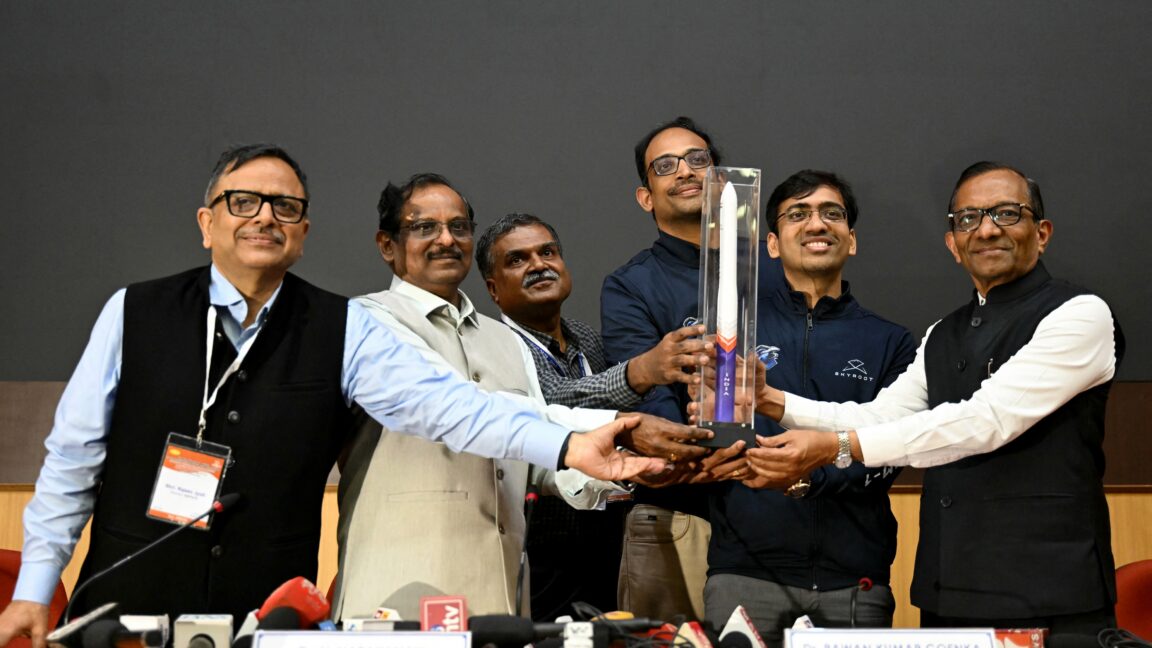
💡India's private space sector breakthrough could lower launch costs for AI-enabled satellite constellations.
⚡ 30-Second TL;DR
What Changed
First successful orbital insertion by an Indian private aerospace company.
Why It Matters
This success signals a shift in the global space economy, potentially lowering costs for satellite deployments and increasing access for AI-driven earth observation startups.
What To Do Next
Monitor the launch provider's payload capacity and launch frequency to evaluate potential integration for edge-computing satellite constellations.
Key Points
- •First successful orbital insertion by an Indian private aerospace company.
- •Demonstrates rapid maturation of private sector aerospace capabilities in India.
- •Validates the feasibility of low-cost, privately-led launch vehicle development.
🧠 Deep Insight
AI-generated analysis for this event — not the original article.
🔑 Enhanced Key Takeaways
- •The launch was executed by Skyroot Aerospace using the Vikram-1 launch vehicle, which utilizes a multi-stage solid propulsion system.
- •The mission, designated 'Prarambh-Orbital', successfully deployed a constellation of three nanosatellites into a 500km Sun-Synchronous Orbit (SSO).
- •Skyroot Aerospace is the first Indian private entity to utilize the Indian Space Research Organisation's (ISRO) launch infrastructure under the IN-SPACe regulatory framework.
- •The Vikram-1 rocket features a unique 3D-printed cryogenic engine for its upper stage, significantly reducing manufacturing time and component count.
- •This achievement follows the successful suborbital test flight of the Vikram-S rocket conducted in November 2022, which served as a technology demonstrator.
📊 Competitor Analysis▸ Show
| Feature | Skyroot (Vikram-1) | Rocket Lab (Electron) | Agnikul Cosmos (Agnibaan) |
|---|---|---|---|
| Payload Capacity | ~300kg to LEO | ~300kg to LEO | ~100kg to LEO |
| Propulsion | Solid/Cryogenic | Liquid (Rutherford) | Semi-Cryogenic (3D Printed) |
| Status | Operational (2026) | Operational | Testing/Early Ops |
🛠️ Technical Deep Dive
- Vehicle Architecture: Four-stage configuration utilizing solid fuel for the first three stages and a cryogenic liquid engine for the final orbital insertion stage.
- Propulsion System: The upper stage utilizes a vacuum-optimized cryogenic engine fueled by Liquid Natural Gas (LNG) and Liquid Oxygen (LOX).
- Structural Material: Carbon-composite airframe designed for high strength-to-weight ratio and rapid manufacturing.
- Avionics: Integrated autonomous flight termination system and AI-driven guidance, navigation, and control (GNC) suite.
🔮 Future ImplicationsAI analysis grounded in cited sources
⏳ Timeline
Weekly AI Recap
Read this week's curated digest of top AI events →
👉Related Updates
AI-curated news aggregator. All content rights belong to original publishers.
Original source: Ars Technica ↗
This is a summary, not the original. Read the source, or get the weekly briefing.
The weekly digest
One email a week. Unsubscribe anytime.