Import AI 451: Superintelligence, Google Minds, Robot Drummer

💡Google's 'society of minds' + robot drummer in Import AI 451: must-read AI trends.
⚡ 30-Second TL;DR
What Changed
Discusses political implications of superintelligent AI systems
Why It Matters
This newsletter keeps AI practitioners updated on high-level research trends, Google's strategic shifts, and embodied AI demos, aiding in anticipating industry directions. It underscores the irreversible nature of AI progress.
What To Do Next
Subscribe to Import AI and read issue 451 for Google's latest multi-agent insights.
Key Points
- •Discusses political implications of superintelligent AI systems
- •Highlights Google's multi-agent 'society of minds' approach
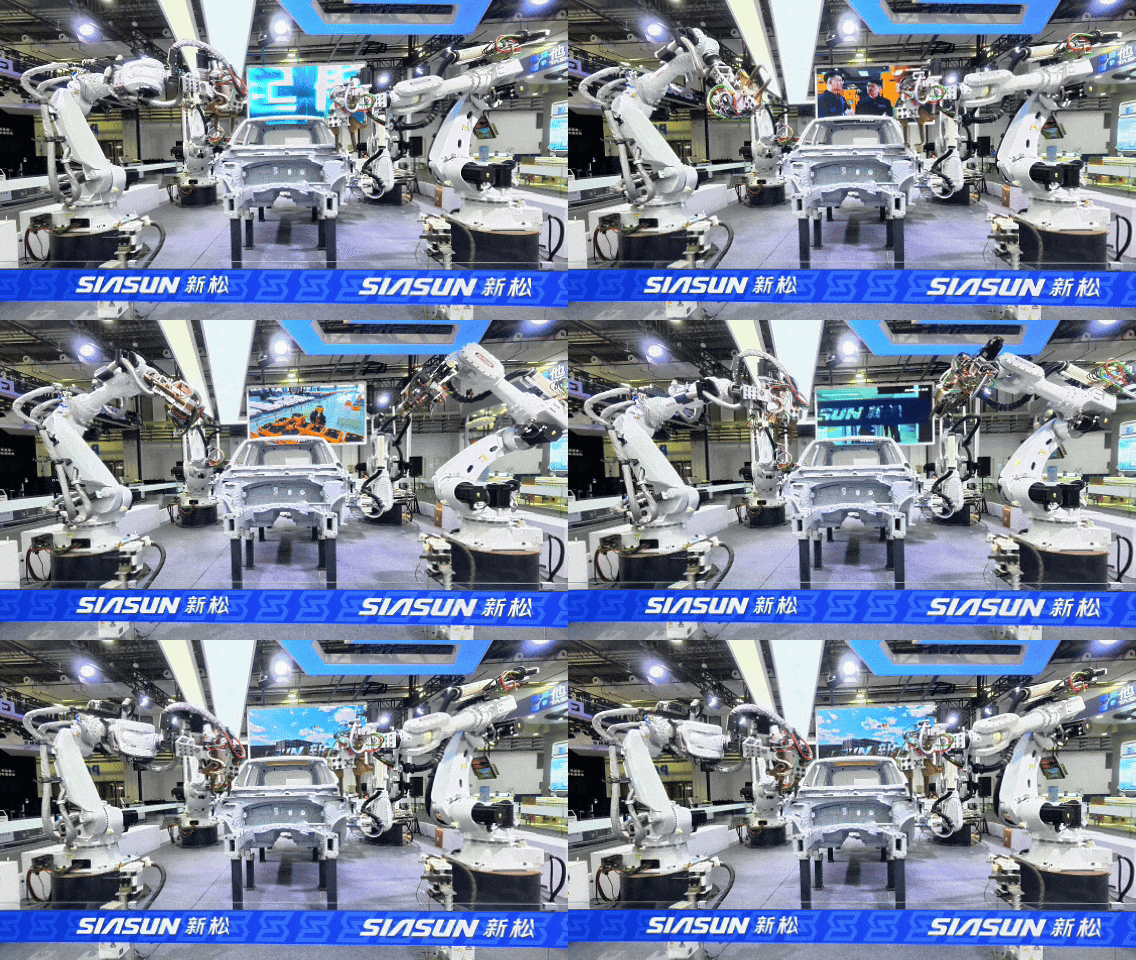
- •Showcases robotics advancement with a drumming robot
- •Questions reversibility of AI 'genies' once released
🧠 Deep Insight
AI-generated analysis for this event — not the original article.
🔑 Enhanced Key Takeaways
- •The 'society of minds' architecture referenced in Import AI 451 builds upon the concept of multi-agent systems where specialized sub-models collaborate to solve complex tasks, moving away from monolithic LLM architectures.
- •The political superintelligence discussion in this issue aligns with emerging academic frameworks regarding 'AI governance at scale,' specifically focusing on how autonomous agents might influence democratic processes or policy-making.
- •The drumming robot demonstration highlights advancements in real-time sensorimotor integration, specifically the latency reduction required for robots to synchronize with human musical performance.
🛠️ Technical Deep Dive
- •Society of Minds Architecture: Utilizes a decentralized framework where individual agents possess distinct 'personas' or specialized knowledge bases, orchestrated by a central 'manager' agent to resolve conflicts and synthesize outputs.
- •Robot Drummer Control Loop: Employs high-frequency feedback loops (likely >1kHz) to process auditory input and adjust actuator torque in real-time, minimizing the temporal gap between sound perception and physical strike.
- •Multi-Agent Coordination: Implements consensus algorithms or game-theoretic approaches to ensure that sub-agents within the 'society' do not produce contradictory information during complex reasoning tasks.
🔮 Future ImplicationsAI analysis grounded in cited sources
⏳ Timeline
Weekly AI Recap
Read this week's curated digest of top AI events →
👉Related Updates
AI-curated news aggregator. All content rights belong to original publishers.
Original source: Import AI ↗
This is a summary, not the original. Read the source, or get the weekly briefing.
Weekly AI briefing
One email a week. Unsubscribe anytime.