IBM Commits $10B+ to Quantum Computing Roadmap
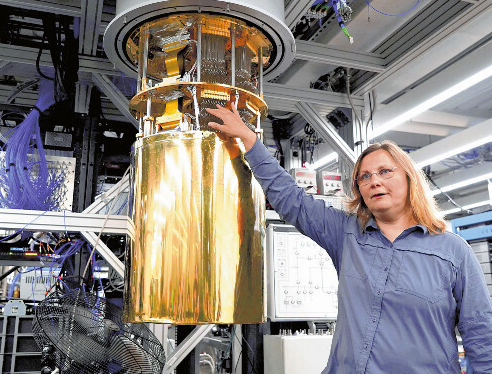
💡IBM's $10B bet on 2029 fault-tolerant quantum computing could redefine the future of AI compute and cryptography.
⚡ 30-Second TL;DR
What Changed
Investment of $10 billion over 5 years for quantum R&D
Why It Matters
This massive capital injection signals a shift from experimental quantum physics to industrial-scale engineering, potentially accelerating breakthroughs in AI optimization and material science.
What To Do Next
Monitor IBM's Qiskit documentation for updates on fault-tolerant algorithm development to prepare for future quantum-classical hybrid workflows.
Key Points
- •Investment of $10 billion over 5 years for quantum R&D
- •Focus on scaling manufacturing and ecosystem partnerships
- •Targeting a large-scale fault-tolerant quantum computer by 2029
- •Strategic goal to maintain US leadership in quantum technology
🧠 Deep Insight
Background and context from public sources — not the original article. 15 sources cited.
🔑 Enhanced Key Takeaways
- •The $10 billion investment is partially supported by approximately $1 billion in federal incentive funds from the U.S. government, provided through the CHIPS and Science Act.
- •A key condition of the government funding requires IBM to establish a new company called "Anderon" in New Albany, New York, which will build the United States' first 300mm wafer foundry dedicated to producing quantum chips, operating as an open foundry for external customers.
- •IBM aims to achieve a practical demonstration of "quantum advantage" by the end of 2026, signifying a quantum computer's ability to outperform classical supercomputers in solving specific real-world problems.
- •The roadmap includes the IBM Quantum Starling system, targeted for delivery by 2029, which is projected to perform 20,000 times more operations than current quantum computers, executing 100 million quantum operations on 200 logical qubits.
- •Beyond the Starling system, IBM plans for a future system named IBM Quantum Blue Jay, designed to handle one billion quantum operations across 2,000 logical qubits.
🛠️ Technical Deep Dive
- IBM's fault-tolerant modular architecture is based on bivariate bicycle (BB) codes, a type of quantum low-density parity check (qLDPC) codes, which are designed to reduce physical qubit overhead.
- The [[144,12,12]] gross code, an example of IBM's qLDPC codes, encodes 12 logical qubits into 144 data qubits and 144 syndrome check qubits (totaling 288 physical qubits), offering a 10x reduction in qubit requirements compared to surface codes for similar error correction capabilities.
- The IBM Quantum Starling system, slated for 2029, is expected to feature approximately 200 logical qubits and be capable of executing 100 million gate operations.
- Starling's development roadmap includes demonstrating magic state injection with multiple modules by 2028.
- IBM has introduced a reference architecture for Quantum-Centric Supercomputing (QCSC), which integrates Quantum Processing Units (QPUs) with classical GPUs and CPUs into a unified computing stack.
- The QCSC architecture is structured into four functional layers: application, application middleware (utilizing the Qiskit software ecosystem), system orchestration (managed by the Quantum Resource Management Interface - QRMI), and hardware infrastructure.
- Current IBM quantum processors include IBM Quantum Heron, a 156-qubit processor that forms the core of the System Two architecture, and Nighthawk, a 120-qubit processor with a square lattice connectivity.
- IBM has successfully demonstrated quantum chips with up to 1,121 qubits, such as the Condor chip released in December 2023.
- Error mitigation techniques employed by IBM include dynamical decoupling, which inserts pulse sequences on idling qubits to suppress coherent errors, and Pauli twirling, which transforms quantum channels into Pauli channels to mitigate coherent noise.
🔮 Future ImplicationsAI analysis grounded in cited sources
⏳ Timeline
📎 Sources (15)
Factual claims are grounded in the sources below. Forward-looking analysis is AI-generated interpretation.
Weekly AI Recap
Read this week's curated digest of top AI events →
👉Related Updates
AI-curated news aggregator. All content rights belong to original publishers.
Original source: cnBeta (Full RSS) ↗
This is a summary, not the original. Read the source, or get the weekly briefing.
The weekly digest
One email a week. Unsubscribe anytime.