💼VentureBeat•Stalecollected in 25m
Hybrid Retrieval Intent Triples in Enterprise RAG
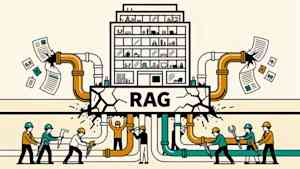
💡RAG scale walls hit: hybrid intent 3x up—rebuild retrieval or fall behind enterprises
⚡ 30-Second TL;DR
What Changed
Hybrid retrieval intent tripled from 10.3% to 33.3% in Q1 2026
Why It Matters
Enterprises scaling RAG face retrieval quality failures, driving a rebuild toward hybrid strategies for agentic AI. This pressures vector DB vendors and boosts integrated platforms, signaling infrastructure maturation.
What To Do Next
Benchmark hybrid retrieval by integrating BM25 keyword search with your vector DB to boost RAG accuracy.
Who should care:Enterprise & Security Teams
Key Points
- •Hybrid retrieval intent tripled from 10.3% to 33.3% in Q1 2026
- •Standalone vector DBs (Weaviate, Milvus, Pinecone, Qdrant) lost adoption share
- •Custom stacks rose to 35.6% adoption
- •Retrieval optimization overtook evaluation as top investment at 28.9%
- •22% of enterprises lack production RAG systems
🧠 Deep Insight
AI-generated analysis for this event.
🔑 Enhanced Key Takeaways
- •The shift toward hybrid retrieval is driven by the 'semantic gap' in pure vector search, where dense embeddings often fail to retrieve precise technical documentation or specific entity names that keyword-based BM25 handles effectively.
- •Enterprises are increasingly adopting 'Reranking' layers (such as Cohere Rerank or BGE-Reranker) as a standard component of the retrieval pipeline to mitigate the noise introduced by multi-stage hybrid retrieval.
- •The decline in standalone vector database adoption is correlated with the rise of 'all-in-one' database platforms (e.g., PostgreSQL with pgvector, MongoDB Atlas Vector Search) which reduce infrastructure complexity and data synchronization overhead for enterprise teams.
📊 Competitor Analysis▸ Show
| Feature | Standalone Vector DBs (e.g., Pinecone) | Provider-Native (e.g., pgvector) | Custom Stacks (e.g., LangChain/LlamaIndex) |
|---|---|---|---|
| Deployment | Managed SaaS | Integrated into existing DB | Modular/Code-based |
| Hybrid Support | Native (Sparse/Dense) | Requires extension/config | Highly customizable |
| Pricing | Usage-based/High TCO | Included in DB cost | Infrastructure/Dev cost |
| Performance | High (Optimized) | Moderate | Variable (Dev dependent) |
🛠️ Technical Deep Dive
- •Hybrid retrieval architectures typically employ Reciprocal Rank Fusion (RRF) to combine scores from dense vector search (semantic) and sparse keyword search (lexical).
- •Implementation often involves a two-stage pipeline: 1) Retrieval (Candidate generation via vector + BM25), 2) Reranking (Cross-encoder model to score top-k results).
- •Custom stacks frequently utilize frameworks like LlamaIndex to orchestrate 'RouterQueryEngines' that dynamically select between vector, keyword, or hybrid retrieval based on query intent classification.
- •The move toward provider-native solutions often leverages HNSW (Hierarchical Navigable Small World) indexing integrated directly into relational database engines to maintain ACID compliance alongside vector search.
🔮 Future ImplicationsAI analysis grounded in cited sources
Standalone vector database vendors will pivot to 'RAG-as-a-Service' platforms.
To survive the commoditization of vector storage, vendors must move up the stack to provide end-to-end retrieval optimization and evaluation tools.
Hybrid retrieval will become the default baseline for all enterprise RAG systems by 2027.
The performance delta between pure vector search and hybrid approaches in production environments is too significant for enterprises to ignore as they scale.
⏳ Timeline
2023-05
Initial surge in standalone vector database funding and enterprise interest.
2024-09
Emergence of 'RAG scaling issues' as a primary topic in enterprise AI conferences.
2025-03
Major cloud providers integrate native vector search into relational databases, triggering market share shifts.
2026-01
Industry-wide pivot toward retrieval optimization and hybrid search architectures.
📰
Weekly AI Recap
Read this week's curated digest of top AI events →
👉Related Updates



AI-curated news aggregator. All content rights belong to original publishers.
Original source: VentureBeat ↗