Humanoid Robots Power Japan’s AI Data Factory
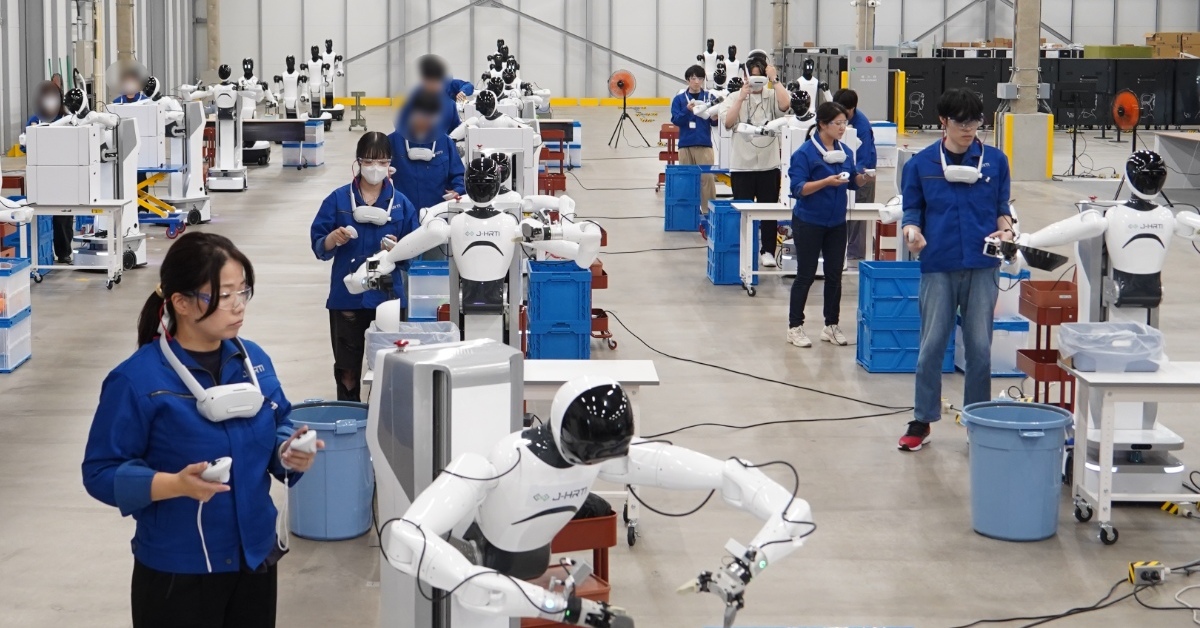
💡See how Japan is scaling the overlooked data-collection layer behind embodied AI.
⚡ 30-Second TL;DR
What Changed
J-HRTI Kanto Data Factory is now operating as a dedicated physical-AI data collection site.
Why It Matters
The facility highlights that physical-AI progress depends not only on models and hardware, but also on large-scale, repeatable real-world data collection. It could signal growing demand for specialized robotics data operations in Japan.
What To Do Next
Benchmark your robotics data pipeline against J-HRTI’s approach by defining repeatable manipulation tasks, sensor schemas, and quality checks before scaling collection.
Key Points
- •J-HRTI Kanto Data Factory is now operating as a dedicated physical-AI data collection site.
- •The facility contains approximately 30 humanoid robots working in parallel.
- •Robots repeatedly perform tasks to generate training data for embodied AI systems.
🧠 Deep Insight
Background and context from public sources — not the original article. 6 sources cited.
🔑 Enhanced Key Takeaways
- •The J-HRTI Kanto Data Factory is part of a broader Japanese national strategy to address a projected 11 million worker shortfall by 2040.
- •The facility aligns with the June 2026 METI and NEDO initiative to develop sovereign multimodal foundation models for Physical AI.
- •Data collected at the facility is intended to feed into a domestic ecosystem that integrates hardware from firms like NSK with advanced Physical AI software.
- •The operation supports the Japanese government's target of deploying 10 million robots across 18 industrial sectors by 2040.
- •The facility serves as a critical infrastructure node for the collaborative-control platform recently initiated by Fujitsu, FANUC, Yaskawa, and Kawasaki Heavy Industries.
📊 Competitor Analysis▸ Show
| Competitor | Focus Area | Key Partnership |
|---|---|---|
| Highlanders, Inc. | Mass-production humanoids | Mitsubishi Motors |
| Dexmate (VEGA) | Industrial Physical AI | NEC Corporation |
| GMO AI & Robotics | Airport/Service logistics | Japan Airlines (JAL) |
| Shimizu Corp | Construction-specific robotics | Internal R&D |
🛠️ Technical Deep Dive
- Focuses on embodied AI training through high-repetition task execution in human-centric environments.
- Utilizes domestic actuator testing data to optimize hardware-software synchronization.
- Integrates with sovereign multimodal foundation models developed under the METI/NEDO program.
- Employs collaborative-control frameworks designed to be interoperable with major industrial robotics standards (FANUC/Yaskawa/Kawasaki).
🔮 Future ImplicationsAI analysis grounded in cited sources
⏳ Timeline
📎 Sources (6)
Factual claims are grounded in the sources below. Forward-looking analysis is AI-generated interpretation.
Weekly AI Recap
Read this week's curated digest of top AI events →
👉Related Updates



AI-curated news aggregator. All content rights belong to original publishers.
Original source: ITmedia AI+ (日本) ↗
This is a summary, not the original. Read the source, or get the weekly briefing.
Weekly AI briefing
One email a week. Unsubscribe anytime.