Humanoid robot aces factory floor POC test
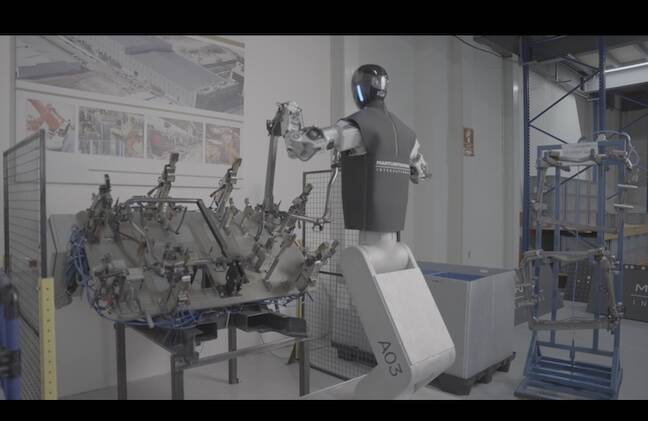
💡POC proves rolling humanoids viable for factories—embodied AI milestone for devs
⚡ 30-Second TL;DR
What Changed
UK Humanoid completes POC for rolling robot in auto manufacturing
Why It Matters
Advances embodied AI towards practical manufacturing automation, potentially disrupting autoworker jobs while boosting efficiency. Signals growing commercial viability for wheeled humanoid prototypes in factories.
What To Do Next
Prototype wheeled humanoid bases like Humanoid's for your factory automation pilots
Key Points
- •UK Humanoid completes POC for rolling robot in auto manufacturing
- •Torso-on-trolley design traverses factory floor successfully
- •Targets warehouse tasks in production environments
- •Demonstrates viability for humanoid robots in industry
🧠 Deep Insight
AI-generated analysis for this event — not the original article.
🔑 Enhanced Key Takeaways
- •The robot, developed by Engineered Arts, utilizes the 'Ameca' platform, which has been adapted for industrial logistics by replacing its lower limbs with a modular wheeled base to prioritize stability and battery efficiency over bipedal locomotion.
- •The proof-of-concept focused on 'pick-and-place' operations, specifically integrating with existing Warehouse Management Systems (WMS) via proprietary API middleware to synchronize robot movements with human-operated forklift traffic.
- •Engineered Arts is positioning this rolling variant as a 'bridge' solution, aiming to lower the barrier to entry for manufacturers who require the dexterity of a humanoid torso but cannot yet justify the complexity and safety certification costs of fully bipedal robots.
📊 Competitor Analysis▸ Show
| Feature | Engineered Arts (Rolling) | Tesla Optimus | Figure AI |
|---|---|---|---|
| Locomotion | Wheeled Base | Bipedal | Bipedal |
| Primary Focus | Human-Robot Interaction | Mass Production/General Purpose | Industrial/Logistics |
| Pricing | Subscription/Lease | Estimated $20k-$30k | Undisclosed |
| Benchmarks | High dexterity/Low mobility | High mobility/High autonomy | High payload/High speed |
🛠️ Technical Deep Dive
- •Architecture: Utilizes a modular torso design based on the Ameca platform, featuring 52 actuators for high-fidelity facial and upper-body expression, repurposed here for fine motor control.
- •Mobility: The trolley base employs a differential drive system with LiDAR-based SLAM (Simultaneous Localization and Mapping) for navigation in dynamic environments.
- •Control System: Implements a hybrid control architecture where high-level task planning is handled by a cloud-based LLM/VLM (Vision Language Model) for object recognition, while low-level motor control is managed by local real-time embedded controllers.
- •Safety: Integrated with an emergency stop system that interfaces with factory-wide safety protocols, including physical bumpers and ultrasonic proximity sensors for obstacle avoidance.
🔮 Future ImplicationsAI analysis grounded in cited sources
⏳ Timeline
Weekly AI Recap
Read this week's curated digest of top AI events →
👉Related Updates

AI-curated news aggregator. All content rights belong to original publishers.
Original source: The Register - AI/ML ↗
This is a summary, not the original. Read the source, or get the weekly briefing.
Weekly AI briefing
One email a week. Unsubscribe anytime.