Humanoid Robot Prices Drop Below 10,000 RMB
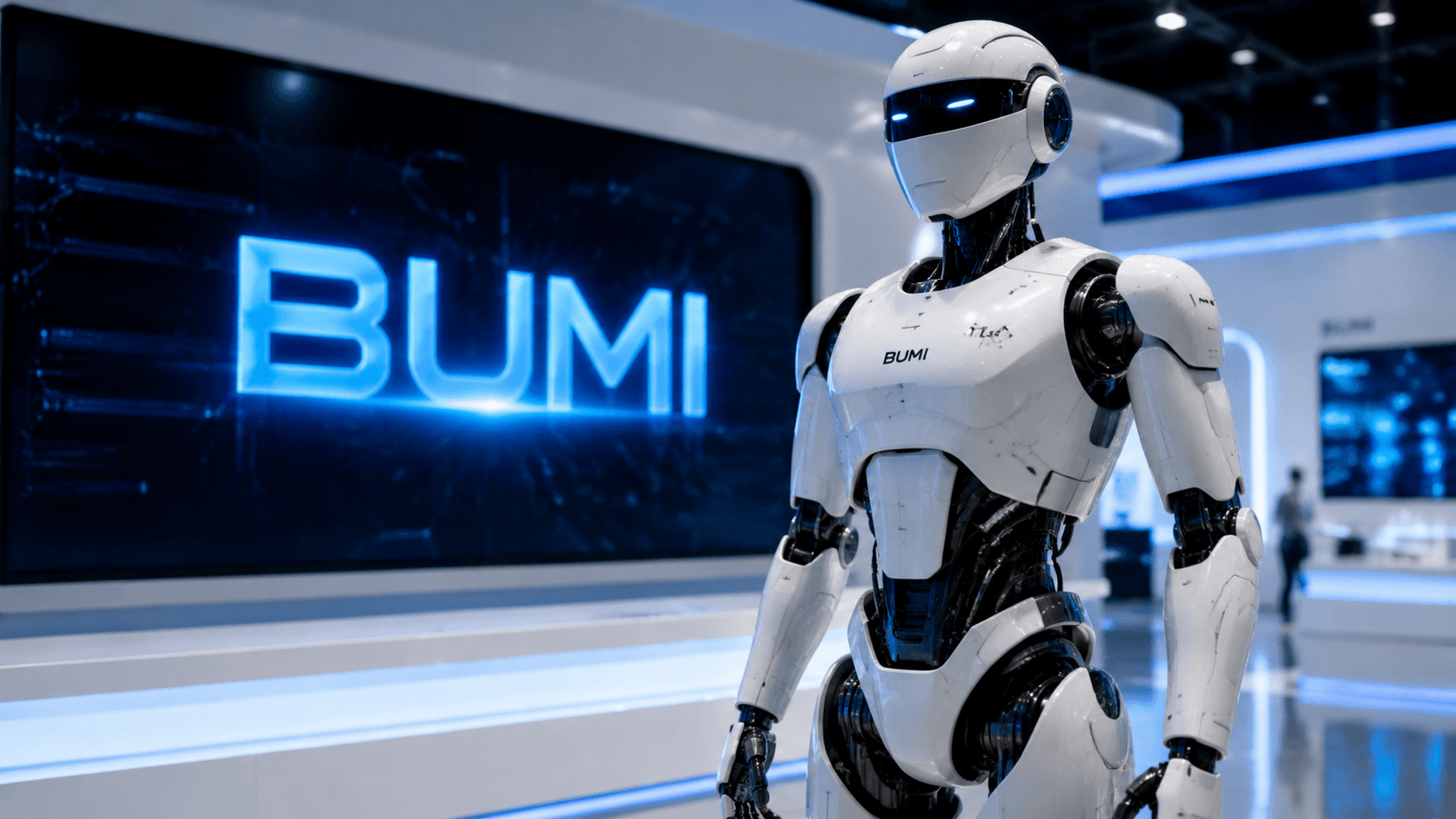
💡Hardware costs are crashing, making embodied AI data collection accessible for developers and researchers.
⚡ 30-Second TL;DR
What Changed
Unit prices for humanoid robots have fallen below the 10,000 RMB threshold.
Why It Matters
The democratization of humanoid hardware will accelerate the development of embodied AI by providing affordable platforms for large-scale data collection and model training.
What To Do Next
Evaluate low-cost humanoid hardware platforms to begin collecting real-world interaction data for your embodied AI models.
Key Points
- •Unit prices for humanoid robots have fallen below the 10,000 RMB threshold.
- •Cost reduction is driven by China's mature manufacturing and supply chain ecosystem.
- •Strategic industry shift focuses on mass data collection rather than industrial-grade precision.
🧠 Deep Insight
Background and context from public sources — not the original article. 27 sources cited.
🔑 Enhanced Key Takeaways
- •The price reduction is exemplified by specific models like Noetix Robotics' Bumi, launched at 9,998 RMB (approximately $1,408 USD), and Unitree's R1, priced at 26,900 RMB (approximately $3,968 USD), making advanced robotics accessible to a broader market.
- •China's dominance in the humanoid robot supply chain, controlling 63% of key component companies (including actuators, motors, and magnets), and leveraging its electric vehicle (EV) supply chain for shared components like batteries and lidar, significantly drives down manufacturing costs.
- •The strategic shift towards data collection is a core driver, with low-cost robots facilitating early adoption and generating vast amounts of real-world data essential for training generalist embodied AI models; companies like AgiBot are actively establishing 'data factories' for this purpose.
- •Domestic component substitution has been critical, with Chinese production rates for high-cost components such as reducers, servo systems, and controllers, which constitute over 70% of a humanoid robot's total cost, now reaching 75-90%.
- •The affordability is also achieved through deliberate engineering downgrades in lower-cost models, which may sacrifice extreme industrial environmental tolerance, limit single-arm payloads to around 2 kg, and offer shorter battery life (1-2 hours) compared to high-end industrial counterparts.
📊 Competitor Analysis▸ Show
| Company/Model | Price (RMB/USD) | Key Features | Height/Weight | Degrees of Freedom (DOF) | Target Market |
|---|---|---|---|---|---|
| Noetix Robotics Bumi | 9,998 RMB / ~$1,408 USD | Child-sized, basic locomotion, no hands, open programming interfaces | 94 cm / 12 kg | N/A (basic) | Education, Entertainment, Consumer |
| Unitree R1 | 26,900 RMB / ~$3,968 USD | Advanced mobility (walks, flips, balances), voice recognition, real-time visual input, open SDK | 165 cm / 25 kg | 26 | Developers, Research, Enthusiasts |
| Unitree G1 | ~$13,500 - $30,000 USD | Compact, locomotion, manipulation capabilities, depth camera + 3D LiDAR | 132 cm / 35 kg | 23-43 | Research, Development Platform |
| Astribot T1 / Xingchen Intelligence T1 | 89,900 RMB / ~$13,200 USD | N/A (limited public details) | N/A | N/A | N/A |
| UBTech U1 (Consumer-grade) | 128,000 RMB / ~$18,800 USD (presale) | Emotional companionship, affective AI, 88 highly mobile joints, encrypted memory storage | 168-183 cm / 35.2-42 kg | 88 | Consumer (emotional companion) |
| UBTech Walker S2 (Industrial) | ~$80,000 - $120,000 USD (estimated for Walker S) | Industrial-grade mobility, dexterous manipulation, autonomous battery swap, Co-Agent system, BrainNet 2.0 AI | 176 cm / 70 kg | 52 | Smart Factories, Logistics, Industrial |
| Xiaomi CyberOne | $89,000 - $104,000 USD | Emotion recognition (85 sounds, 45 emotions), 3D vision system, bipedal motion | 177 cm / 52 kg | 21 | Internal development, limited commercial availability |
| Fourier Intelligence GR-1 | ~$150,000 USD (research unit) | Research and rehabilitation, pure vision solution (6 RGB cameras, BEV, Transformer, Occupancy Network) | 165 cm / 55 kg | N/A | Research, Education, Rehabilitation |
🛠️ Technical Deep Dive
- Component Sourcing and Integration: Unitree's G1 humanoid robots utilize rotary actuator joints with permanent magnet synchronous motors, often sourced from the same supply chain as new energy vehicles. Reducers are made from standard industrial components, depth cameras from Intel, lidar from DJI, and main control chips from Rockchip.
- Cost Reduction Strategies: Noetix Robotics achieved its low-cost Bumi robot through vertical integration, designing its own control boards and motor drivers in-house, and through material innovation, replacing heavy metal frames with lighter composite materials reinforced only where necessary.
- Degrees of Freedom and Actuation: The Unitree R1 features 26 degrees of freedom (DOF) and incorporates custom direct-drive actuators for fluid, dynamic movements like handstands, cartwheels, and fall recovery.
- Perception and AI Architecture: The UBTech Walker S2 is equipped with dual-RGB stereo vision, fisheye cameras, and deep-learning depth estimation for real-time 3D spatial mapping. Its AI system combines UBTech's Co-Agent system and BrainNet 2.0 for multimodal reasoning and autonomous control.
- Vision-based Navigation: Fourier Intelligence's GR-1 Pro employs a pure vision solution that integrates BEV (Bird's Eye View), Transformer models, and Occupancy Network to perceive its environment using six RGB cameras, generating a real-time 3D occupancy grid for enhanced navigation.
🔮 Future ImplicationsAI analysis grounded in cited sources
⏳ Timeline
📎 Sources (27)
Factual claims are grounded in the sources below. Forward-looking analysis is AI-generated interpretation.
- chinadaily.com.cn
- scmp.com
- youtube.com
- futura-sciences.com
- humanoid.guide
- merics.org
- mckinsey.com
- invesco.com
- grabarobot.com
- youtube.com
- htx.com
- reddit.com
- pandaily.com
- youtube.com
- futurobots.com
- unitree.com
- sixthtone.com
- robotsinternational.com
- robotshop.com
- qviro.com
- therobotreport.com
- robozaps.com
- humanoidindex.org
- roboticscenter.ai
- indiamart.com
- therobotreport.com
- roboticscenter.ai
Weekly AI Recap
Read this week's curated digest of top AI events →
👉Related Updates

AI-curated news aggregator. All content rights belong to original publishers.
Original source: Pandaily ↗
This is a summary, not the original. Read the source, or get the weekly briefing.
Weekly AI briefing
One email a week. Unsubscribe anytime.