Hugging Face Launches a $399 Open Robot Duck
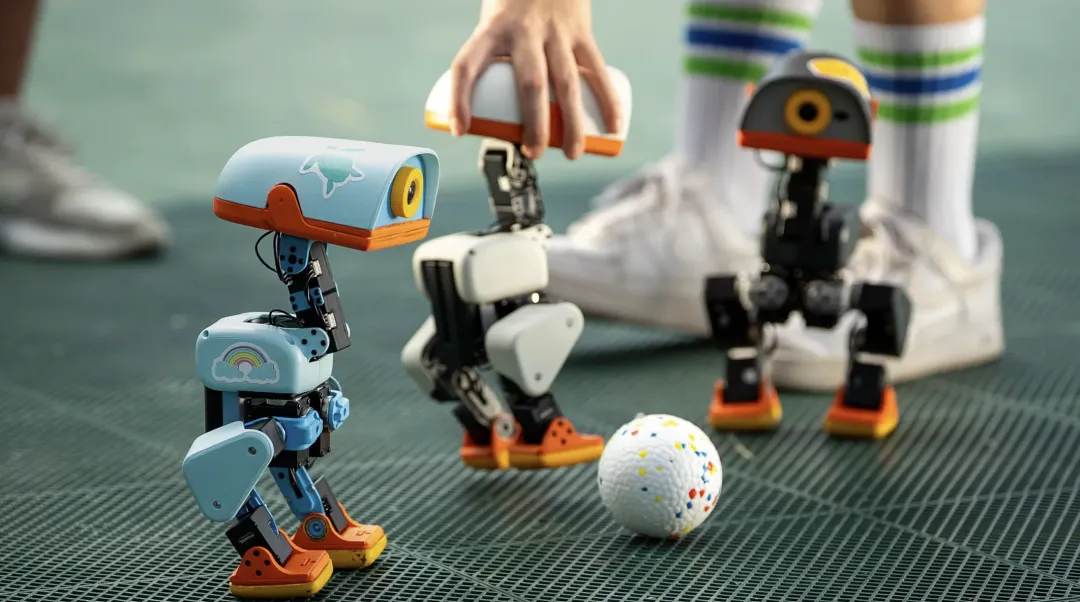
💡A $399 robot turns reinforcement-learning experiments into a shareable, physical platform for developers.
⚡ 30-Second TL;DR
What Changed
Microduck includes seven pretrained reinforcement-learning behaviors, including walking, self-righting, grabbing objects, kicking, and skating.
Why It Matters
Microduck lowers the cost and complexity of experimenting with reinforcement learning and sim-to-real robotics. For Hugging Face, it offers a potential community flywheel in which users train, share, and reuse physical-world behavior policies.
What To Do Next
Clone the Microduck SDK and MuJoCo environment when available, then reproduce one pretrained behavior in simulation before attempting sim-to-real deployment.
Key Points
- •Microduck includes seven pretrained reinforcement-learning behaviors, including walking, self-righting, grabbing objects, kicking, and skating.
- •The robot supports hands-on interaction through a game controller, camera-based laser tracking, NFC-triggered behaviors, and detachable roller skates.
- •Its SDK, MuJoCo simulation environment, training pipeline, and behavior policies are released under Apache 2.0.
- •Pollen Robotics keeps the hardware designs and circuit schematics closed, creating an open software ecosystem around proprietary hardware.
🧠 Deep Insight
Background and context from public sources — not the original article. 14 sources cited.
🔑 Enhanced Key Takeaways
- •Pollen Robotics, the developer of Microduck, was officially acquired by Hugging Face in 2025 to bolster its physical AI and robotics division.
- •The robot utilizes a complex sensor suite including a camera, LiDAR, and dual inertial measurement units (IMUs) to facilitate spatial awareness.
- •Microduck achieved significant commercial traction immediately upon launch, generating over $2.6 million in pre-order revenue within the first 24 hours.
- •The product is designed specifically to bypass the 'uncanny valley' effect by utilizing a non-humanoid, duck-like aesthetic to improve user comfort in domestic settings.
- •Microduck serves as the successor to the 'Reachy Mini,' marking Hugging Face's second foray into the consumer-facing robotics hardware market.
📊 Competitor Analysis▸ Show
| Feature | Microduck | Reachy Mini | Open Duck Mini |
|---|---|---|---|
| Pricing | $399 | ~$3,000+ | DIY/Variable |
| Form Factor | Bipedal Duck | Desktop Arm | Duck-inspired |
| Primary Use | RL Research | Research/Education | Hobbyist/DIY |
| Hardware | Closed | Open | Open |
🛠️ Technical Deep Dive
- Actuation: Features 15 individual motors for precise movement and balance.
- Payload: Capable of lifting objects weighing up to 800 grams using its beak mechanism.
- Sensor Suite: Integrated camera, LiDAR, and dual IMUs for environmental perception.
- Workflow: Employs a sim-to-real pipeline where policies are trained in MuJoCo and deployed via Hugging Face Jobs.
- Software: SDK and reinforcement learning stack are hosted on GitHub under Apache 2.0 licensing.
🔮 Future ImplicationsAI analysis grounded in cited sources
⏳ Timeline
📎 Sources (14)
Factual claims are grounded in the sources below. Forward-looking analysis is AI-generated interpretation.
Weekly AI Recap
Read this week's curated digest of top AI events →
👉Related Updates
AI-curated news aggregator. All content rights belong to original publishers.
Original source: 极客公园 ↗
This is a summary, not the original. Read the source, or get the weekly briefing.
Weekly AI briefing
One email a week. Unsubscribe anytime.