Huawei HarmonyOS Expanding into Robotics
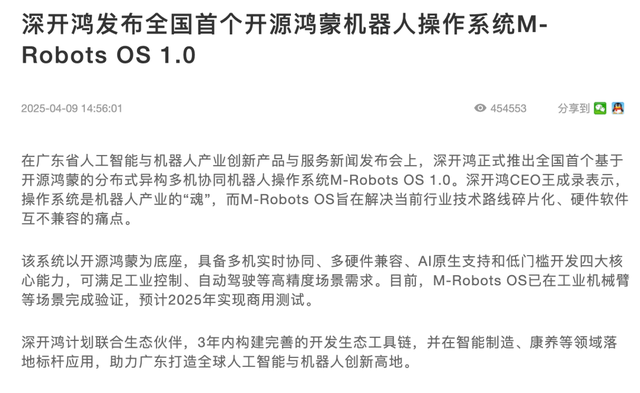
💡Huawei is bringing its massive OS ecosystem to robotics—a major step for embodied AI development.
⚡ 30-Second TL;DR
What Changed
HarmonyOS is expanding its reach from mobile and automotive to robotics.
Why It Matters
This move could accelerate the standardization of humanoid and service robot development in China, providing a unified OS for developers to build on top of.
What To Do Next
Explore the HarmonyOS developer documentation for robotics to see how you can port your existing AI models to their distributed framework.
Key Points
- •HarmonyOS is expanding its reach from mobile and automotive to robotics.
- •The strategy aims to leverage the existing 1.3 billion device ecosystem.
- •Huawei is seeking to standardize the 'brain' of robots using its OS.
🧠 Deep Insight
AI-generated analysis for this event — not the original article.
🔑 Enhanced Key Takeaways
- •Huawei is utilizing the 'HarmonyOS Robotics' framework to enable cross-device distributed computing, allowing robots to offload complex AI processing tasks to nearby edge servers or high-performance Huawei devices.
- •The initiative focuses on the 'Hongmeng' (HarmonyOS) kernel's microkernel architecture, which provides the low-latency, real-time communication capabilities essential for industrial and humanoid robot motor control.
- •Huawei has established a dedicated 'Robotics Innovation Lab' in Shenzhen to collaborate with domestic manufacturing partners on integrating HarmonyOS into robotic arms and autonomous mobile robots (AMRs).
- •The platform incorporates Huawei's Pangu AI models directly into the OS layer, providing robots with enhanced multimodal perception and natural language processing capabilities out of the box.
- •Huawei is promoting an open-source version of its robotics middleware, aiming to create a unified hardware abstraction layer (HAL) to reduce fragmentation in the Chinese robotics industry.
📊 Competitor Analysis▸ Show
| Feature | Huawei HarmonyOS Robotics | NVIDIA Isaac / Jetson | ROS 2 (Open Source) |
|---|---|---|---|
| Core Focus | Ecosystem/OS Integration | AI Compute/Simulation | Middleware/Communication |
| Hardware Lock-in | High (Huawei/Partner chips) | High (NVIDIA GPUs) | Low (Agnostic) |
| Real-time OS | Microkernel (Native) | RTOS (via partners) | Middleware (OS-dependent) |
| Market Strategy | Unified Device Ecosystem | High-Performance AI/Compute | Industry Standard Research |
🛠️ Technical Deep Dive
- Distributed Soft Bus: Enables seamless data sharing between robot sensors and external Huawei compute nodes with sub-millisecond latency.
- Microkernel Architecture: Decouples hardware drivers from the OS core to improve system stability and security in mission-critical robotic operations.
- Pangu-Robotics Model: A specialized version of the Pangu LLM integrated into the OS for task planning, object recognition, and human-robot interaction.
- Hardware Abstraction Layer (HAL): Standardizes interfaces for actuators, LiDAR, and camera modules to ensure compatibility across diverse robotic form factors.
- Deterministic Latency Engine: Optimizes task scheduling within the HarmonyOS kernel to ensure real-time response for motion control loops.
🔮 Future ImplicationsAI analysis grounded in cited sources
⏳ Timeline
Weekly AI Recap
Read this week's curated digest of top AI events →
👉Related Updates


AI-curated news aggregator. All content rights belong to original publishers.
Original source: 钛媒体 ↗
This is a summary, not the original. Read the source, or get the weekly briefing.
Weekly AI briefing
One email a week. Unsubscribe anytime.