Huawei Cloud Unveils Dozens of New AI Offerings
💡Huawei's massive AI product launch signals a major shift in enterprise-grade AI infrastructure and agent deployment.
⚡ 30-Second TL;DR
What Changed
Launch of comprehensive AI infrastructure and model services
Why It Matters
This massive rollout signals Huawei's aggressive push to capture the enterprise AI market by providing a full-stack ecosystem. It challenges existing cloud providers by integrating AI directly into industrial workflows.
What To Do Next
Review the Huawei Cloud INSPIRE documentation to see if their new enterprise agent platforms can optimize your current cloud-based AI workflows.
Key Points
- •Launch of comprehensive AI infrastructure and model services
- •Introduction of new enterprise agent platforms for business automation
- •Expansion of industry-specific AI solutions to accelerate digital transformation
🧠 Deep Insight
Background and context from public sources — not the original article. 17 sources cited.
🔑 Enhanced Key Takeaways
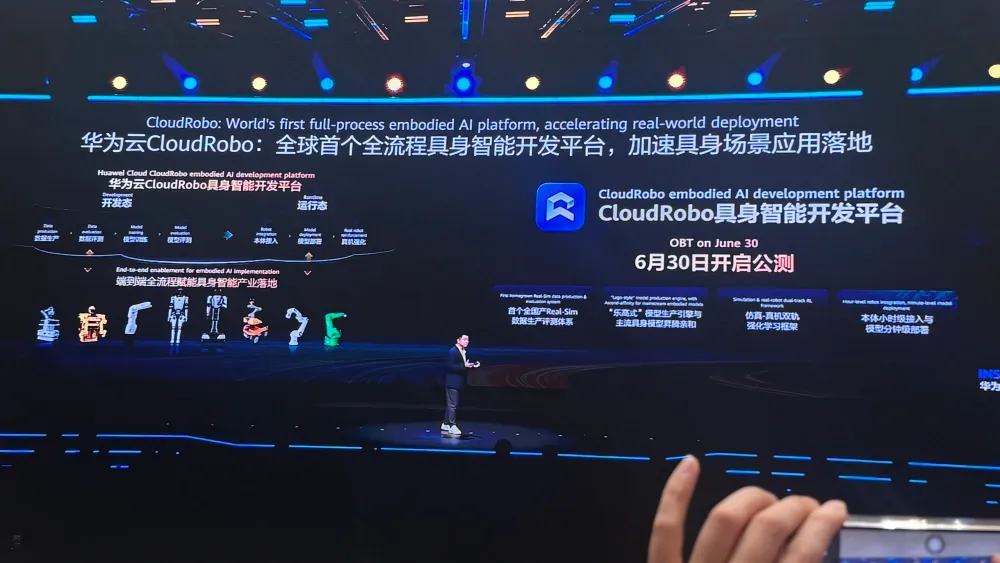
- •Huawei Cloud introduced CloudRobo, the world's first full-stack embodied AI development platform, and Zhiyuan, a new AI-native cloud entry point, at the INSPIRE conference.
- •The company launched the AICS Lingqu intelligent computing cluster, which supports a 100,000-card cluster scale with a total computing power reaching 200 EFLOPS, alongside AMS Agentic Memory Storage designed for AI agents.
- •Huawei Cloud's ModelArts platform received significant upgrades, now supporting models from partners such as Kimi, Zhipu AI, DeepSeek, and MiniMax, in addition to its proprietary Pangu series, and features like Reinforcement Learning as a Service (RLaaS).
- •New enterprise agent platforms debuted include CodeArts for AI-powered software development, which has already attracted over 100,000 developers, and AgentArts for comprehensive enterprise agent lifecycle management.
- •Huawei Cloud is strategically pursuing a 'silicon-based black soil' paradigm for the Agentic AI era, focusing on an infrastructure model that includes efficient token factories, continuous learning capabilities, and converged general-purpose and intelligent computing scheduling.
🛠️ Technical Deep Dive
- AICS Lingqu intelligent computing cluster: Supports a 100,000-card cluster scale with a total computing power of 200 EFLOPS. It achieves token generation latency under 10 milliseconds and delivers 5 million tokens per second throughput per thousand cards, with 99.95% online service availability.
- AMS Agentic Memory Storage: A high-capacity, layered storage solution specifically built for AI agents. It leverages NPU-direct Context Memory Storage (CMS) hardware with PB-scale memory space and KV Cache layered pooling to reduce inference costs and support day-long tasks, addressing memory bottlenecks for sustained agent operation.
- CloudRobo: Positioned as the first full-process embodied intelligence development platform. It features a secure and trusted PB-level data foundation and development pipeline, the industry's first cloud-native embodied model production engine, and a fully domestically developed Real-Sim data production and model evaluation system. The platform offers millions of ready-to-use data assets and over 20 Ascend-compatible model assets.
- Pangu Models: Designed with a three-layer architecture for business-to-business (ToB) markets, comprising L0 foundation models, L1 industry-tailored models, and L2 scenario-specific models. The series includes Pangu NLP, CV, Scientific Computing, Multimodal, and Prediction models. An earlier version, Pangu-Σ, was a colossal language model with 1.085 trillion parameters, trained on 512 Ascend 910 AI accelerator chips.
- Ascend AI Chips: Huawei's roadmap includes the Ascend 950PR (available 1Q26, optimized for prefill inference and recommendation, utilizing HiBL 1.0 HBM), Ascend 950DT (scheduled for 4Q26, optimized for decoding and training, using HiZQ 1.0 HBM), and the Ascend 960 (planned for 4Q27, aiming to double compute power, memory access bandwidth, memory capacity, and interconnect ports compared to the 950, and supporting Huawei's proprietary HiF4 data format for 4-bit precision). Huawei is also developing CANN as an alternative to Nvidia's CUDA software stack.
- AgentArts: A one-stop enterprise-level intelligent agent development platform that supports zero-code/low-code hybrid development. It enables workflow orchestration, intelligent prompt generation, and rich skill configuration through knowledge bases and plug-ins, offering full-link development and debugging support.
🔮 Future ImplicationsAI analysis grounded in cited sources
⏳ Timeline
📎 Sources (17)
Factual claims are grounded in the sources below. Forward-looking analysis is AI-generated interpretation.
Weekly AI Recap
Read this week's curated digest of top AI events →
👉Related Updates
AI-curated news aggregator. All content rights belong to original publishers.
Original source: Pandaily ↗
This is a summary, not the original. Read the source, or get the weekly briefing.
The weekly digest
One email a week. Unsubscribe anytime.