How the Internet Crosses Oceans Without You Noticing
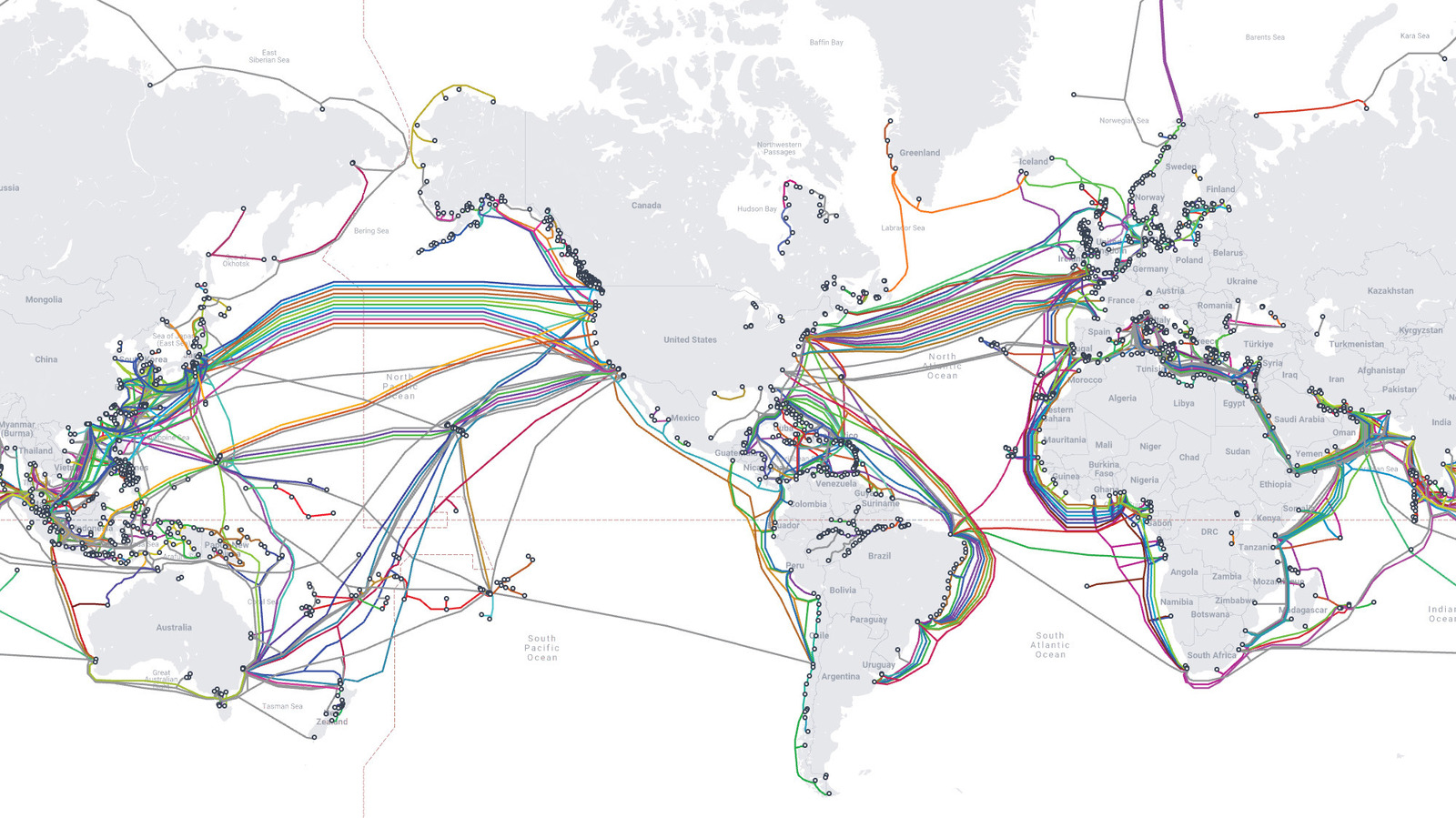
💡Essential background on the physical infrastructure powering global AI model training and data synchronization.
⚡ 30-Second TL;DR
What Changed
Overview of global undersea fiber optic cable networks
Why It Matters
Understanding the physical limitations of global data transit is crucial for architects designing distributed AI training clusters across continents.
What To Do Next
Review your data residency and latency requirements when architecting multi-region AI deployments.
Key Points
- •Overview of global undersea fiber optic cable networks
- •Physical infrastructure requirements for high-bandwidth data transmission
- •The role of subsea cables in supporting global cloud and AI data centers
🧠 Deep Insight
Background and context from public sources — not the original article. 39 sources cited.
🔑 Enhanced Key Takeaways
- •Hyperscale cloud providers like Google, Meta, Microsoft, and Amazon are increasingly dominating investment in new subsea cable projects, often opting for exclusive fiber pair ownership rather than traditional consortium models to gain greater control over infrastructure, performance, and cost structures.
- •Beyond commercial interests, undersea cables have become a critical geopolitical asset, with nations like the US and China competing for influence over cable routes and landing points, raising concerns about surveillance, sabotage, and the potential for network bifurcation.
- •Modern subsea cables utilize advanced technologies such as Wavelength Division Multiplexing (WDM) and Spatial Division Multiplexing (SDM) to transmit multiple terabits per second, far surpassing the capacity and speed of satellite internet, which accounts for only a tiny fraction of global data traffic.
- •The deployment and maintenance of these cables face significant challenges, including navigating rough seabed terrain, extreme pressures, and risks from natural hazards like earthquakes, as well as human activities such as fishing trawlers and ship anchors, leading to an average of around 200 faults annually.
- •While generally considered to have a minimal long-term environmental footprint, the installation of subsea cables can cause temporary habitat disruption, and ongoing research explores potential impacts of electromagnetic fields on marine life navigation and sensory systems.
🛠️ Technical Deep Dive
- Optical Fiber Core: Made of ultra-pure glass or plastic, typically the diameter of a human hair, transmitting data as pulses of light via total internal reflection.
- Cladding and Coating: The core is surrounded by cladding with a lower refractive index to keep light within the fiber, and an outer coating protects against environmental factors.
- Cable Construction: Modern cables are typically about 25 mm (1 inch) in diameter for deep-sea sections, reinforced with layers of gel-filled buffer tubes, steel or aluminum strength members, and a robust outer jacket, often polyethylene, to withstand pressure, corrosion, and physical damage. Near shore, cables are thicker and have extra armoring.
- Signal Amplification (Repeaters): To maintain signal strength over long distances (thousands of kilometers), submersible repeaters are strategically placed every 60 to 100 km. These optoelectronic devices convert light signals to electrical, amplify them, and reconvert them to light. Erbium-doped fiber amplification is a common technology. Repeaters require electrical power, typically around 10,000 volts DC, fed from both landing stations.
- Signal Multiplexing:
- Wavelength Division Multiplexing (WDM)/Dense Wavelength Division Multiplexing (DWDM): Allows multiple signals to be transmitted simultaneously over a single fiber using different wavelengths (colors) of light, significantly increasing capacity.
- Spatial Division Multiplexing (SDM): Involves increasing the number of fiber pairs within a cable; modern SDM cables can have 12 to 24 fiber pairs, up from older cables with 4 or 8.
- Fiber Types: Ultra-low-loss (ULL) single-mode fibers, such as ITU-T G.654.D, are optimized for long-haul and submarine applications, offering lower attenuation and larger effective areas to reduce non-linear effects.
- Capacity: Modern cables can carry multiple terabits per second (Tbps); for example, the Grace Hopper cable has a potential capacity of 350 Tbps.
- Installation: Specialized cable-laying ships deploy cables along pre-charted routes, avoiding obstacles like coral reefs and earthquake zones, a process that can take months.
🔮 Future ImplicationsAI analysis grounded in cited sources
⏳ Timeline
📎 Sources (39)
Factual claims are grounded in the sources below. Forward-looking analysis is AI-generated interpretation.
- telin.net
- interglobixmagazine.com
- totaltele.com
- currentanalysis.com
- comsoc.org
- hinrichfoundation.com
- allresearchjournal.com
- washington.edu
- njfx.net
- hec.edu
- fmradiobroadcast.com
- telegeography.com
- economyinsights.com
- wikipedia.org
- youtube.com
- reddit.com
- keynet-systems.com
- quintillionglobal.com
- coherentmarketinsights.com
- itu.int
- recordedfuture.com
- mdpi.com
- noaa.gov
- unep-wcmc.org
- leadventgrp.com
- mozillafoundation.org
- isocfoundation.org
- quintillionglobal.com
- feiboer.com.cn
- opelink.com
- scribd.com
- itu.int
- engadget.com
- fierce-network.com
- interglobixmagazine.com
- victorianweb.org
- submarinecablesystems.com
- noaa.gov
- ptt.ma
Weekly AI Recap
Read this week's curated digest of top AI events →
👉Related Updates
AI-curated news aggregator. All content rights belong to original publishers.
Original source: Engadget ↗
This is a summary, not the original. Read the source, or get the weekly briefing.
The weekly digest
One email a week. Unsubscribe anytime.