How Meta Cools AI With Closed-Loop Liquid Systems
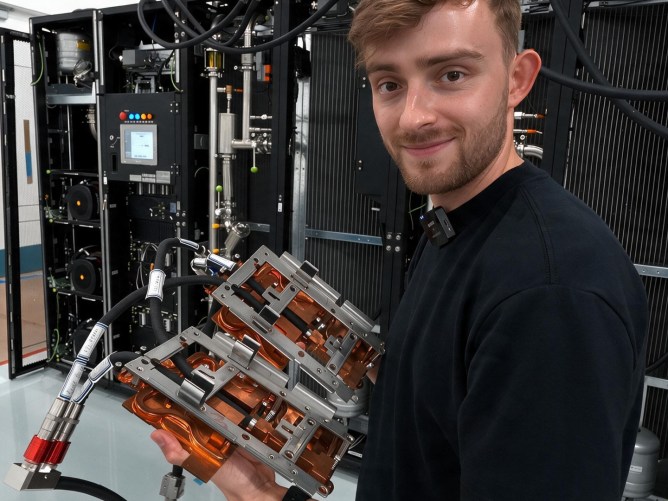
💡See how Meta’s closed-loop plumbing tackles the rising heat demands of AI infrastructure.
⚡ 30-Second TL;DR
What Changed
Meta is using closed-loop liquid cooling for AI infrastructure.
Why It Matters
As AI workloads generate increasing heat, cooling architecture is becoming a core data-center design constraint. Meta’s approach may offer enterprise infrastructure teams a reference for evaluating liquid cooling in AI deployments.
What To Do Next
Audit your next AI server deployment for rack heat density and compare closed-loop liquid cooling with air cooling before finalizing the data-center design.
Key Points
- •Meta is using closed-loop liquid cooling for AI infrastructure.
- •The approach is designed to improve cooling efficiency for AI workloads.
- •The article explains the plumbing and operational principles behind the cooling system.
🧠 Deep Insight
Background and context from public sources — not the original article. 8 sources cited.
🔑 Enhanced Key Takeaways
- •Meta has transitioned from legacy air cooling to direct-to-chip, closed-loop liquid cooling to support rack power densities reaching 120–140kW, a significant increase from the previous 20kW standard.
- •The cooling architecture utilizes dry coolers to reject heat, which eliminates the need for water-intensive evaporative cooling towers and results in zero operational water consumption for the cooling process.
- •Meta’s cooling strategy evolved through a multi-year transition starting in 2021, moving from traditional air cooling to hybrid Air-Assisted Liquid Cooling (AALC) before adopting native liquid cooling.
- •The company is actively deploying these high-density cooling systems in specific new data center facilities, including sites in El Paso, Texas, and Beaver Dam, Wisconsin.
- •Meta leverages the Open Compute Project (OCP) to standardize these liquid cooling designs, contributing to an industry-wide trend where liquid cooling penetration for AI hardware is expected to exceed 50% by 2026.
📊 Competitor Analysis▸ Show
| Feature | Meta (Closed-Loop) | Google/AWS/Microsoft |
|---|---|---|
| Cooling Method | Direct-to-chip / Dry Coolers | Hybrid / Immersion / Evaporative |
| Water Usage | Zero (Operational) | Varies (Often higher) |
| Rack Density | 120-140kW | 100kW+ |
| Standardization | Open Compute Project (OCP) | Proprietary / Mixed |
🛠️ Technical Deep Dive
- Direct-to-chip cooling architecture utilizes a sealed, closed-loop piping system to transport coolant directly to high-heat AI accelerators.
- Heat rejection is managed via dry coolers, which utilize forced air over heat exchangers to dissipate thermal energy without water evaporation.
- System design is optimized for high-density AI clusters, specifically targeting the thermal requirements of next-generation GPU/TPU hardware.
- Infrastructure supports rack power densities up to 140kW, necessitating a complete redesign of mechanical and electrical distribution compared to legacy air-cooled facilities.
🔮 Future ImplicationsAI analysis grounded in cited sources
⏳ Timeline
📎 Sources (8)
Factual claims are grounded in the sources below. Forward-looking analysis is AI-generated interpretation.
Weekly AI Recap
Read this week's curated digest of top AI events →
👉Related Updates



AI-curated news aggregator. All content rights belong to original publishers.
Original source: Meta Newsroom ↗
This is a summary, not the original. Read the source, or get the weekly briefing.
Weekly AI briefing
One email a week. Unsubscribe anytime.