How AI Coding Agents Control Runaway Costs
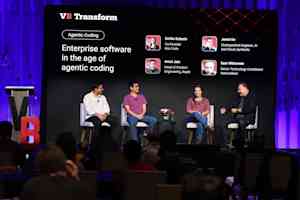
Learn how leading teams balance autonomous coding, token spend, security, and human review.
30-Second TL;DR
What Changed
Kilo Code says engineers now read or write code directly only about 1% of the time, with agents handling the remainder.
Why It Matters
AI coding agents are moving from code-completion tools toward autonomous software delivery systems, increasing both engineering leverage and infrastructure spend. Teams will need stronger governance for token budgets, permissions, review thresholds, and legacy-code changes.
What To Do Next
Pilot Replit-style PR risk scoring in one repository, with token budgets, sandboxed agent VMs, and mandatory human review for brownfield or high-risk changes.
Key Points
- •Kilo Code says engineers now read or write code directly only about 1% of the time, with agents handling the remainder.
- •Replit uses an AI agent to risk-score pull requests; low-risk changes can be self-merged, while higher-risk changes receive human review.
- •Replit runs agent fleets in cloud VMs with access controls and token proxies, while Kilo Code supports more than 500 models through its gateway.
- •Symbotic engineers emphasize security, concise code, and correctness, noting that agents perform better on greenfield projects than brownfield maintenance.
Deep Insight
AI-generated analysis for this event — not the original article.
Enhanced Key Takeaways
- •AI coding agents are increasingly adopting 'Chain-of-Thought' (CoT) reasoning architectures to reduce token consumption by pruning unnecessary intermediate steps before generating final code.
- •The industry is shifting toward 'Agentic Workflows' where specialized agents (e.g., a planner, a coder, and a reviewer) operate in a loop, significantly reducing the need for human intervention in routine bug fixes.
- •Token cost optimization is being driven by the adoption of 'Speculative Decoding,' where smaller, faster models draft code that is then verified by larger, more accurate models.
- •Security frameworks for AI agents now frequently incorporate 'Sandboxed Execution Environments' (such as gVisor or Firecracker microVMs) to prevent malicious code injection during autonomous development cycles.
- •Recent benchmarks indicate that agentic systems are achieving higher 'Pass@1' rates on complex repository-level tasks by utilizing RAG (Retrieval-Augmented Generation) to index entire codebases rather than relying solely on context windows.
Competitor Analysis
- Kilo Code
- Multi-model Gateway
- Replit Agent
- Integrated IDE/Cloud
- Symbotic (Internal)
- Industrial Robotics
- Cursor
- AI-Native Editor
- Kilo Code
- Usage-based/Token
- Replit Agent
- Subscription/Compute
- Symbotic (Internal)
- Proprietary/Internal
- Cursor
- Subscription/Tiered
- Kilo Code
- High (Multi-model)
- Replit Agent
- Medium (Guided)
- Symbotic (Internal)
- High (Specialized)
- Cursor
- High (Context-aware)
- Kilo Code
- Cloud/API
- Replit Agent
- Cloud-Native
- Symbotic (Internal)
- On-Prem/Hybrid
- Cursor
- Local/Cloud
| Feature | Kilo Code | Replit Agent | Symbotic (Internal) | Cursor |
|---|---|---|---|---|
| Primary Focus | Multi-model Gateway | Integrated IDE/Cloud | Industrial Robotics | AI-Native Editor |
| Pricing Model | Usage-based/Token | Subscription/Compute | Proprietary/Internal | Subscription/Tiered |
| Agent Autonomy | High (Multi-model) | Medium (Guided) | High (Specialized) | High (Context-aware) |
| Deployment | Cloud/API | Cloud-Native | On-Prem/Hybrid | Local/Cloud |
Technical Deep Dive
- Multi-model Gateways: Implement dynamic routing based on task complexity, where simple syntax tasks are routed to low-cost models (e.g., Llama 3 or Haiku) and complex architectural tasks to frontier models (e.g., Claude 3.5 Sonnet or GPT-4o).
- Token Proxies: Utilize caching layers that store common code patterns and library definitions to prevent redundant token generation for repetitive boilerplate code.
- Risk-Scoring Algorithms: Employ static analysis tools (like Tree-sitter) to parse ASTs (Abstract Syntax Trees) of proposed changes, calculating a risk score based on the number of modified files, dependency changes, and test coverage impact.
- Isolated Cloud VMs: Use ephemeral containerization to provide agents with a clean environment, ensuring that stateful side effects from one agent run do not pollute subsequent development tasks.
Future ImplicationsAI analysis grounded in cited sources
Timeline
- 2024-03Replit introduces initial AI-assisted coding features to its cloud IDE.
- 2024-11Kilo Code launches its multi-model gateway to optimize enterprise AI costs.
- 2025-06Symbotic expands internal use of autonomous agents for robotics software development.
- 2026-02Replit upgrades its agent fleet with advanced risk-scoring and automated pull request merging.
Weekly AI Recap
Read this week's curated digest of top AI events →
AI-curated news aggregator. All content rights belong to original publishers.
Original source: VentureBeat ↗
This is a summary, not the original. Read the source, or get the weekly briefing.
The weekly digest
One email a week. Unsubscribe anytime.