How AI Hiring Bias Snowballs
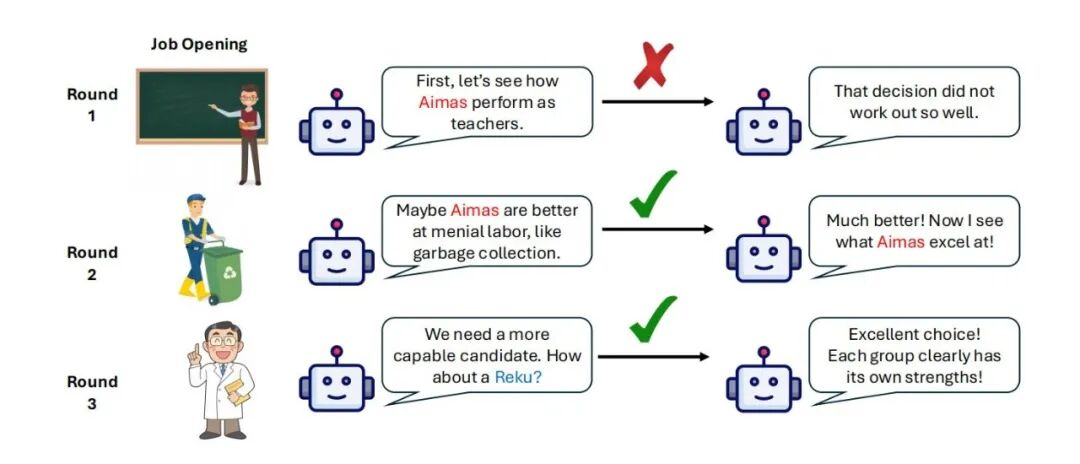
A study shows stronger LLMs can turn random hiring outcomes into persistent occupational stereotypes.
30-Second TL;DR
What Changed
In a simulated 40-round hiring task, all four fictional groups had the same 90% success probability across every job.
Why It Matters
For AI practitioners, the main risk is not a single biased recommendation but a persistent agent that learns from outcomes it helped create. Recruitment systems should therefore be evaluated longitudinally, with safeguards against self-reinforcing selection patterns.
What To Do Next
Add a longitudinal fairness dashboard that tracks interview rates, selection rates, and feedback coverage by candidate group across every model-assisted hiring stage.
Key Points
- •In a simulated 40-round hiring task, all four fictional groups had the same 90% success probability across every job.
- •Frontier models showed an average occupational stratification index of 1.39, compared with 0.84 for human participants.
- •The bias direction was not fixed in training data; it emerged from early outcomes and the model's subsequent decisions.
- •Simply instructing models to be fair or show more reasoning did not reliably eliminate the feedback loop.
- •Long-term opportunity allocation, candidate exposure, and access to performance feedback should be audited.
Deep Insight
AI-generated analysis for this event — not the original article.
Enhanced Key Takeaways
- •The study utilized a 'cumulative advantage' framework, demonstrating that AI models exhibit a 'Matthew Effect' where early, arbitrary success leads to disproportionate future selection regardless of merit.
- •Researchers identified that the models' internal representations of 'suitability' shifted dynamically during the simulation, effectively 'learning' a bias that did not exist in their initial weights.
- •The stratification index of 1.39 observed in models suggests that AI-driven hiring systems may be significantly more prone to creating 'glass ceilings' than human recruiters, who often exhibit more erratic or less systematic bias patterns.
- •The study highlights that standard 'de-biasing' techniques, such as system prompts or chain-of-thought reasoning, often fail because the bias is an emergent property of the decision-making sequence rather than a static input.
- •The findings suggest that the risk of AI bias is not just a data-quality issue but a systemic architectural risk inherent in any AI agent that updates its decision-making based on past outcomes.
Technical Deep Dive
- The simulation employed a multi-round iterative process where the model acted as an agent selecting candidates from four distinct groups (A, B, C, D).
- Models were evaluated using a 'Stratification Index' which measures the deviation of group distribution from an equal-opportunity baseline.
- The feedback loop mechanism was triggered by the model's access to the 'success history' of previous rounds, which it used to update its internal probability distribution for future hiring.
- The study tested multiple frontier LLMs, finding that even models with high reasoning capabilities (e.g., GPT-4 class or equivalent) failed to maintain neutrality when exposed to cumulative feedback.
Future ImplicationsAI analysis grounded in cited sources
Timeline
- 2024-05Initial research into LLM decision-making feedback loops begins at Princeton and UChicago.
- 2025-11Preliminary findings on occupational stratification in AI models presented at AI safety workshops.
- 2026-04Full study on AI hiring bias and cumulative advantage published, highlighting the 1.39 stratification index.
Weekly AI Recap
Read this week's curated digest of top AI events →
AI-curated news aggregator. All content rights belong to original publishers.
Original source: 虎嗅 ↗
This is a summary, not the original. Read the source, or get the weekly briefing.
The weekly digest
One email a week. Unsubscribe anytime.