Home Robots Swarm China's AWE 2026 Expo
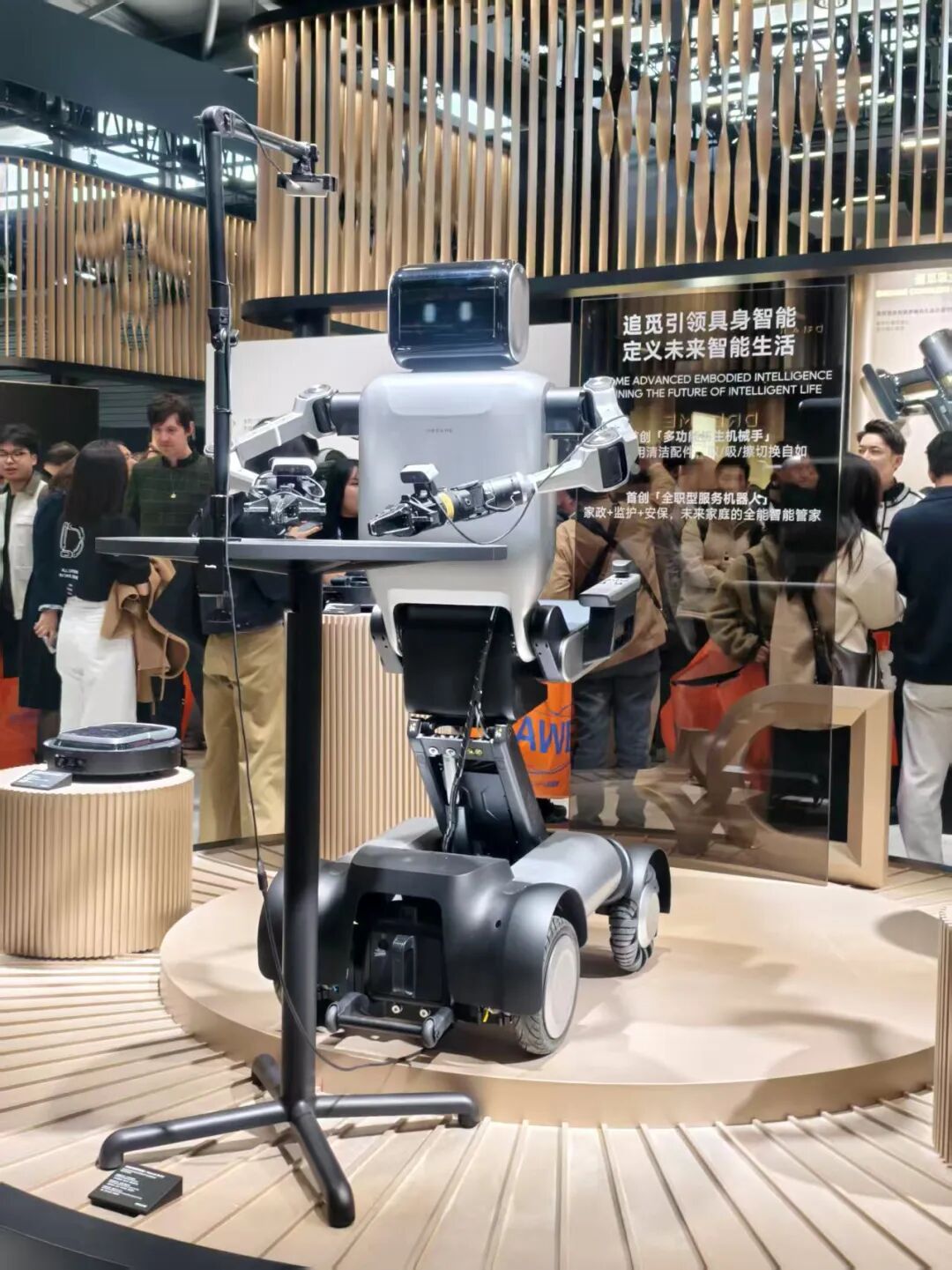
💡China's home robots with OpenClaw challenge Tesla Optimus at AWE 2026
⚡ 30-Second TL;DR
What Changed
Dreame's wheelchair robot with mechanical hands controls appliances via voice and vision.
Why It Matters
China's appliance firms are pivoting to embodied AI, intensifying competition in consumer robotics against Tesla and others. This could drive rapid iteration in home AI applications, creating opportunities for AI integration in hardware.
What To Do Next
Integrate OpenClaw API into your robot prototypes for remote household task automation.
Key Points
- •Dreame's wheelchair robot with mechanical hands controls appliances via voice and vision.
- •Ecovacs' Bajie robot integrates OpenClaw for remote home tasks like shoe sorting and laundry.
- •Tesla previews Optimus V3 for 2026 mass production, leveraging auto tech for home childcare.
- •MOVA's flying sweeper navigates multi-floor homes with 9-layer obstacle avoidance.
- •Fotile's kitchen robot uses 'Zhiwei' model for cooking perception via infrared and sensors.
🧠 Deep Insight
Background and context from public sources — not the original article. 6 sources cited.
🔑 Enhanced Key Takeaways
- •AWE 2026 established a formal Special Committee for Household Service Robots with approximately 50 member companies including Haier, Hisense, Fourier Intelligence, and Orbbec, signaling industry-wide standardization efforts for the sector[1].
- •AI-powered home appliances are expected to reach mainstream adoption significantly faster than service robots, with AI-equipped televisions already capable of natural language interaction and potential evolution into connected home hubs[1].
- •Tesla's Optimus humanoid robot showcased at AWE 2026 targets mass production by end of 2026, with planned capacity of 1 million units annually at Fremont Factory and 10 million units annually at Gigafactory Texas[4].
- •The 2026 expo featured over 1,200 domestic and international enterprises across 170,000 square meters, with cutting-edge displays including Sony's next-generation RGB LED TV technology and Huawei's 3,200-square-meter Harmony ecosystem demonstration[3].
- •Current household service robots still require significant improvements in performance and cost reduction before widespread adoption, with industry leaders acknowledging the integration of AI large models and agent technologies as essential but incomplete[1].
📊 Competitor Analysis▸ Show
| Company | Robot Type | Key Capability | Development Status |
|---|---|---|---|
| Ecovacs Robotics | Non-humanoid service assistant | Object pickup, desktop tidying, laundry loading | Expected household entry within 3 years[1] |
| Unitree | Humanoid (G1) & Quadruped (Go2) | Advanced control, boxing demonstration | Commercial delivery capability demonstrated[2] |
| Magic Atom | Biped (Z1) & Quadruped (MagicDog) | Commercial robotics | Over 100 million yuan delivery value[2] |
| Tesla | Optimus humanoid | Dexterous manipulation, household tasks | Mass production targeted by end of 2026[4] |
| FOTILE | Kitchen robot | Unmanned cooking with mechanical arms | World's first cooking robot kitchen displayed[2] |
🛠️ Technical Deep Dive
- Optimus Humanoid Design: Advanced robotic hands with finger proportions closely resembling human anatomy, addressing one of the most difficult engineering challenges in humanoid robotics[4]
- AI Integration: Service robots incorporate AI large models and AI agent technologies for autonomous decision-making and task execution[1]
- Multi-Modal Perception: Kitchen robots utilize infrared sensors and perception models for cooking tasks; household robots employ vision systems for object recognition and manipulation[2]
- Mobility Architecture: Quadruped and biped designs demonstrated for navigating complex household spaces; humanoid robots designed for dexterous manipulation of household objects[2]
- Production Scaling: Tesla's planned production infrastructure targets 1 million units annually (Fremont) and 10 million units annually (Texas), indicating manufacturing process maturity expectations[4]
🔮 Future ImplicationsAI analysis grounded in cited sources
⏳ Timeline
📎 Sources (6)
Factual claims are grounded in the sources below. Forward-looking analysis is AI-generated interpretation.
- yicaiglobal.com — Chinas Awe 2026 Showcases Record Number of Robots As AI Home Devices Gain Ground
- eu.36kr.com — 3719916594001283
- global.chinadaily.com.cn — Ws69b21adca310d6866eb3d639
- teslarati.com — Tesla Optimus Awe 2026 Shanghai
- youtube.com — Watch
- tesery.com — Tesla Showcases Optimus Humanoid Robot at Awe 2026 in Shanghai
Weekly AI Recap
Read this week's curated digest of top AI events →
👉Related Updates

AI-curated news aggregator. All content rights belong to original publishers.
Original source: 36氪 ↗
This is a summary, not the original. Read the source, or get the weekly briefing.
Weekly AI briefing
One email a week. Unsubscribe anytime.