🐯虎嗅•Stalecollected in 18m
Hisense Charges into AI Hardware
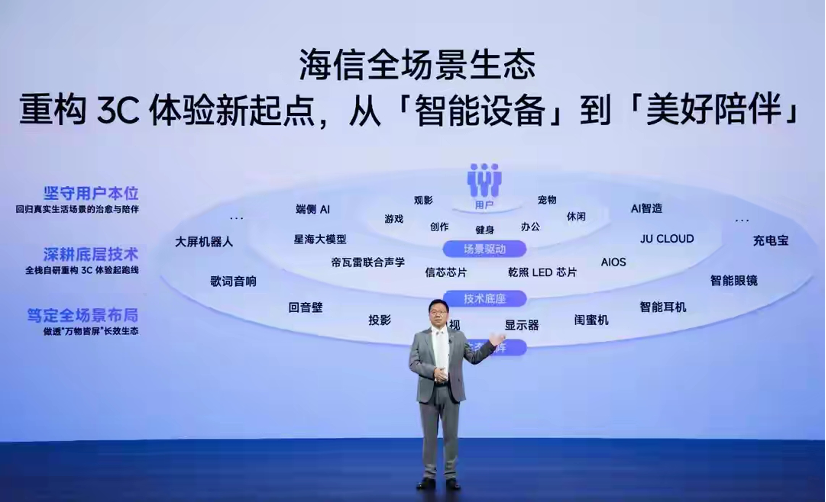
💡Hisense AI glasses launch signals TV giants pivot to wearables
⚡ 30-Second TL;DR
What Changed
Launched 6 products: ladymate machine, monitor, projector, AI audio glasses for multi-scenes.
Why It Matters
Diversifies Hisense from declining TV to AI wearables, but scale small (15% new biz); tests tech spillover in crowded 3C markets.
What To Do Next
Prototype AI integrations using Hisense Vidda projector APIs for multi-scene displays.
Who should care:Developers & AI Engineers
Key Points
- •Launched 6 products: ladymate machine, monitor, projector, AI audio glasses for multi-scenes.
- •Reuses display/chip/optics tech from TV; Vidda projector #1 in premium segment.
- •TV market down: China 2025 -8.5%, 2026Q1 -11.4%; TCL-Sony merger threatens share.
- •AI glasses market grows 44% to 14.8M units; Meta 70% share, Apple incoming.
🧠 Deep Insight
AI-generated analysis for this event.
🔑 Enhanced Key Takeaways
- •Hisense is integrating its proprietary 'Xinghai' large language model across these new hardware categories to enable localized, low-latency voice interaction without relying solely on cloud processing.
- •The company is pivoting its supply chain strategy to utilize 'chiplet' architectures, allowing them to repurpose high-performance TV SoCs for smaller form-factor devices like monitors and projectors to maintain cost efficiency.
- •Hisense has established a dedicated 'AIoT Innovation Lab' in Qingdao to accelerate the convergence of its smart home ecosystem with these new wearable and personal computing devices.
📊 Competitor Analysis▸ Show
| Feature | Hisense AI Glasses | Meta Ray-Ban (Gen 3) | Apple Vision Pro (Lite) |
|---|---|---|---|
| Primary Focus | Audio/Display Hybrid | Audio/Camera/AI | Spatial Computing |
| SoC | Hisense Custom SoC | Qualcomm AR1 Gen 2 | Apple M-series |
| Display | Micro-LED (Projected) | None (Audio-only) | Micro-OLED |
| Est. Price | ~$350 USD | ~$299 USD | ~$1,999 USD |
🛠️ Technical Deep Dive
- •AI Audio Glasses: Utilize bone-conduction transducers paired with a custom DSP for real-time noise cancellation and ambient sound transparency.
- •Projector Tech: Employs a proprietary triple-laser light source (LPU) derived from Hisense's high-end Laser TV line, achieving 110% BT.2020 color gamut coverage.
- •Monitor Integration: Features a 'Smart-Sync' protocol that allows seamless hand-off of display content from Hisense TVs to monitors via a unified account ecosystem.
- •Software Architecture: The devices run on a lightweight, containerized version of Hisense's VIDAA OS, optimized for rapid wake-word detection and edge-AI inference.
🔮 Future ImplicationsAI analysis grounded in cited sources
Hisense will achieve a 15% revenue contribution from non-TV 3C products by end of 2027.
The aggressive diversification strategy aims to offset the structural decline in the global TV market by capturing high-growth wearable and peripheral segments.
Hisense will face increased regulatory scrutiny regarding data privacy in its AI-enabled wearables.
Expanding AI hardware into personal spaces like glasses necessitates stricter compliance with evolving global data protection standards for voice and visual data.
⏳ Timeline
2023-09
Hisense officially unveils the 'Xinghai' large language model at the IFA Berlin trade show.
2024-05
Hisense announces a strategic restructuring to prioritize AIoT and smart wearable integration.
2025-02
Hisense reports a significant year-over-year decline in domestic TV shipments, prompting a shift toward 3C product diversification.
2026-03
Hisense completes the integration of its AI-driven voice assistant across its premium projector product line.
📰
Weekly AI Recap
Read this week's curated digest of top AI events →
👉Related Updates
AI-curated news aggregator. All content rights belong to original publishers.
Original source: 虎嗅 ↗