Higher Education Spreads WEIRD Cultural Values Globally
💡Discover why your AI training data may be more culturally biased than you think.
⚡ 30-Second TL;DR
What Changed
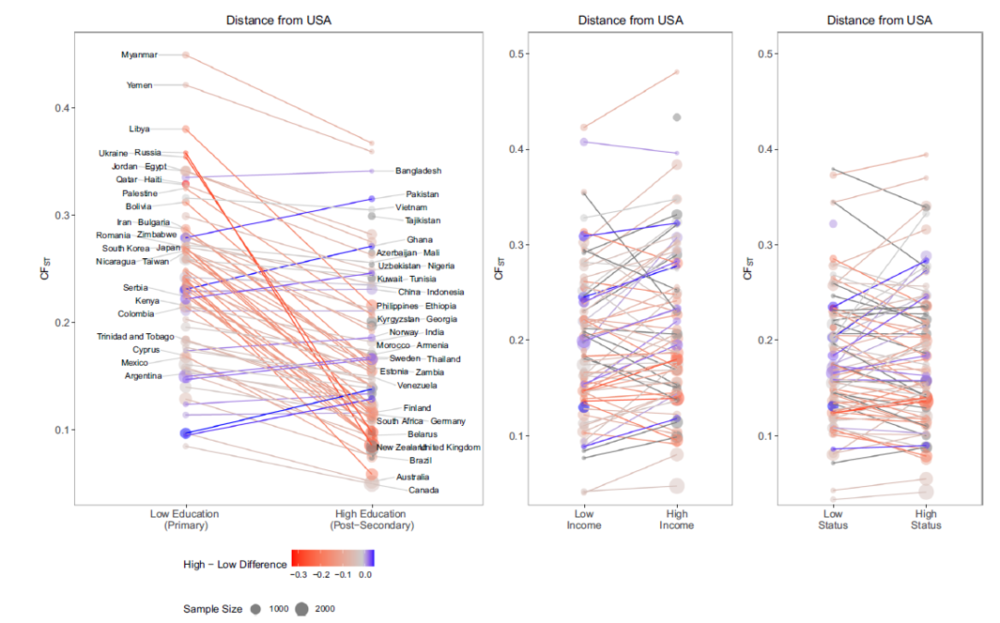
Higher education significantly increases cultural proximity to Western nations.
Why It Matters
This research suggests that global AI models trained on data from educated populations may inherently encode Western-centric biases, regardless of the geographic origin of the data.
What To Do Next
Audit your training datasets for WEIRD bias and consider diverse data collection strategies to ensure cultural representation in LLM fine-tuning.
Key Points
- •Higher education significantly increases cultural proximity to Western nations.
- •Income and subjective social status do not correlate with 'Westernization' as strongly as education.
- •The study analyzed 268,992 participants across 95 countries using World Values Survey data.
- •Educated elites globally share more cultural traits with each other than with their less-educated compatriots.
🧠 Deep Insight
Web-grounded analysis with 20 cited sources.
🔑 Enhanced Key Takeaways
- •The "WEIRD" acronym was introduced in 2010 by Joseph Henrich, Steven J. Heine, and Ara Norenzayan to emphasize the overrepresentation of individuals from Western, Educated, Industrialized, Rich, and Democratic societies in psychological research.
- •WEIRD individuals typically exhibit psychological traits such as high individualism, self-focus, nonconformity, and analytical thinking, which often contrast with the characteristics observed in non-WEIRD societies, such as a preference for peer conformity and deference to elders.
- •The 2026 Nature Communications study, co-authored by Cindel White and Michael Muthukrishna, employed the cultural fixation index (CFST) as a specific metric to quantify cultural distance between groups.
- •The research indicated that while higher education correlated with cultural similarity to WEIRD countries, it did not show the same pattern of cultural alignment with other major influential nations like China, Russia, or India.
- •The World Values Survey (WVS), established in 1981, serves as a foundational global research program that systematically tracks and analyzes changes in values and beliefs across nearly 100 countries, utilizing standardized questionnaires and primarily face-to-face interviews.
🛠️ Technical Deep Dive
- The study utilized the cultural fixation index (CFST) to measure cultural distance between individuals with varying levels of education.
- Data for the analysis was drawn from the World Values Survey (WVS), specifically covering survey waves conducted between 2005 and 2022.
- The World Values Survey employs a rigorous, standardized methodology for data collection, predominantly through face-to-face interviews conducted with representative national samples.
- WVS questionnaires consist of a standardized battery of approximately 290 closed questions, organized into 12 topical modules, with responses typically recorded on ordinal/Likert-style scales.
- Sampling procedures for the WVS aim to cover at least 95% of a country's adult population (ages 18-85), with Principal Investigators in each country responsible for adhering to established rules and procedures.
🔮 Future ImplicationsAI analysis grounded in cited sources
⏳ Timeline
📎 Sources (20)
Factual claims are grounded in the sources below. Forward-looking analysis is AI-generated interpretation.
- Google Search Source
- Google Search Source
- Google Search Source
- Google Search Source
- Google Search Source
- Google Search Source
- Google Search Source
- Google Search Source
- Google Search Source
- Google Search Source
- Google Search Source
- Google Search Source
- Google Search Source
- Google Search Source
- Google Search Source
- Google Search Source
- Google Search Source
- Google Search Source
- Google Search Source
- Google Search Source
Weekly AI Recap
Read this week's curated digest of top AI events →
👉Related Updates


AI-curated news aggregator. All content rights belong to original publishers.
Original source: 虎嗅 ↗