HiDream.ai: From Video Generation to World Models
💡Learn how video generation pioneers are pivoting to build the next generation of world models for robotics.
⚡ 30-Second TL;DR
What Changed
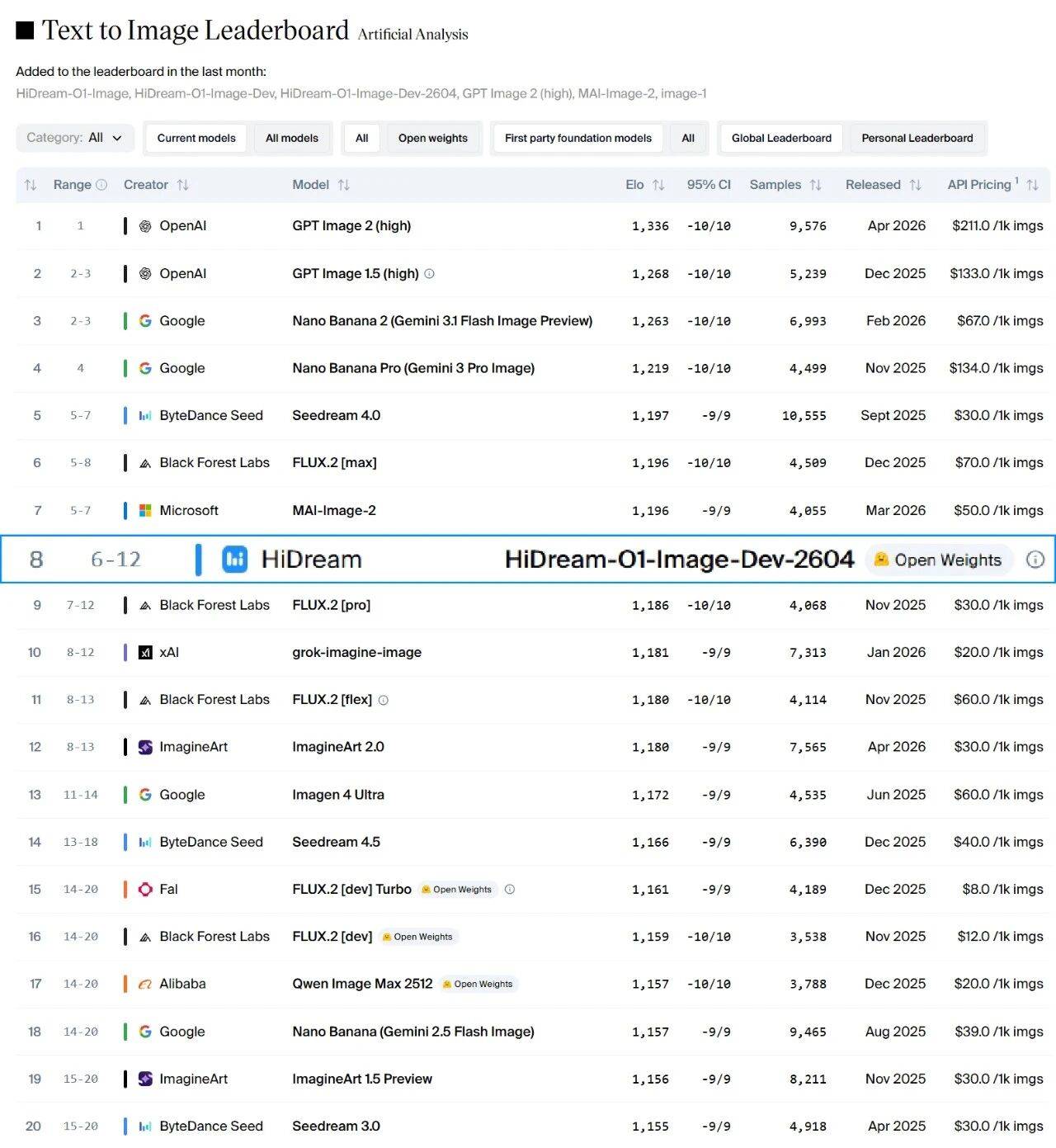
HiDream-O1-Image open-source model ranks top on Artificial Analysis leaderboard.
Why It Matters
Highlights the industry trend where video generation companies are becoming the primary candidates to build foundational world models for robotics.
What To Do Next
Evaluate the UiT architecture approach for your multi-modal projects to improve understanding and generation efficiency.
Key Points
- •HiDream-O1-Image open-source model ranks top on Artificial Analysis leaderboard.
- •Shift from DiT to UiT architecture allows for unified understanding and generation with fewer parameters.
- •Expanding focus from creative video generation to embodied AI world models.
- •Strategic emphasis on high-quality, physics-based data for training world models.
🧠 Deep Insight
Web-grounded analysis with 23 cited sources.
🔑 Enhanced Key Takeaways
- •HiDream.ai has secured over $70 million USD (500M+ CNY) in funding, with a significant round completed in April 2026, indicating strong investor confidence in its multimodal generative AI vision.
- •The company's HiDream-O1-Image, an 8-billion-parameter open-source model, utilizes a pixel-space diffusion architecture and has demonstrated superior performance against larger models (e.g., 32B FLUX.2 [dev]) across multiple image quality benchmarks.
- •HiDream.ai has formed a strategic partnership with Noitom Robotics to overcome the data bottleneck in embodied AI by combining Noitom's high-precision, real-world motion capture data with HiDream's millimeter-level controllable video generation AI to create vast, physically consistent datasets.
- •The UiT (Pixel-level Unified Transformer) architecture is a natively unified generative architecture that processes raw image pixels, text tokens, and task conditions in a single shared token space, eliminating the need for external VAEs or disjoint text encoders.
- •HiDream.ai's models incorporate a "Reasoning-Driven Prompt Agent" that performs an internal reasoning pass over prompts before generation, similar to chain-of-thought in language models, to improve adherence on complex compositional requests.
📊 Competitor Analysis▸ Show
| Feature / Model | HiDream.ai (HiDream-O1-Image) | ByteDance Seed (Seedance 1.0 API) | Google (Veo 3.1) | Runway (Gen-4.5) |
|---|---|---|---|---|
| Primary Focus | Multimodal (Image, Video, 3D, Text), World Models | Video Generation | Video Generation | Video Generation |
| Architecture | UiT (Pixel-level Unified Transformer), Diffusion Transformer | Diffusion Transformer (MMDiT, DiT, MoE) | Diffusion Transformer | Diffusion Transformer |
| Parameters | HiDream-O1-Image: 8B (open-source) | Not specified for Seedance 1.0 | Not specified | Not specified |
| Leaderboard Rank (Image) | #8 on Artificial Analysis Text-to-Image Arena (highest open-weight) | N/A (Video focused) | N/A (Video focused) | N/A (Video focused) |
| Leaderboard Rank (Video) | N/A (Primary focus shifting, but has video capabilities) | #1 globally on Artificial Analysis benchmark | High ranking, production-grade | #1 on Artificial Analysis Text to Video benchmark (1,247 Elo points) |
| Key Features | Pixel-native, 2048x2048 native resolution, Reasoning-Driven Prompt Agent, text-to-image, image editing, subject personalization, storyboard generation | Multi-shot storytelling, consistent characters/styles/scenes, smooth motion, precise prompt adherence, 5-10 sec cinematic videos | Native 4K resolution, vertical video support, improved character consistency, native audio generation, reference-to-video, first-last-frame-to-video | Motion brushes, scene consistency, dynamic results, powerful motion and camera control |
| Pricing | Free online image generator (HiDream-O1/I1) | Free trial (2M tokens), pay-as-you-go from $1.8/M tokens | From $19.99/month (Gemini Advanced) | From $12/month |
🛠️ Technical Deep Dive
- UiT (Pixel-level Unified Transformer) Architecture: HiDream-O1-Image is built on a Pixel-level Unified Transformer that natively encodes raw pixels, text, and task-specific conditions into a single shared token space. This end-to-end architecture discards traditional modular pipelines that rely on external VAEs (Variational Autoencoders) or disjoint text encoders.
- Reasoning-Driven Prompt Agent: The models incorporate a built-in "thinking" agent that performs an internal reasoning pass over user prompts. This mechanism, conceptually similar to chain-of-thought in language models, helps resolve implicit knowledge, layout, and text rendering before generation, leading to better prompt adherence for complex compositional requests.
- Native High Resolution: HiDream-O1-Image supports direct image synthesis up to 2,048 × 2,048 pixels, providing sharp, fine-grained detail without the need for external AI upscaling, thus preserving quality.
- Multimodal Capabilities: The unified architecture enables a single model to handle multiple tasks including text-to-image generation, long-text rendering, instruction-based image editing, subject-driven personalization, and multi-panel image generation for storyboard production.
- Efficiency: The 8-billion-parameter HiDream-O1-Image model achieves performance parity with or surpasses larger open-source Diffusion Transformers (DiTs) and leading closed-source models, demonstrating exceptional efficiency.
- World Models for Embodied AI: HiDream.ai's strategy involves building internal representations and future predictions of the external world to facilitate physical law-compliant embodied interactions. This requires vast, high-quality multimodal datasets combining visual, motion, and tactile information.
- Hybrid Data Generation: In partnership with Noitom Robotics, HiDream.ai is developing a hybrid solution where Noitom provides high-precision, real-world motion capture data (ground truth), and HiDream.ai's controllable video generation AI amplifies and diversifies this data into large, visually rich, and physically consistent video datasets for training embodied AI.
🔮 Future ImplicationsAI analysis grounded in cited sources
⏳ Timeline
📎 Sources (23)
Factual claims are grounded in the sources below. Forward-looking analysis is AI-generated interpretation.
- Google Search Source
- Google Search Source
- Google Search Source
- Google Search Source
- Google Search Source
- Google Search Source
- Google Search Source
- Google Search Source
- Google Search Source
- Google Search Source
- Google Search Source
- Google Search Source
- Google Search Source
- Google Search Source
- Google Search Source
- Google Search Source
- Google Search Source
- Google Search Source
- Google Search Source
- Google Search Source
- Google Search Source
- Google Search Source
- Google Search Source
Weekly AI Recap
Read this week's curated digest of top AI events →
👉Related Updates

AI-curated news aggregator. All content rights belong to original publishers.
Original source: 虎嗅 ↗