HEPS Synchrotron Shifts Focus to Industrial Impact
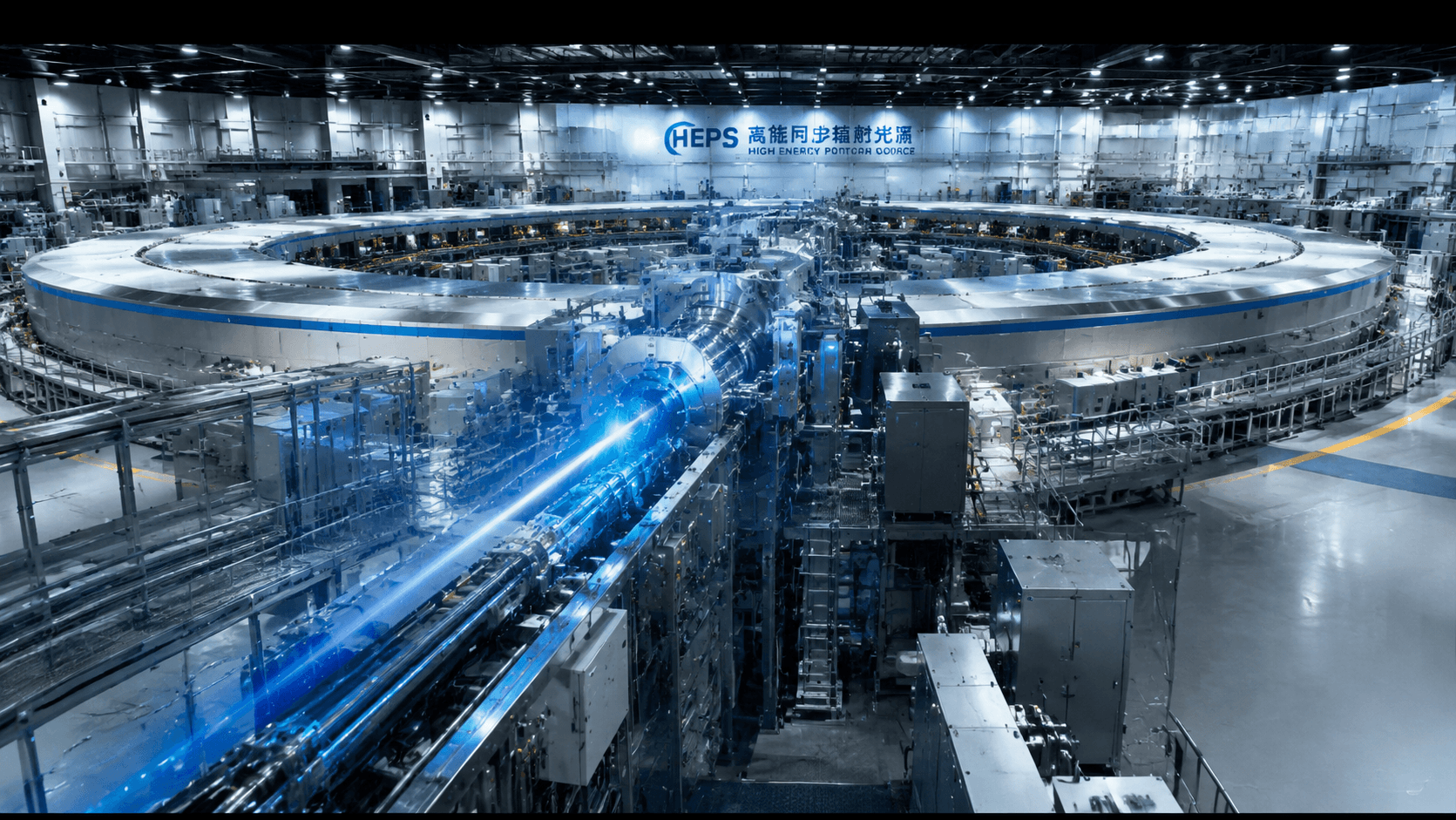
Learn how state-of-the-art physics facilities are pivoting to support industrial hardware and semiconductor R&D.
30-Second TL;DR
What Changed
HEPS shifts research focus from academic output to industrial utility
Why It Matters
This shift signals a broader trend in Chinese state-funded research to prioritize tangible economic and industrial outcomes over theoretical research, potentially accelerating hardware innovation cycles.
What To Do Next
If you are working on material science or hardware R&D, explore partnership opportunities with HEPS for high-resolution structural analysis of your prototypes.
Key Points
- •HEPS shifts research focus from academic output to industrial utility
- •Priority sectors include battery development, aviation, and chip manufacturing
- •Fourth-generation light source technology enables high-precision material analysis
Deep Insight
AI-generated analysis for this event — not the original article.
Enhanced Key Takeaways
- •HEPS (High Energy Photon Source) is located in Huairou Science City, Beijing, and is a key component of China's national major science and technology infrastructure projects.
- •The facility utilizes a diffraction-limited storage ring (DLSR) design, which significantly increases the brightness and coherence of the X-ray beams compared to third-generation sources.
- •The project is managed by the Institute of High Energy Physics (IHEP) under the Chinese Academy of Sciences (CAS).
- •HEPS achieved its first light in 2024, marking a critical transition from the construction phase to the commissioning and user-operation phase.
- •The facility's beamlines are specifically designed to support in-situ and operando experiments, allowing researchers to observe material changes in real-time under working conditions.
Competitor Analysis
- HEPS (China)
- 6.0 GeV
- ESRF-EBS (France)
- 6.0 GeV
- APS-U (USA)
- 6.0 GeV
- HEPS (China)
- 4th Gen DLSR
- ESRF-EBS (France)
- 4th Gen DLSR
- APS-U (USA)
- 4th Gen DLSR
- HEPS (China)
- Industrial/Academic
- ESRF-EBS (France)
- Academic/Industrial
- APS-U (USA)
- Academic/Industrial
- HEPS (China)
- Operational
- ESRF-EBS (France)
- Operational
- APS-U (USA)
- Operational
| Feature | HEPS (China) | ESRF-EBS (France) | APS-U (USA) |
|---|---|---|---|
| Energy Level | 6.0 GeV | 6.0 GeV | 6.0 GeV |
| Technology | 4th Gen DLSR | 4th Gen DLSR | 4th Gen DLSR |
| Primary Focus | Industrial/Academic | Academic/Industrial | Academic/Industrial |
| Status | Operational | Operational | Operational |
Technical Deep Dive
- Energy: 6 GeV storage ring with a circumference of 1,360.4 meters.
- Emittance: Ultra-low horizontal emittance of less than 60 pm·rad.
- Brightness: Peak brightness exceeding 10^22 photons/s/mm^2/mrad^2/0.1%BW.
- Beamlines: Designed to host over 90 beamlines at full capacity, focusing on high-energy, high-flux X-ray imaging and spectroscopy.
- Stability: Sub-micron beam stability achieved through advanced vibration isolation and feedback systems.
Future ImplicationsAI analysis grounded in cited sources
Timeline
- 2017-12HEPS project officially receives approval from the National Development and Reform Commission.
- 2019-06Construction of the HEPS facility officially commences in Huairou, Beijing.
- 2023-12The storage ring tunnel is completed and the installation of the accelerator components begins.
- 2024-07HEPS successfully achieves 'first light,' marking the successful commissioning of the storage ring.
Weekly AI Recap
Read this week's curated digest of top AI events →
Related Updates



AI-curated news aggregator. All content rights belong to original publishers.
Original source: Pandaily ↗
This is a summary, not the original. Read the source, or get the weekly briefing.
The weekly digest
One email a week. Unsubscribe anytime.